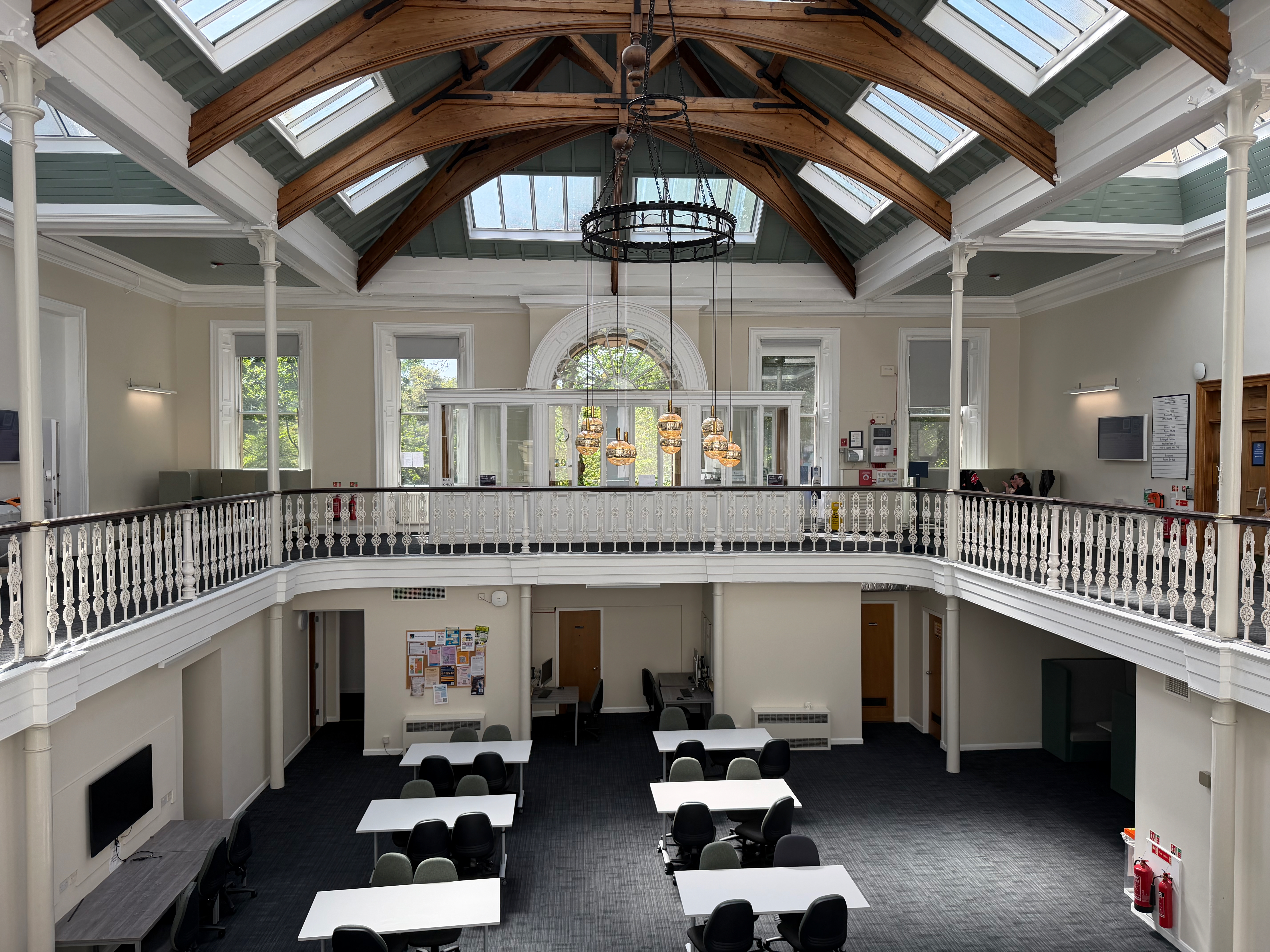
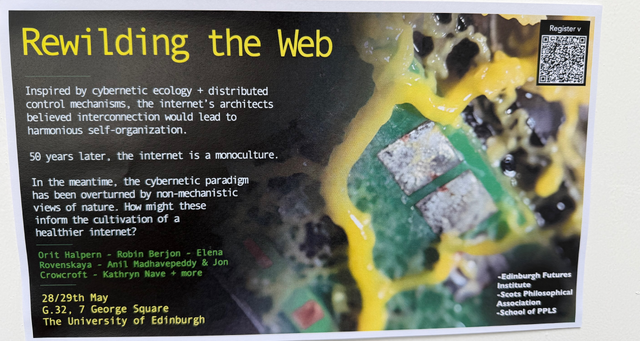
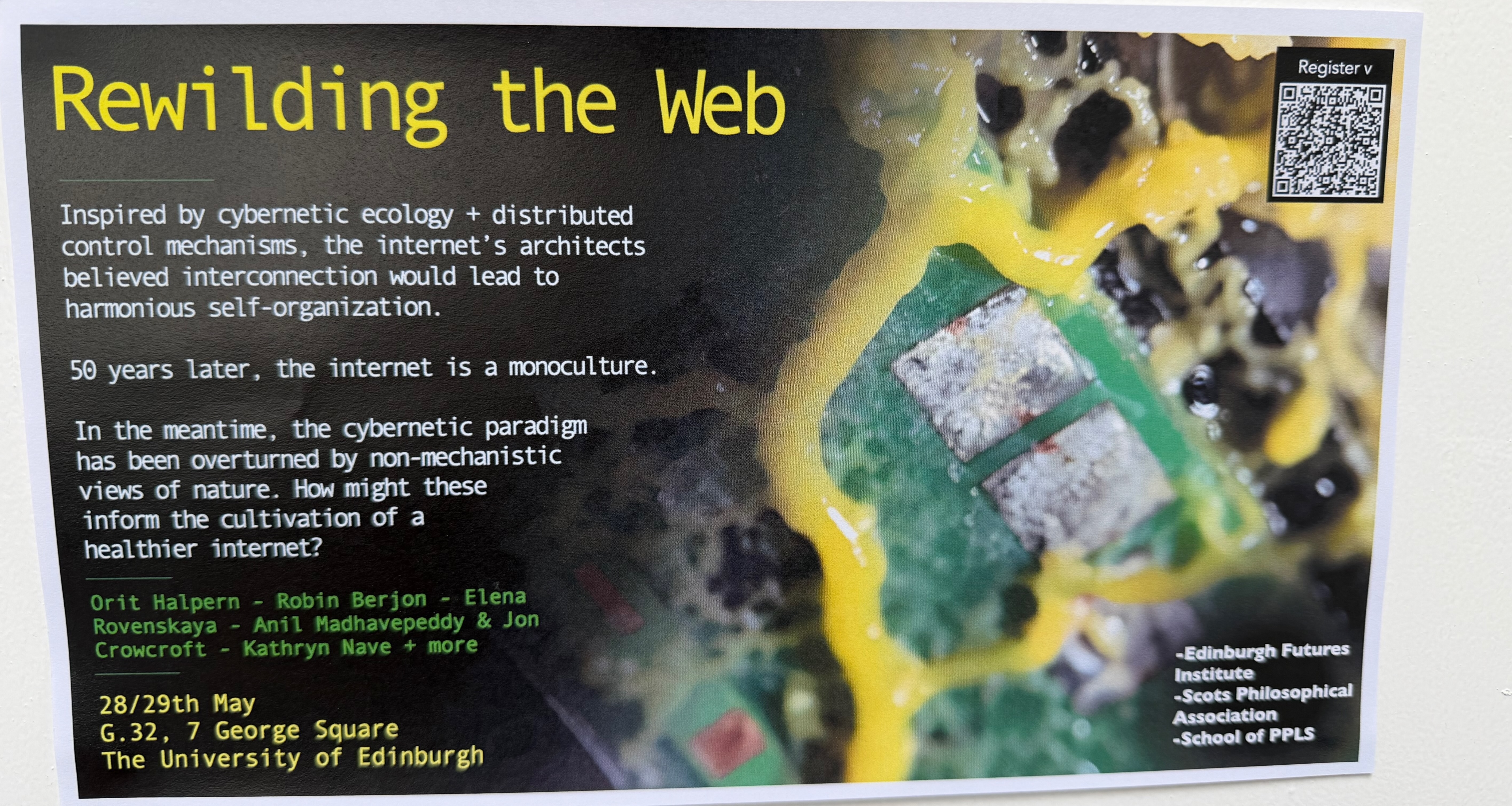
I trotted up to Scotland with Jon Crowcroft to speak at a really fun workshop on "Rewilding the Web: Diversity & Resilience in Sociotechnical Infrastructure", organised by Kate Nave at the University of Edinburgh:
The internet has become a monoculture. This interdisciplinary workshop will host discussion of how we can rewild our digital lives. Inspired by visions of nature as an ecosystem of self-regulating feedback loops, the 20th-century architects of the internet proposed that a perfectly interconnected world would allow free individuals to spontaneously self-organise into harmonious networks of exchange, without any need for top-down control.
[...] This workshop brings together technologists, ecologists, philosophers and cultural theorists to discuss how contemporary insights from theoretical biology and ecology can provide a richer understanding of what makes for a thriving biosphere, and how this might provide inspiration for cultivating sociotechnical infrastructure that is more resilient against co-option by monopolising tendencies. Rewilding The Web, Kate Nave and David Ward, Edinburgh, 2026
1 Overview
The inspiration for the workshop was the 'We need to rewild the Internet' article by Maria Farrell and Robin Berjon, both of whom were in attendance! This is also the piece that inspired me to work on our Internet ecology paper for Aarhus, so I was particularly thrilled to be invited up by Kate to get more perspectives to guide our hacking!
Both Maria and Robin have a deep well of optimism in their approach to the future ("Even at the end of the world, there's still a duty of hope", "We shouldn't do things for everyone; instead we should have a world in which everyone can do and does"), and the workshop crowd further accentuated that constructive feeling. There were economists, lawyers, ecologists, techies, philosophers, authors and architects present. I think most talks I took notes on had a distinct set of professional backgrounds from the other speakers!
Below are my partial notes; they are necessarily incomplete since after every talk there was a good 15-20 minutes of really interactive audience discussions which I couldn't capture here, but I do have some scribbled down in my notebook for the future! In lieu of a table of contents to the speaker notes, here's a collated reading list of things that the speakers mentioned which demonstrate how diverse the topics were. Click on the speaker's name to jump to the right part of the notes.
- Rovenskaya's talk: Fritjof Capra & Ugo Mattei, The Ecology of Law: Toward a Legal System in Tune with Nature and Community (2015).
- Nave's talk: Toyabe et al., "Thermodynamic efficiency and mechanochemical coupling of F1-ATPase" (PNAS 2011).
- Holford-Lovell's talk: "Dealing with Disobedient Objects", 2016.
- Newson's talk: Lorraine Daston, Against Nature (2019). On the trap of treating nature as a source of moral norms.
- Berjon's talk: James Bridle, Ways of Being (2022). AI, non-human intelligence, ecology, more-than-human relations.
- Emrys' talk: Ruthanna Emrys, A Half-Built Garden (2022). Watershed-governance first-contact novel.
- Cook's talk: Bronwen & Francis Percival, Reinventing the Wheel: Milk, Microbes and the Fight for Real Cheese (2017).
- Bonus: James C. Scott, The Art of Not Being Governed: An Anarchist History of Upland Southeast Asia (2009).
2 Elena Rovenskaya on coopetition in digital markets
We opened with Elena Rovenskaya, who is the group leader of the human-natural systems modelling group at IIASA. Elena's a mathematician who's been looking into coopetition for how complex adaptive systems survive and thrive.
Rovenskaya came to digital markets from sustainable-development modelling, and treats the platform economy as a living system whose dynamics are complex enough that policy regulators keep misreading the signals. She noted that digital platforms are now big enough that they behave as economic and societal actors, not individual products. Their influence has meant that normally distinct sectors like retail, logistics and cloud have all collapsed into vertically-integrated ecosystems, and thus destroyed the diversity of the surrounding markets. Regulators (esp. EU ones) are perpetually reacting in this situation since, by the time a harm is recognised, the market has already shifted. Anticipation in this new world therefore requires a different model, which is the topic of their research.
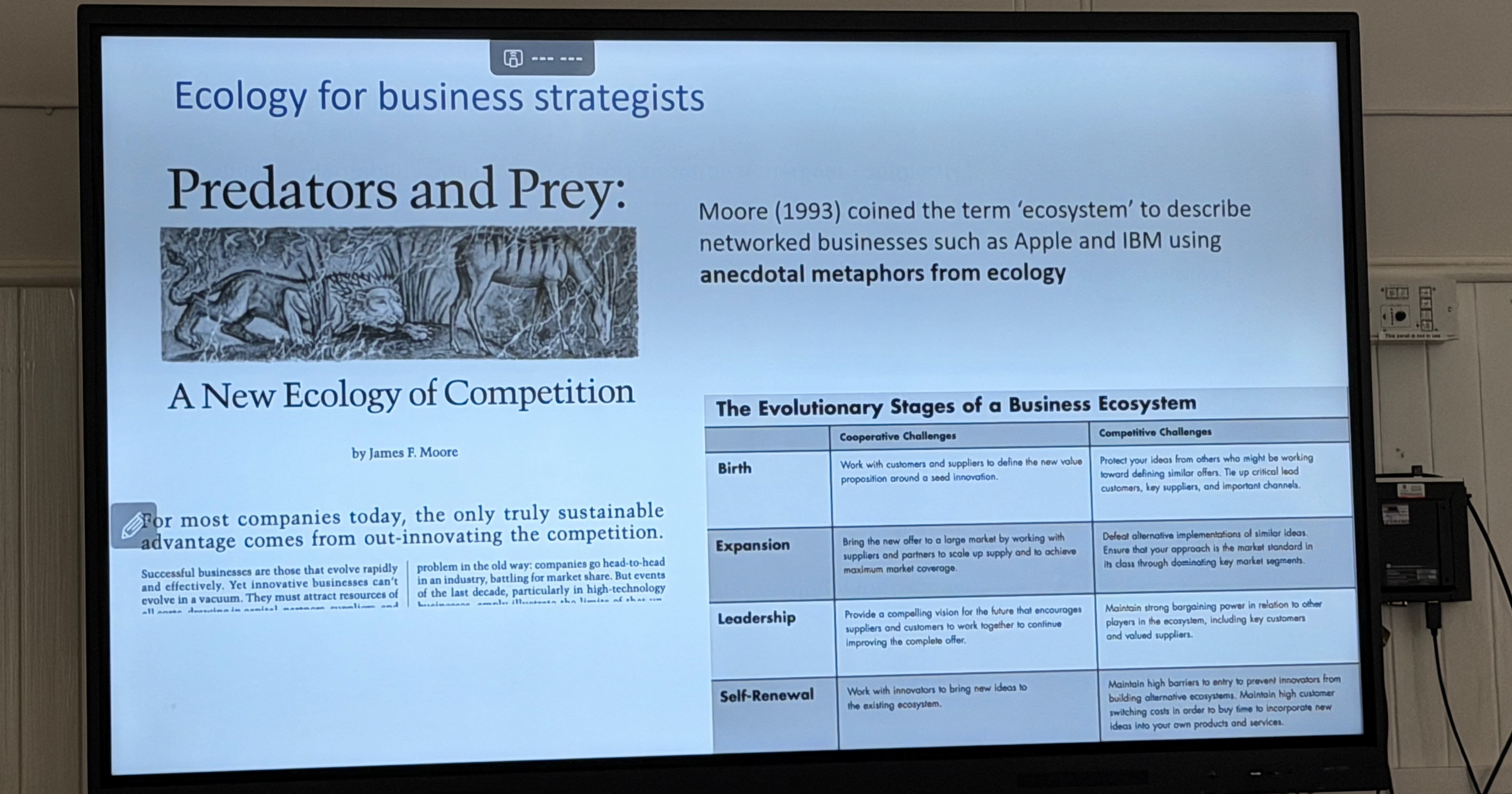
Interestingly, the vocabulary that digital platforms use about themselves ("ecosystem", "flexibility", "emergent complexity", "co-creation of value") is borrowed straight from ecology when Moore in 1993 coined the term "business ecosystem" with the same birth/expansion/leadership/self-renewal lifecycle as ecological systems.
She described how co-opetition works in agent-driven models, where the actors simultaneously cooperate (share data and jointly create demand) and compete (protect IPR, race to ship products). Having both happen at once is what makes platform ecosystems surprisingly robust and hard to dismantle or dislodge.
The interconnectedness of all this means that the 20th-century framing of the economy as a machine no longer holds, and instead the 21st century economy is more of a complex adaptive 'living' system. Jack Ma's perspective on this was that he's a "blind man riding on the back of blind tigers" in modern business, and it's too complex to predict.
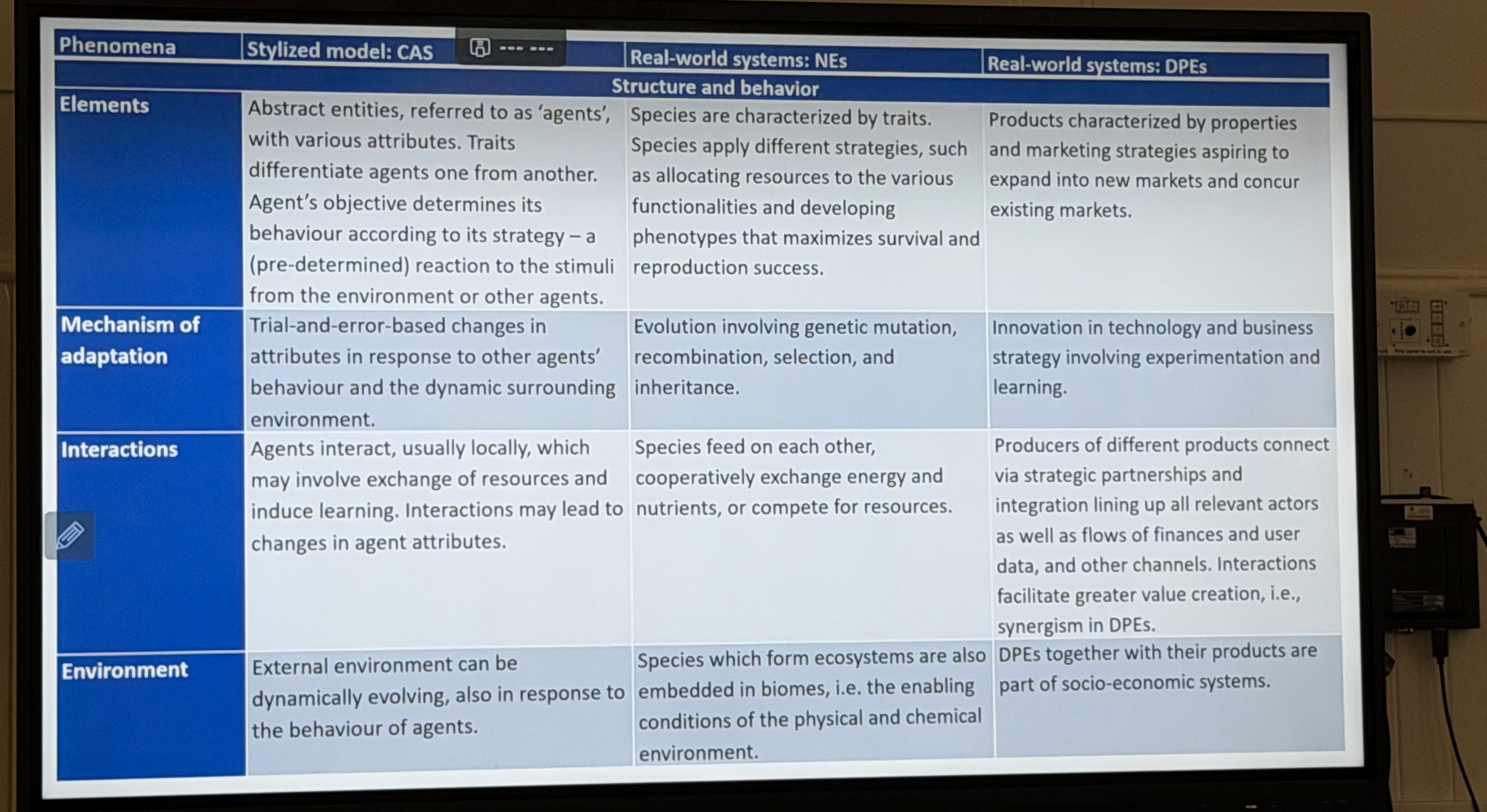
The overall connection between 'complex adaptive systems' (the stylised high level idea) was combined with natural ecosystems and digital platform ecosystems, showing correspondence between how we might model things. It was interesting that the "gatekeeper" term in the DMA is borrowed loosely from the ecology concept of a keystone species. The metaphor doesn't quite carry, but it shows regulators reaching for ecological vocabulary even in the halls of the EU.
I enjoyed reading her paper on this:
Competition authorities worldwide have started to acknowledge the implications of ‘ecosystems’ in the digital economy. This is recognized in the emergence of ‘ecosystem theories of harm’, which attempt to explain how the economy of scope, data aggregation, network effects, and other platform strategies exploiting interconnections between their products can impact competition dynamics, consumer welfare, and other socio-economic parameters.
These arguments are increasingly being made as part of merger reviews, such as Meta's acquisition of Giphy or Google's acquisition of the fitness tracker company Fitbit, as well as in market studies, such as the UK Mobile Ecosystems study. However, the lack of a common framework consolidating regulatory actions continues to allow ecosystem orchestrators to challenge scrutiny which further complicates the challenges of the competition authorities. -- Rovenskaya et al, An ecological perspective to master the complexities of the digital economy, NPJ Complexity, 2025
Her argument that regulators should think of themselves as gardeners and not observers (i.e. do ongoing, adaptive intervention) gave me some echoes of ARIA's recent Accelerated Adaptation program as well, and also made me wonder what happened to their collective flourishing program.
3 Kathryn Nave on the principle of excessive variety
We then shifted from mathematics to the philosophy of biology and cognitive science, with our workshop organiser Kate Nave. Her talk on the "Principle of Excessive Variety" was a reexamination of the assumption that nature is an optimiser. Instead, she argued that living systems aren't hugely efficient, and that's the whole point!
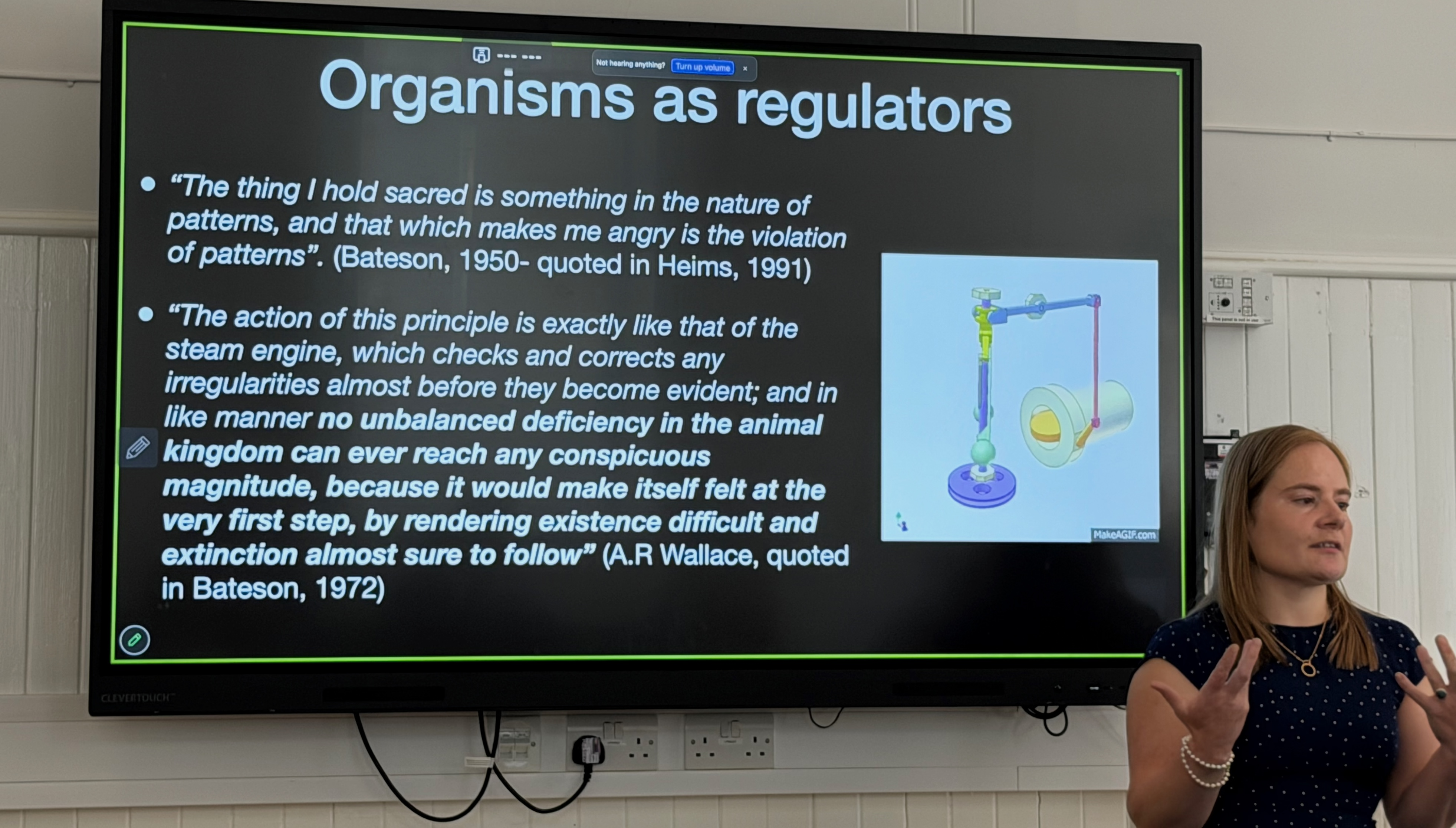
Kate's talk opened with how biology is often viewed as a more efficient machine than human constructions; for example F1-ATPase as a near-thermodynamically-perfect rotary motor from 2011. But for each of these examples, there are other cases where nature isn't a great exemplar for efficiency, such as the 2021 paper that notes that a neuron's computation cost is roughly 10^8 times less energy-efficient than the physical optimum.
This sits awkwardly with the classical cybernetic view that goes back to Conant & Ashby's 1970 dictum that organisms function as regulatory machines, in which any variety beyond what the environment demands is just "unnecessary complexity". The implication is that evolution, learning and development are all processes that converge on an efficient amount of variation that is (presumably) proportional to environmental variability.
The problem is that machines designed to converge on a stable state, well... they converge on a stable state. Generative systems trained on their own outputs lose the tail of the original distribution and degrade, and so access to genuine human-generated content turns out to be really important. So why don't biological systems also experience the same collapse? Valen's 1973 "new evolutionary law" noticed that organisms in a given adaptive zone don't actually seem to become fitter or more stable over time; something about their environment keeps generating novel variation that prevents successive generations from collapsing. Modern open-ended-evolution research still considers this an unsolved problem in evolutionary biology.
3.1 Cryptic variation as a store of entropy
Kate's solution to this difference came via Wagner's work on cryptic variation which notes that genetic variation can accrue without being phenotypically visible, so individuals who look identical actually occupy different points in genotype space, each with access to different "adjacent possibilities". Mutations can accumulate without immediate risk to the individual, which struck me as awfully similar to how digital source code can also have bugs that emerge at different times.
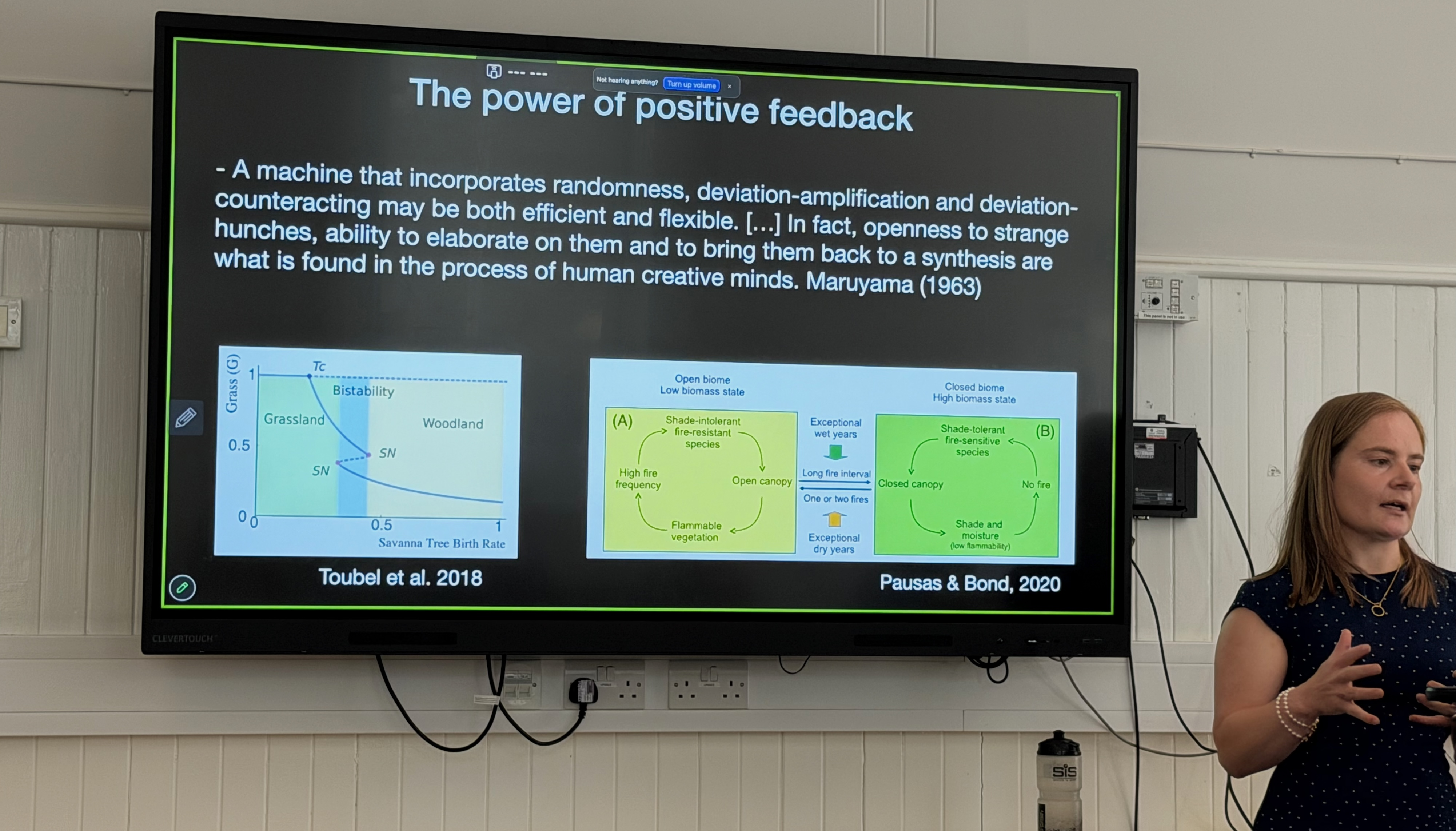
Layered on top of this is the power of positive feedback as a driver of bistability and morphogenesis which lets a landscape flip between grassland and woodland suddenly rather than smoothly interpolating between them or flattening into an average.
3.2 Play also builds redundancy
An enjoyable thread in Kate's talk was the role of play as a difference between physical/biological systems! Play has no clear evolutionary function but occurs in flies to belugas as a positive-feedback loop that does nothing selectively useful for the organism. But while this is seemingly useless, it turns out that humpback whales took bubble loops and turned them into a useful hunting strategy.
The implication for the Internet seems obvious: ruthlessly optimising for engagement, efficiency and 'AI legibility' kills exactly the excess variation that future resilience depends on to come up with new ideas. I had the same rant last week about how our University Drupal, while well meaning, has completely killed the interesting diversity in academic homepages and made everything look-and-feel the same in return for...something.
In the Q&A, someone noted that the 1990s accelerationists framed surplus as something to be reinvested socio-economically, and I noted that biological entities spend an enormous fraction of their energy on inward-facing curation and maintenance: should online communities take the same view of themselves?
Another thread asked what it would take to prioritise "play" on the internet, and whether large-scale things can ever really be fun: we've been trained that play is inefficient and unproductive (and without safety there's simply no room for it in online spaces). Another pointer was to Ulanowicz's work on quantifying the optimal balance between efficiency and redundancy in ecosystems.
3.3 Donna Holford-Lovell on digital infrastructures for bioregional justice in Tayside
We shifted from the philosophy of biology to a much more grounded counterweight on what digital infrastructures look like when they're accountable to an ecological watershed! Donna is a native of Tayside and (among many other things!) runs the Cake or Dice boardgames cafe that I must visit next time I'm in Dundee.
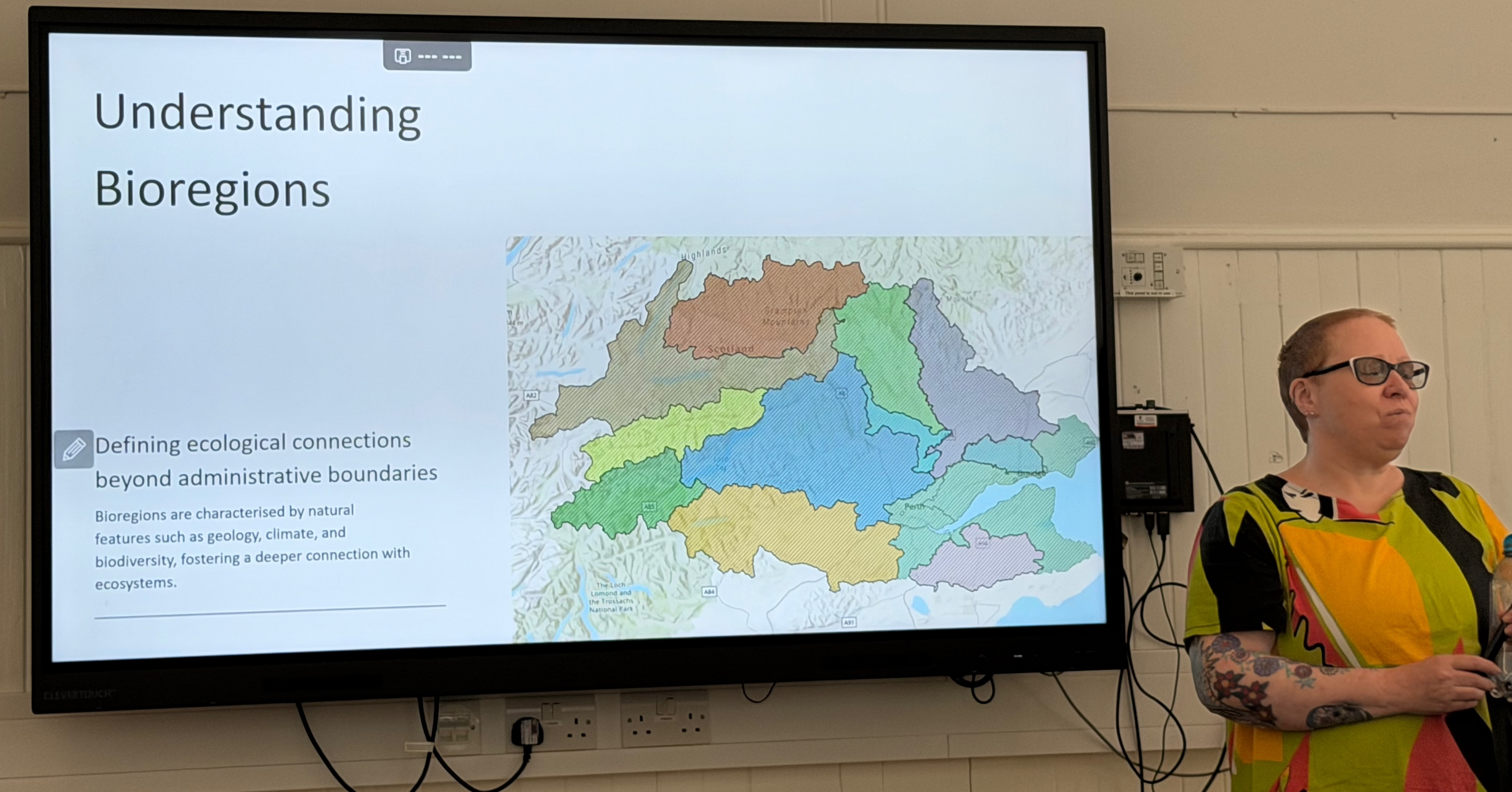
Donna's talk discussed the intersection of ecological bioregions (defined by natural features like geology, climate, biodiversity) with administrative boundaries in Scotland; the ecological connections cut across councils, and so need to be managed accordingly.
She had a number of examples around the River Ericht which floods regularly as a forcing event for thinking about digital services at bioregional scale. She described four axes for evaluating digital services in this frame: environmental impact, the services themselves, governance, and stewardship, and described how they've been evaluating participatory solutions with locals across all of these.
My notes were sparse here since I was busy messaging Ryan Gibb about how perfect her usecases were for selfhosting solutions like Eilean! Donna described one scenario where, after a weather incident, the only computer left functioning was a Linux self-hosted Raspberry Pi, since everything else depended on the (inaccessible) Microsoft cloud. This is exactly the kind of edge-resilience our decentralised stack work has been aimed at. While we often consider sensing as something to deploy in remote exotic climes, it seems obvious to me after Donna's talk that we need it to boost the best bits of rural life in the UK as well, and to do so in a way that fits in with life there.
3.4 Anil & Jon on steps towards an ecology for the Internet
Jon Crowcroft and I then presented our thoughts on the Internet architecture viewed through an ecological lens, and the need for an Internet immune system. To make it more fun, we did an unrehearsed double act with us tagging the other in. It's been a few years since I've presented with Jon, so this introduced a certain amount of Lucretius-style 'swerving' into our presentation...
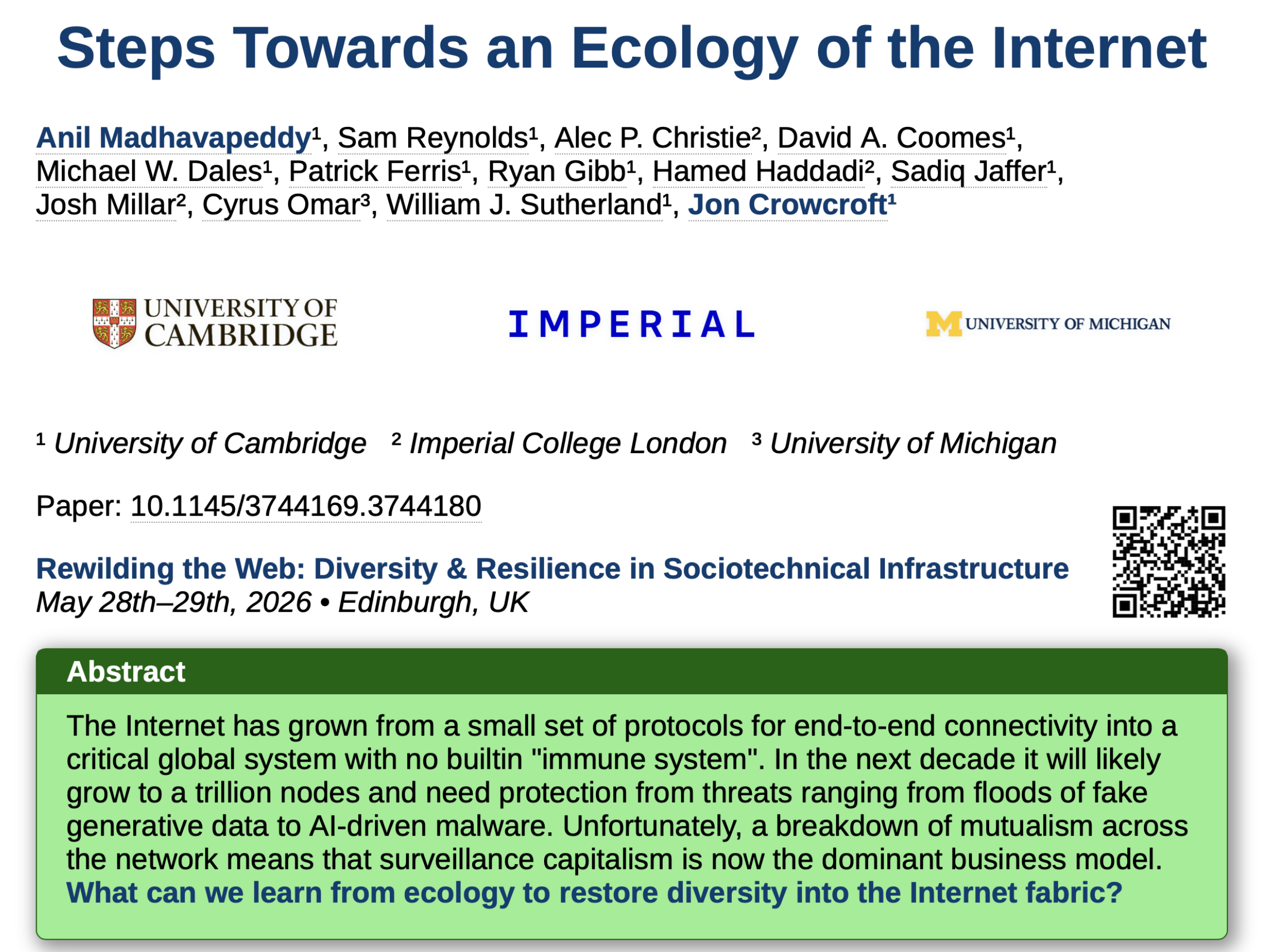
There was quite a bit of audience discussion afterwards. One immediate observation that struck me was that nobody was skeptical that the basic ideas of antibotty networks and code self-modification could work. This is unlike just six months ago at Aarhus when I presented this where people thought it was a sci-fi concept. Just goes to show how quickly coding agents have hit the mainstream.
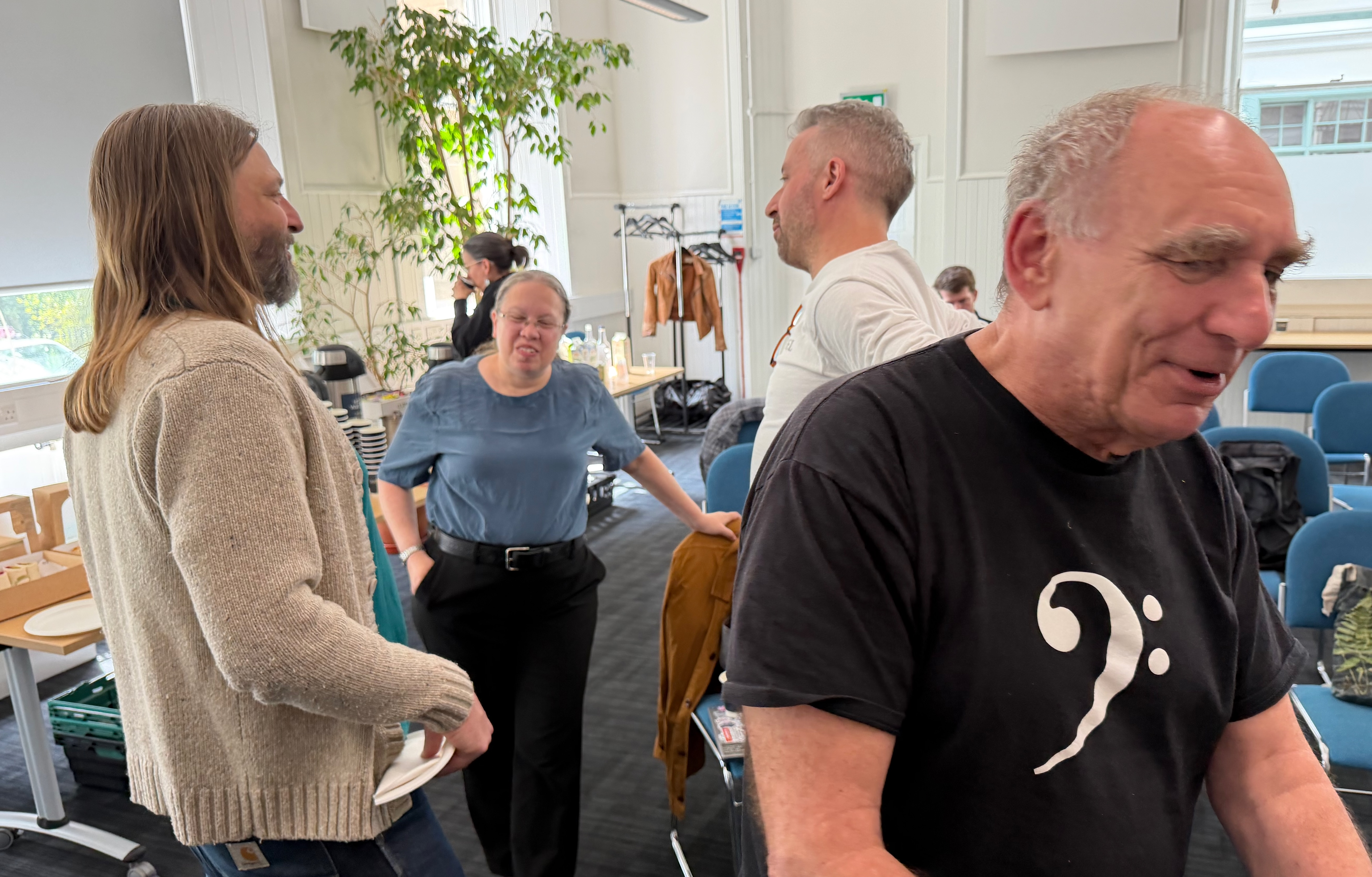
The other thread of discussion was around safety, access and equitability, particularly around how computer science literacy was needed to be able to guide some of these things. During the break afterwards, a couple of people were interested in both TESSERA mapping and my self-hosted deployment of Owntracks location tracking, so I showed how those worked and some of my custom location scripts. One person remembered Dopplr (!) and I showed them Michael Dales' 2011 work on Placewhisper (which is an app we really need to bring back).
4 Georgie Newson on moving beyond self-organisation
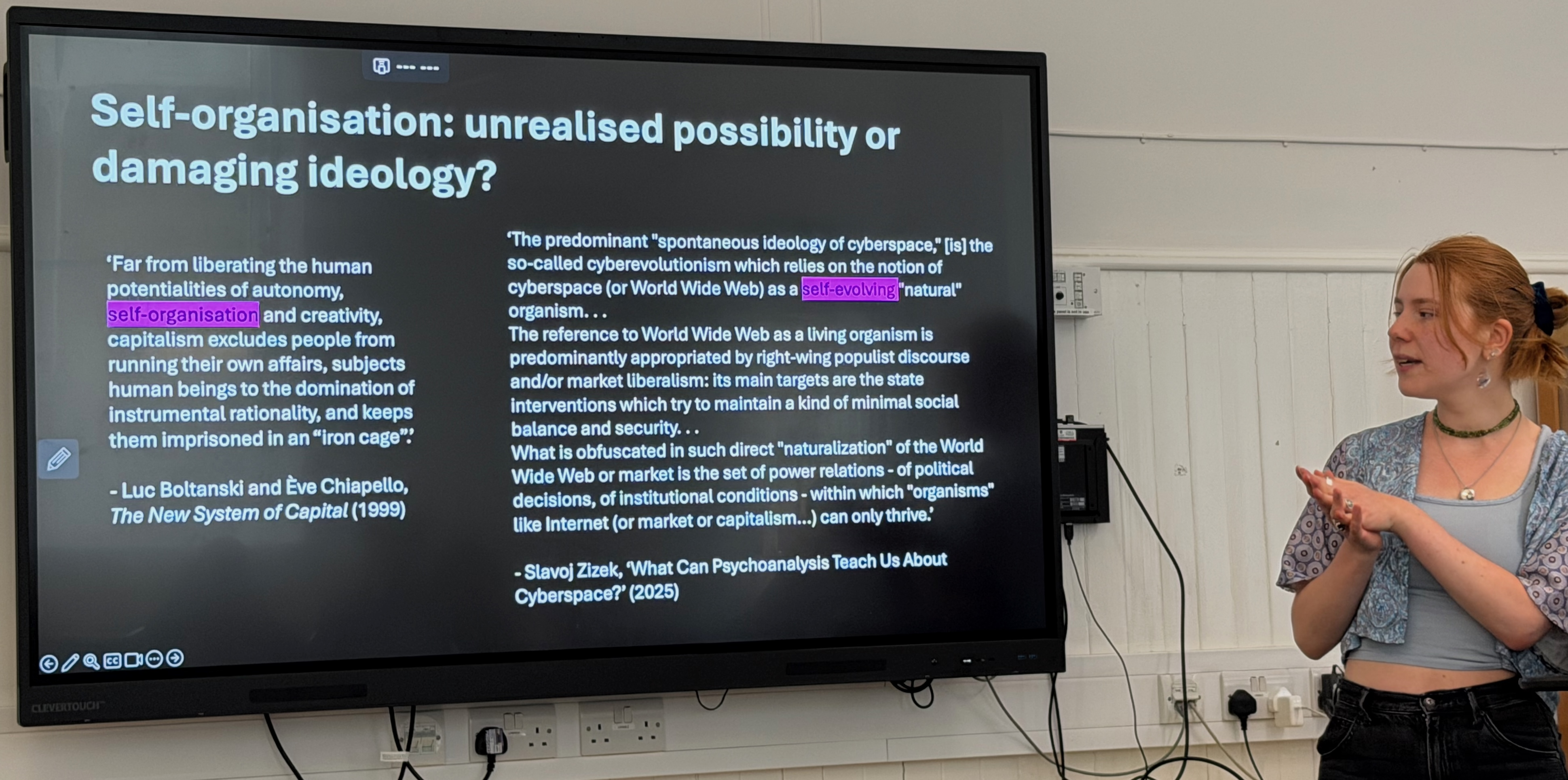
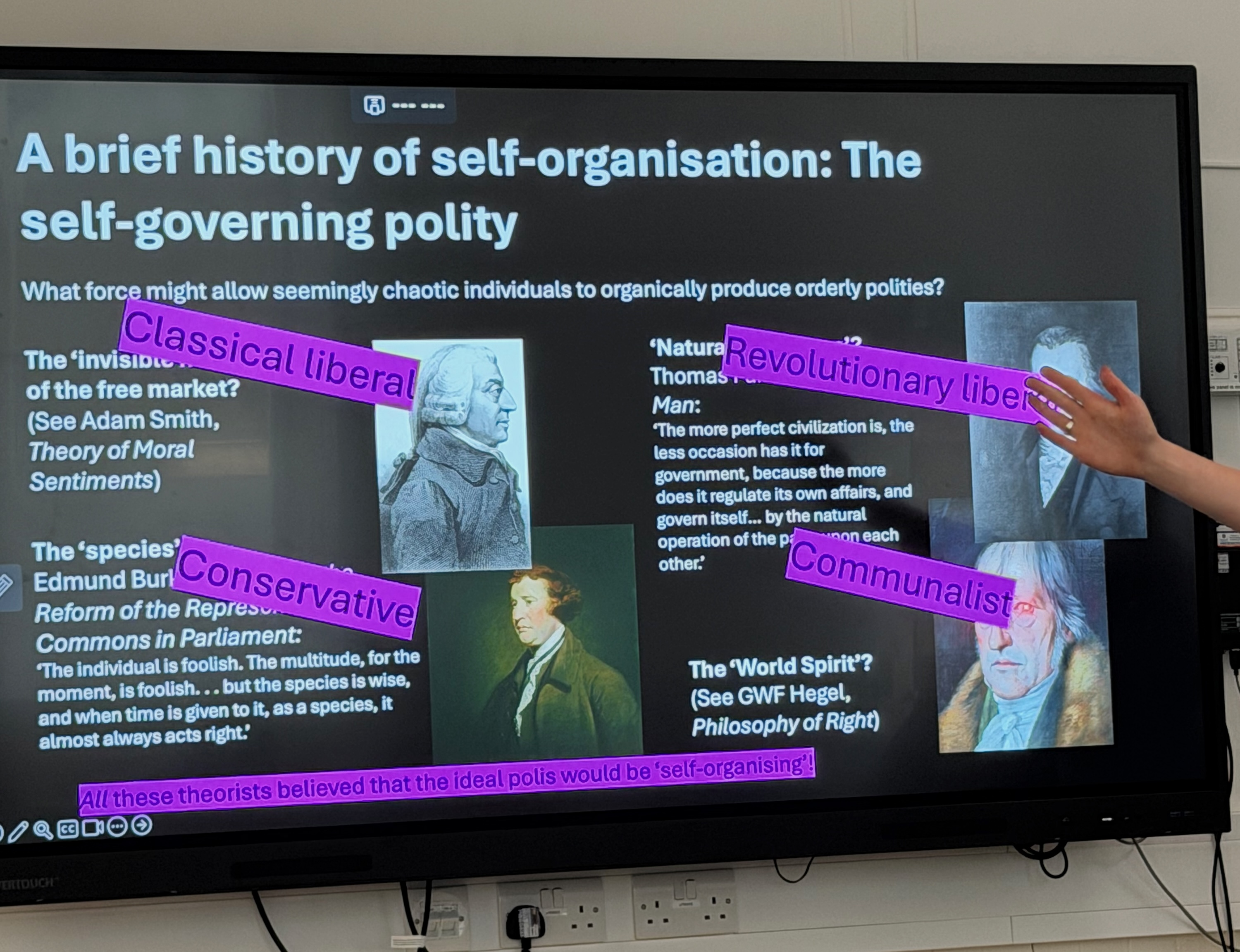
We then shifted to the philosophy of whether 'self-organisation' even means anything useful, with Georgie Newson (a PhD student here in Edinburgh) giving an outstanding seminar on the history and implications of the term. Newson started with questioning whether the dream of an organic self-organising public sphere actually failed, or if it was just a fantastical dream from the start. She went back to the lineage of the "spontaneous order" idea, traced back to the Roman poet Lucretius:
Our world was made by nature, when atoms, meeting by chance, spontaneously, and joined in myriad useless, fruitless ways, at last found patterns, which when thrown together became at once the origin of great things: earth, sea, and sky, and life in all its forms. -- Lucretius. On the nature of things, 1977 (translated)
This tied back in my head to Kate Nave's earlier point about recursive ML training collapsing into a stable distribution when recursively trained. I found this breakdown of ancient atomic physics that explained Lucretius' view:
Lucretius builds upon his atomic theory by linking the physical qualities of atoms to the existence of human agency and free will. In Book 2, he introduces the concept of the atomic clinamen ("swerve"): incertisque locis spatio depellere paulum... / quod nisi declinare solerent, omnia deorsum / imbris uti guttae caderent per inane profundum / nec foret offensus natus nec plaga creata ("and in uncertain places, they swerve slightly in space... If they did not swerve, everything would fall downward, like raindrops through the deep void, and there would be no collisions, no impacts would be produced", 2.219–23).
The swerve (depellere paulum, declinare) brings about uncertainty and change. -- Antigone, Shikar Misra, 2025
This question of what makes nature's emergent behaviour vs cold deterministic machinery has been one we've been grappling with for a looong time! Without an external lawgiver and just free beings interacting, why doesn't chaos reign? Every ecosystem must have some organising force and so 'self-organisation' can be used to justify almost any ideology or intervention as it's politically promiscuous.
4.1 Moving to rewilding instead of self-organisation
Newson's PhD includes defining 'neurolibertarianism' as a distinct new term in this space. She posed three diagnostic questions to ask of any 'self-organisation' claim:
- What features are required for the system to organise; i.e. which are intrinsic ("natural") and which are externally imposed?
- What are the boundaries of the system; i.e. what is the "self" that's organising?
- What counts as "order" vs "disorder" for this specific kind of system?
Something I'd not thought about before is whether projecting normativity on nature is a good idea at all. Lorraine Daston asked this in Against Nature and argued that "no amount of philosophical argument or political critique deters the persistent and pervasive temptation to conflate the 'is' of natural orders with the 'ought' of moral orders."
The conclusion is quite practical: prefer specificity via terms like "rewilding" to "self-organisation" since:
- Self-organisation implies "letting nature be", wherein what counts as "natural" and as "letting-be" is wide open to capture and misinterpretation.
- Rewilding implies ongoing, regulative strategies aimed at sustainable diversity, and is more precise and honest about its intentions.
Of all the notes I've taken, this was the most incomplete: I do hope recordings or slides are published at some point as there was a lot of nuance here that I haven't scribed!
5 Robin Berjon on not letting a good polycrisis go to waste
The next talk was by Robin Berjon who rolled up the social, technological and ecological crises all into one glorious talk about their interconnectedness! He opened with Henry Farrell's recent piece on cybernetics as the science of the polycrisis:
[...] how do you manage an inherently complex system? Beer talks about "variety engineering".
[...] attenuation. Here, you take what is complex, and you make it less so. You reduce the variety of the environment you are trying to deal with, so that the system produces fewer possible states of the world to be anticipated or managed.
[...] amplification. [...] you amp up the variety inside the organizational structures that you have built, so that it better matches the variety of the environment you find yourself in. Very often, this involves building better feedback loops through which different bits of the organization can negotiate with each other over unexpected problems. -- Henry Farrell, 2024
Governance was designed in the 18th century and we need to drag it into a 21st century place where it can actually help us survive what's now happening. He used Amartya Sen's capabilities approach (i.e. don't just deliver food, deliver education and democracy) to frame how a digital version is also necessary.
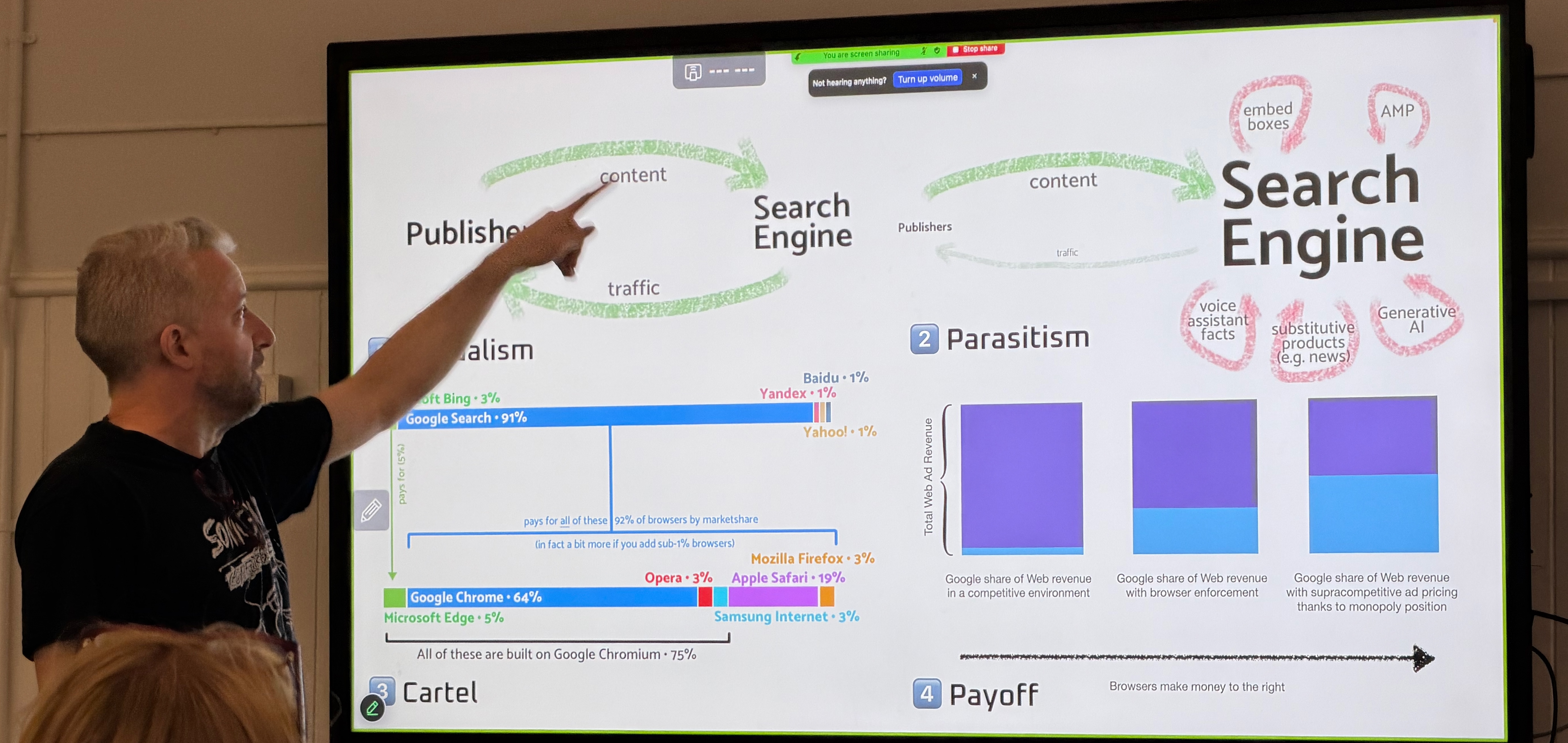
Robin got into similar mutualism/parasitism comparisons as Elena's talk (above, on coopetition) and our own ecology paper also delved into. It's fairly obvious at this point that juggernauts like Google rarely have altruism in mind when appearing mutual (giving away Chrome for free): embrace, extend and extinguish is very much still the game they're playing.
5.1 Towards engineering digital agency
There are some glimmers of a fightback happening here with the Funding the Web (FtW) consortium reforming the browser/search levy so it stops enshittifying search and defunding the rest of the Web. beckn is a P2P protocol for two-sided markets; I thought this looked connected to India's UPI payments and peer-ownership I observed during the Indian AI summit a few months ago.
Robin then discussed how agency over one's life, either physical or digital, correlates with the conditions that avoid terminal minima. If our design provides a sense of coherence around comprehensibility, manageability and meaningfulness, then we can design good digital ecosystems.
However, the "default" engineering mindset excludes the users of the system from its design, thereby hugely reducing their agency. Concretely, GDPR's "consent to everything" (think cookie popups) and "decentralisation" (think Mastodon) both fail because they aren't user-centric: we need to engineer richer models of autonomy that support real self-governance.
Therefore, a key principle in the new AI-driven world is that in order to build better tools, we need to figure out how to augment cognition, and not offload it onto someone else's computer.
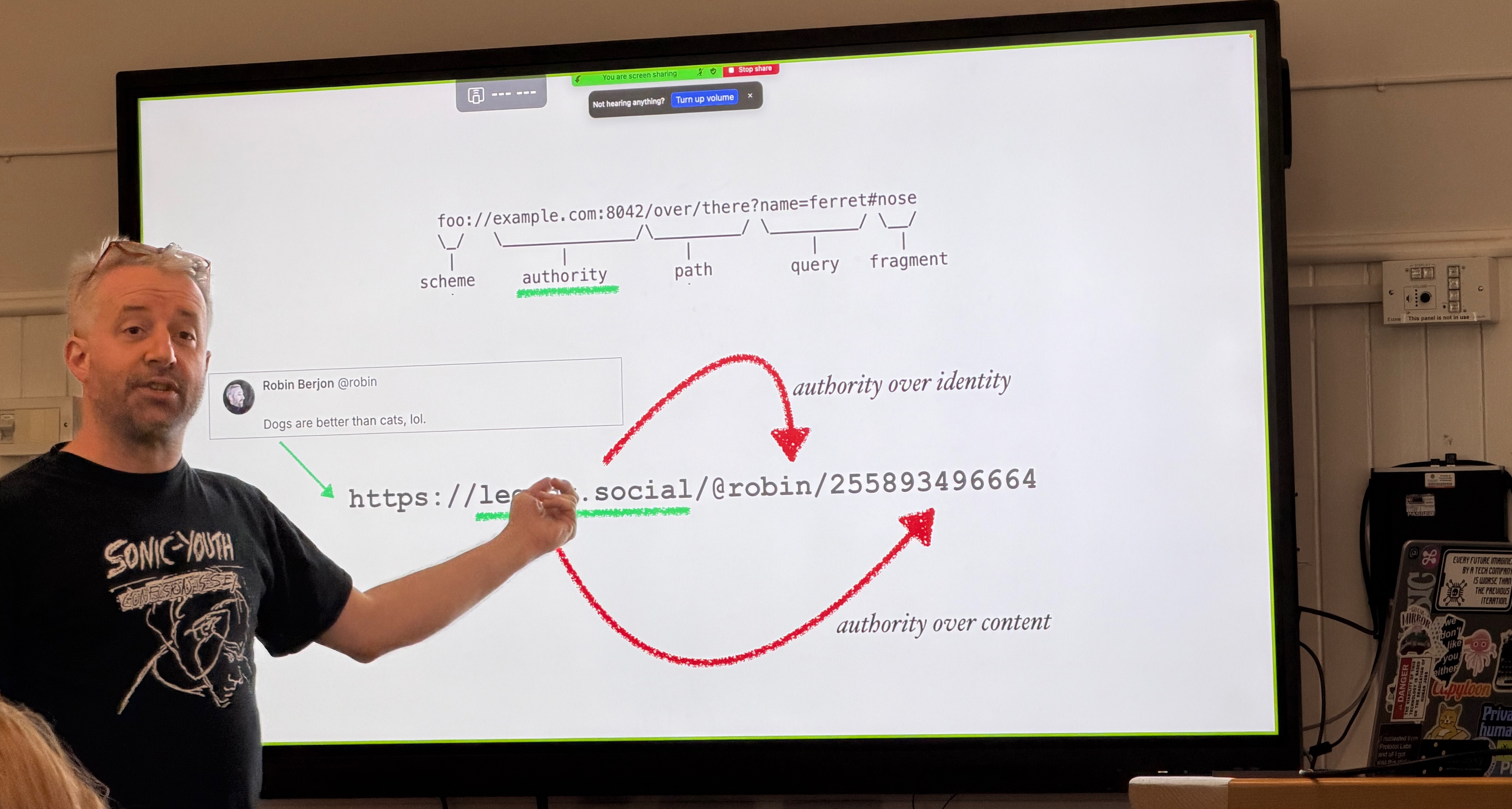
Robin then went into a topic that Patrick Ferris has spent a lot of time on: what's in a URL, how does it tie back to agency, and does provenance make sense when resolving them. Robin described the URL's role in establishing authority over identity (the key to ATProto, and what makes things like disentangling git with Bluesky actually viable). I'm also interested in how to establish uncertainty and non-determinism in resolution, for when URLs change or datasets themselves are shifting over time as accuracy improves (e.g. for weather or satellite forecasting).
I did flag Robin's DASL content-addressed primitives (the substrate Bluesky uses) as an interesting OCaml implementation target. I've got an OCaml ATProto (used as part of my publishing pipeline) that works reasonably well for my day-to-day use, but the CBOR implementation is subtle and needs more work before I can release this beyond just Thomas Gazagnaire and me using it.
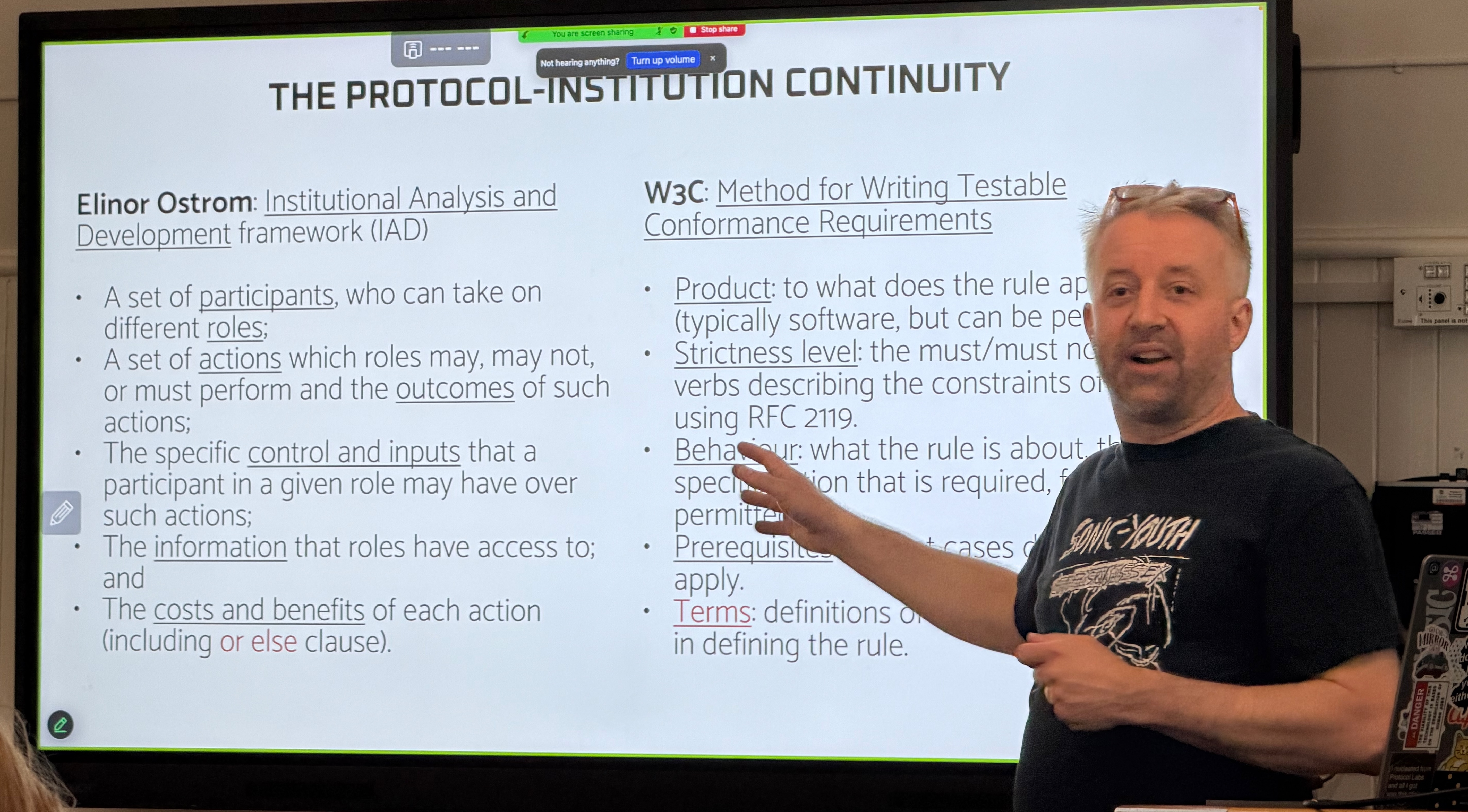
Robin left me with lots and lots of technical ideas. He noted the correspondence between Elinor Ostrom's work and how the W3C operates, as I did a few years ago with the Cambridge Green Blue cooperation-via-sport experiment.
I do like the idea of treating commons-governance theory as a serious input to standards work. But an open question remains if we have the runway to craft the resulting institutions deliberately, or if major transitions are just what happens when a new public good stabilises. And if so, are some technical affordances inherently anti-cooperative? I'd love to have a 'denylist of technical ideas that seem good but in fact lead to bad social outcomes'!
If you've liked Children of Time then Robin also closed by recommending James Bridle's Ways of Being. On my reading list! I also had the opportunity to geek out about Google ATmosphere apps with Robin, how Matrix and Tangled might bridge, how funding signals on ATProto might work, and much more. There's a lot of hacking to be done here...
6 Ruthanna Emrys on rewilding the web with protopias
Our next discipline was literature, with Ruthanna Emrys who is an accomplished science fiction author. I started reading her Innsmouth Legacy series on the train back to Cambridge!
She started by reminding us of an origin story we often forget. The visions of the "tame corporate net" came before the real thing that turned out to be wild. William Gibson had never been on the internet when he wrote Neuromancer, and in fact he wrote it on a typewriter!
[...] Neuromancer and its two sequels are not about computers. They may pretend, at times, and often rather badly, to be about computers, but really they're about technology in some broader sense. Personally, I suspect they're actually about Industrial Culture; about what we do with machines, what machines do with us, and how wholly unconscious (and usually unlegislated) this process has been, and will be. -- William Gibson, afterword of Mona Lisa Overdrive, 1988
The wildness in his novels was projected, and it's only years afterwards (in 1996) that Gibson wrote:
As new technologies search out and lace over every interstice in the net of global communication, we find ourselves with increasingly less excuse for ... slack. And that, I would argue, is what the World Wide Web, the test pattern for whatever will become the dominant global medium, offers us.
Today, in its clumsy, larval, curiously innocent way, it offers us the opportunity to waste time, to wander aimlessly, to daydream about the countless other lives, the other people, on the far sides of however many monitors in that postgeographical meta-country we increasingly call home. It will probably evolve into something considerably less random, and less fun [...] but in the meantime, in its gloriously unsorted Global Ham Television Postcard Universes phase, surfing the Web is a procrastinator's dream. -- The Net is a Waste of Time, W. Gibson, NY Times, 1997
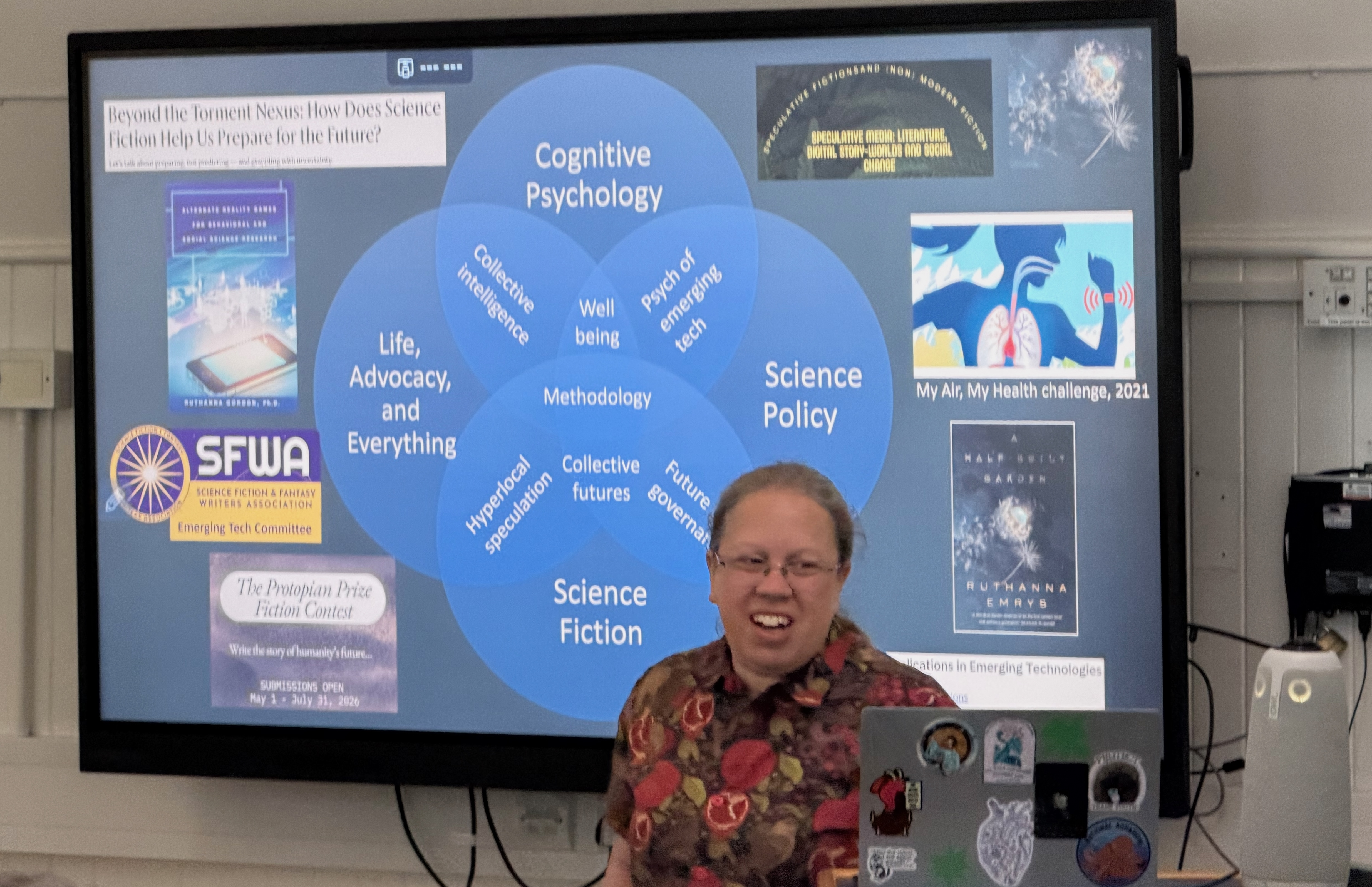
Emrys diagnosed some of the reasons for this evolution of the Internet into "something considerably less random", notably due to walled gardens overwhelming thriving ecosystems, legibility overwhelming sustainability, corporate goals overwhelming user goals, and ultimately slop overwhelming human creativity.
Things have gotten so bad in today's Internet that "enshittification" is now policy vocabulary, and Norway's Consumer Council has taken aim at it with a brilliant 4 minute video:
6.1 The protopian movement against dystopian slop
There are fights back against the slop happening, like Global Voices called out as an example of the older, plural web that's still alive, and newer initiatives like Kagi Small Web (which I've submitted my own site to and get a surprising amount of traffic from!).
However, another angle is to influence the future via the stories we tell. Science fiction has historically acted as a deliberative library. Emrys helps organise the Protopian Prize which rewards stories of a measurable, plausible better future.
It's not a utopia in which everything is wonderful. It's a future measurably better than today's, but you can see how we got from here to there. -- Protopia contest rules, 2026
I got quite distracted by reading through Protopia during her talk, as I've been reading a lot of Adrian Tchaikovsky's weirder insect fiction stories from his earlier days. Protopia isn't just a dystopia-with-happy-twist ending, nor is it just a simple "good-vs-evil". A good protopia admits drama, conflict, tragedy; it can be worse in some axes (e.g. climate) while better in others.
It's the first time I've learnt about this term and the contest, and there's even a 2023 NYTimes article on it called "Forget Utopia. Ignore Dystopia. Embrace Protopia!" (archive.is mirror). This then led me to the two book recommendations from this talk:
- What Technology Wants from Kevin Kelly who coined the term protopia, but that's criticised for being overly teleological (which I quite like in Jesuit philosophy but less so for the topic at hand of digital rewilding after listening to Georgie Newson's talk earlier).
- A Half-Built Garden by the speaker, a first-contact novel where aliens arrive expecting to find humans on the verge of ecological self-destruction and instead encounter a watershed-based commons governance! Can't wait to get into this one.
7 Blaine Cook on the conditions for cultural diversity in decentralized infrastructure
Blaine Cook then took us back to technology, but via the medium of cheese (more on that later!). Blaine is, among many things, the author of the oAuth and webfinger (which I've written in OCaml!), and deeply experienced in the social networking space.
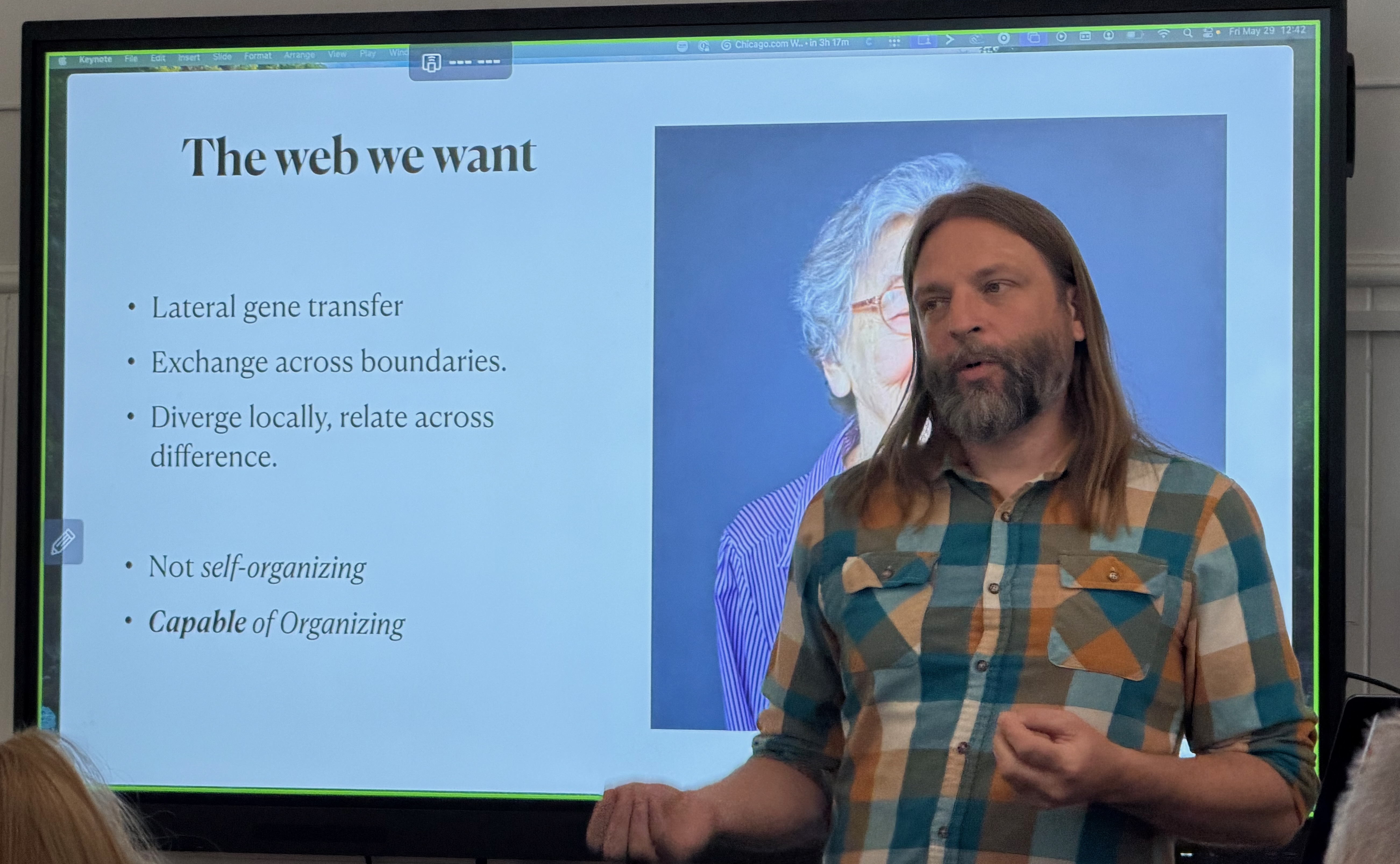
He's now living in rural Canada and working on New_ Public, where he's building spatially explicit social networking (e.g. for local neighbourhoods) that can maintain civic standards of discourse. Their first tool is called Roundabout:
[...] stewardship: supporting the people who give their time and energy to setting norms and facilitating healthy conversations in local spaces. On big tech platforms, these stewards are often in a reactive mode, not recognized or empowered. Roundabout is designed to change that.
[...] co-design. The New_ Public team has worked closely with stewards to understand their day-to-day experience and their challenges, not just researching and talking with them, but building alongside them. Together, "the practices and the product are what makes our approach to Roundabout." The goal, Trei emphasized, is ultimately to increase social trust at the local level: "what are all the ways that we're serving information needs, but also creating connection between neighbors?" -- A Pro-Social Platform for Local Communities, 2026
Blaine motivated his approach by discussing cheese, where Bronwen & Francis Percival's "Reinventing the Wheel" book discusses the subtleties of balancing safety with taste. There are two paths to food safety: sterilisation kills everything and centrally controls the variables involved in pathogens. Meanwhile, cultivation curates the microbial community and lets it do the work with careful oversight.
The French term that describes factors which affect an edible crop is terroir, and is not just branding but a combination of location, land, climate, organisms, and the people that together define what the ecosystem is. Strip any of them out and you don't have terroir, just data! The Wikipedia page pointed me to some examples of this in action with actual cheese:
A scientifically validated example of terroir can be found in the alpine cheeses of the Aosta Valley (Italy), such as Fontina. The diet of the Valdostana cows includes Alpine clover (Trifolium alpinum), a plant that emits a strong, spicy fragrance. Research has confirmed that volatile organic compounds from this clover are transferred to the milk and can be detected in the final cheese, imparting a unique aroma and flavour. -- Terroir / Artisanal cheese
The tie back to digital ecosystems is in how we do moderation. Decentralised infrastructure has been choosing sterilisation, but new approaches like that adopted in ATProto (which powers Bluesky) allow for much more local nuance in what we permit.
Blaine's view of how social networking should be engineered was that "[...] we don't want to define the shape of the whole world, but we do want to build the DNA". I like this view a lot as I continue with my antibotty experiments; we need to let local diversity actually flourish without recentralising all the time, but still bubble up locally good ideas and share them globally. I also got the opportunity to quickly show Blaine my TESSERA explorer to see if it would help with Roundabout; I'll follow up on this once the Zarr conversion is complete so it's more easily consumable!
His closing reading recommendation was James C. Scott's The Art of Not Being Governed which is about Zomian highland societies that have deliberately organised 100 million people to remain illegible to their surrounding states.
8 Closing thoughts (such as they are)
My notes are unfortunately incomplete as I had to leave early from the second day of the workshop to get a train back to Cambridge. The three remaining speakers were from equally diverse backgrounds, so I'm genuinely gutted to have missed the discussions there too! The recording setup wasn't quite up to picking up the audience questions, so I guess the only answer here is to convince Kate to do a second edition of this workshop in the future to pick up on these debates.
Things I loved about the workshop structure:
- A very engaged audience from all walks of academia and practise. Everyone there had something interesting to say.
- Extremely constructive pickup on points across disciplines. If I didn't understand something or used technical jargon, someone else just asked what that means, which always lead to a useful exposition.
- Plenty of time for post-talk discussions, so it wasn't just an endless sequence of slides but actual interaction.
- Utterly delicious Norwegian chocolate brought by an attendee to celebrate the recent Constitution Day. If that's not pro-social then what is?
As you might be able to tell from my personal (and often rambling) notes above, I have lots of self educating and reading to do on this topic in the coming months. I am having a terribly good time soaking it all in though!
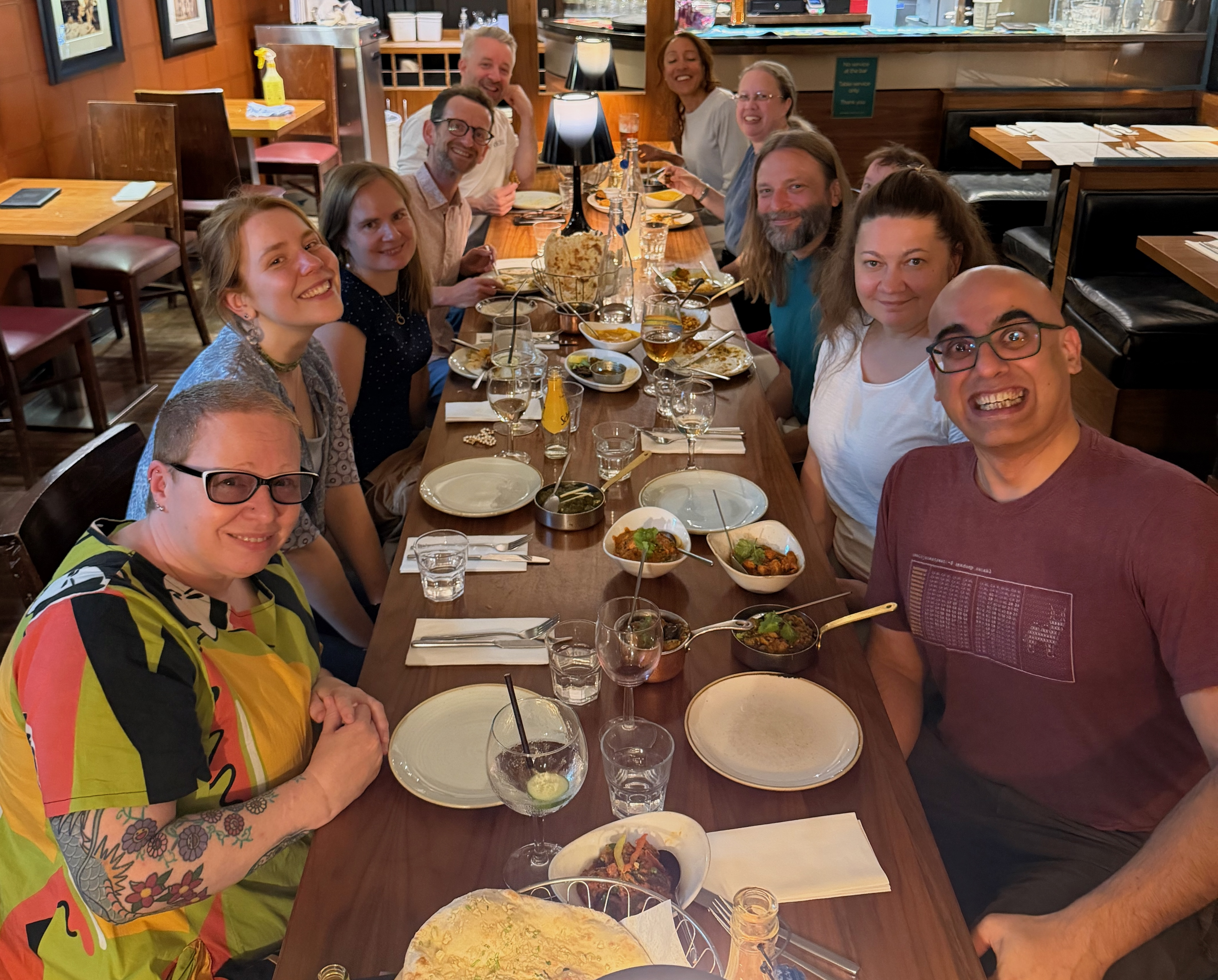
Visiting Edinburgh is always fun, and this is the first time I've been to the School of Psychology, which is in a lovely building. Running in Edinburgh was also a lot more three-dimensional than in Cambridge, and I couldn't feel my legs for the whole weekend after doing a morning sprint there.