
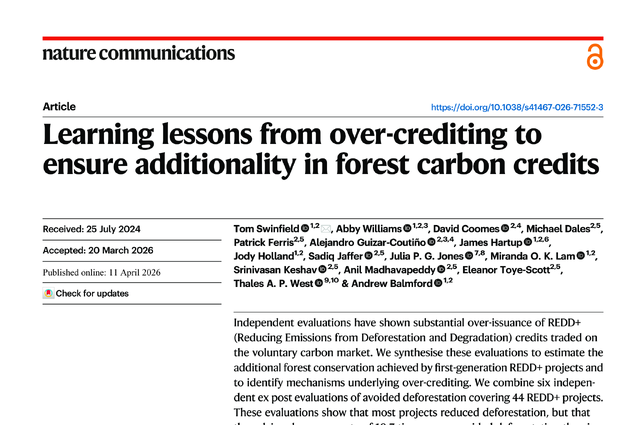
Our paper on learning lessons from past REDD+ over-crediting came out in Nature Communications today, led by Thomas Swinfield, and is the culmination of years of work in 4C. It's a comprehensive ex-post synthesis of first-generation REDD+ projects worldwide, and I wanted to explain the findings here more accessibly than a scientific paper (see also the cam.ac.uk and cst.cam coverage).
For those unfamiliar with the terminology, I've defined a carbon credit before as a quantified climate benefit from an intervention, distinct from how it might later be used to offset unavoidable emissions. This matters once we get to pricing these things.
The first finding in the paper broadly matches investigative reporting from 2023, as our synthesis confirms the voluntary market did over-credit carbon claims from many forest projects. However, the second finding is more important for our future: most of these projects slowed deforestation on the ground and were positive interventions! Four in five forest projects produced measurable positive conservation outcomes against a credible counterfactual. My co-author Julia P.G. Jones explains it well:
This new paper makes the point very explicitly that many projects delivered substantial reductions in deforestation (just not as much as was claimed). The scandal in the voluntary carbon market left many with the impression that tackling climate change through avoiding deforestation is somehow dodgy.
That is supremely unhelpful. To tackle climate change, we simply must slow deforestation and many REDD+-funded projects have been doing good work on the ground, and delivering real emissions reductions. -- Julia P. G. Jones, 2026
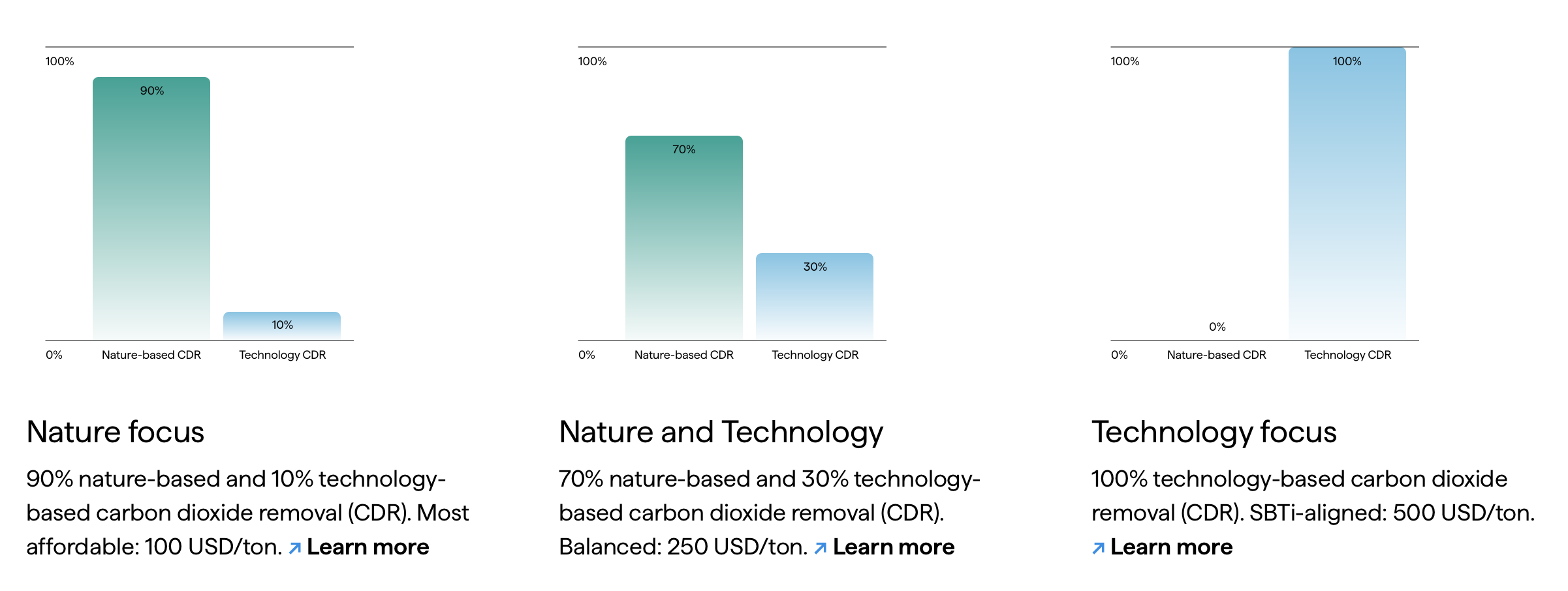
The root problem is that the base price per forest carbon credit is currently far too low; it's two orders of magnitude off! For example, Climeworks is a company that does direct air capture by sucking CO2 out of the air and sticking it into the ground in Iceland. They charge $500/ton for this service. Meanwhile REDD+ credits for forests sit at around $5-$15/ton! Even if most of these projects we analysed were inflated tenfold, they're still cheaper at 10x the price/ton even when impermanence is accounted for.
This seems more like a market failure to me rather than a fundamental problem with REDD+, and I believe there is ample room to ensure that projects credit honestly and are paid properly for the extremely difficult work of tropical forest protection.
1 The vital importance of tropical forest protection credits
To explain why the recommendations in our paper are important, let's look at some recent statistics. The World Resources Institute released their annual Forest Pulse report last week. 42% of global tree-cover loss in 2025 was attributable to fire, more than double what it was twenty years ago. While the top-line that tropical primary forest loss is down 36% year-on-year is encouraging, the mix of threats is shifting under our feet much faster than in the past.
Two decades ago, tropical deforestation was overwhelmingly about the agricultural frontier, but today it's more about threats from natural events like wildfires, accelerated by climate change, drought and spillover from human-set burns. The threats in 2026 do not look like the threats back in 2000, and they probably won't look the same in 2040. In other words, the baselines of 'business as usual' into the future constantly shift as the world evolves.
REDD+ began back in 2005 as the UN-backed scheme to direct funds to developing countries to reduce emissions from deforestation and degradation. Typical projects run on multi-decade horizons, so a project designed today must predict what would have happened to its forest over the next thirty years absent the project. That counterfactual forms the baseline against which credits are issued, but only for the additional impact beyond business as usual. It should seem obvious that a baseline locked in decades ago at registration time cannot possibly anticipate the qualitative shift in deforestation drivers decades into the future. Yet that's how the measuring of credits is currently structured.
Our paper explores some of the reasons why this doesn't work well in some detail. We found a lot of selection bias in the control areas used to estimate avoided deforestation. Control areas selected by the projects tended to face higher deforestation pressure than the project area would have on its own. That in turn inflates the counterfactual loss, which inflates the credits issued.
We found that many REDD+ projects were at far lower risk of deforestation than anticipated by project-led evaluations. Credits were issued based on predictions that these forests were at imminent risk of deforestation, but in reality this risk was often lower.
It's vital that future forest carbon credits accurately represent their benefits for these schemes to be a meaningful solution to deforestation. -- Tom Swinfield, 2026
There's also a lot of methodological flexibility across projects, since they vary their modelling approaches, comparator regions and risk assumptions in ways that (sometimes inadvertently!) all leaned the same direction towards overcrediting. Recent recommendations by the ICVCM push for independent assessors, tighter methodologies and larger scale jurisdictional approaches. Our argument is that these reforms are necessary but not sufficient; they must be paired with ex-post certification against dynamically-updated counterfactuals that can keep up with the changing world.
2 A single baseline cannot last thirty years
Imagine a REDD+ project that was registered in 2012, with a counterfactual fitted to the past decade (2002–2012) of deforestation patterns. Nothing in that statistical model anticipates that by 2025 fire would be responsible for 42% of global tree-cover loss. As frontiers shift and climate change intensifies, a counterfactual that was reasonable at the project start may be wildly wrong by the time the project is halfway through its crediting period.
This is why my colleagues and I have been arguing for years for more dynamic methods that can be analysed credibly with remote sensing for avoided deforestation and forest restoration. Crediting must move from ex-ante (future) predictions to ex-post assessment against dynamic, continuously-updated counterfactuals that reflect the physical reality more closely.
The historical objection has mostly been a practical one: keeping track of all these projects manually would be expensive, and projects need finance upfront to get started. We've written about release schedules and permanence elsewhere which address some of this. But the biggest shift is probably that remote sensing and planetary computing make it economic to figure all this out globally.
3 Remote sensing has caught up
When Srinivasan Keshav and I first started chatting about all this around 2019 and then set up 4C with Andrew Balmford, David Coomes and Thomas Swinfield, evaluating a single REDD+ project at the level of rigour we wanted was a serious undertaking. It took Sadiq Jaffer, Patrick Ferris and Michael Dales months just to work through a single area as we were building all the scaffolding required.
Six years on, the picture is much rosier as we've figured out how to process the imagery from Sentinel-1 and Sentinel-2. In the future, modern geospatial foundation models such as our own TESSERA will continue to collapse months of bespoke feature engineering into extremely cheap inference from map tiles.
Put together, we can now monitor every REDD+ project on the planet against dynamically-updated counterfactuals, and do so transparently: with data and code reproducible by independent third parties. This doesn't eliminate all uncertainty and the data shouldn't be blindly trusted, but it's a big step forward to restoring trust and comparability to carbon markets.
4 The baseline price of forest protection is wrong
We have credible monitoring within reach, and a clear methodological recommendation (ex-post, dynamic, and independent). What we don't have, though, is a price that lets honest and long-lived REDD+ projects thrive.
If most of the projects in our synthesis (which were broadly effective on the ground but issued too many credits) just adjusted their prices per tonne, they would still be very affordable. The PACT analysis we did for Cambridge showed that a high-quality tropical rainforest project in Sierra Leone came in at around £73/tonne even after permanence adjustments while the aforementioned Climeworks cleared £1100/tonne (!). The cheaper forestry project also comes with a legion of biodiversity and livelihood benefits.
Therefore, I believe that if forest carbon credits were paid at rates remotely comparable to permanent removals, the financial pressures that drag methodologies toward inflation would simply disappear. Projects could be financially viable on realistic credit volumes, upfront funding to launch new projects would be much easier to find, and ex-post certification becomes much easier to require when projects aren't fighting an unwinnable race to a bargain-basement floor.
REDD+ projects, on the whole, protected precious old-growth forest that would otherwise have been lost (and interestingly, some areas like Madagascar were particularly effective). I hope our work goes towards constructively shoring up these projects doing good work, and not dismissing carbon finance as 'hot air'.
5 How you can contribute
I'm focusing here on credit quality and whether the tonnes of avoided deforestation a credit represents are real. That's a different question from whether a tonne avoided in a forest should be used to cancel out a tonne emitted elsewhere. I think it almost never should, and have described a "carbon contributions" framing for how we should spend carbon credits. This model is what the University of Cambridge has adopted:
[...] the University has adopted the term ‘Carbon Contribution’ in place of offsetting, and ‘Carbon Contribution Units’ in place of carbon credits. This choice of terminology reflects that our priority remains to minimise our scope 3 emissions at source as much as possible, and is in keeping with the University’s wish to contribute to global efforts to mitigate climate change and biodiversity loss. -- Our approach to offsetting, University of Cambridge, 2025
If you're at Cambridge, you can take advantage of this contribution scheme to compensate for unavoidable international air travel by supporting some great REDD+ projects that we've analysed using the methods described in today's paper. While 4C is coming to a project conclusion at the University, the research carries on through the Canopy PACT spinout charity. As ever, all errors in this article are mine alone, and I'd love to hear your thoughts.
Find the paper here. As a random aside, Nature has now published a transparent peer review file, which was particularly intense for this paper: there were 111 pages of reviewer comments and responses. A huge thank you to the reviewers for their diligence and constructive arguments.