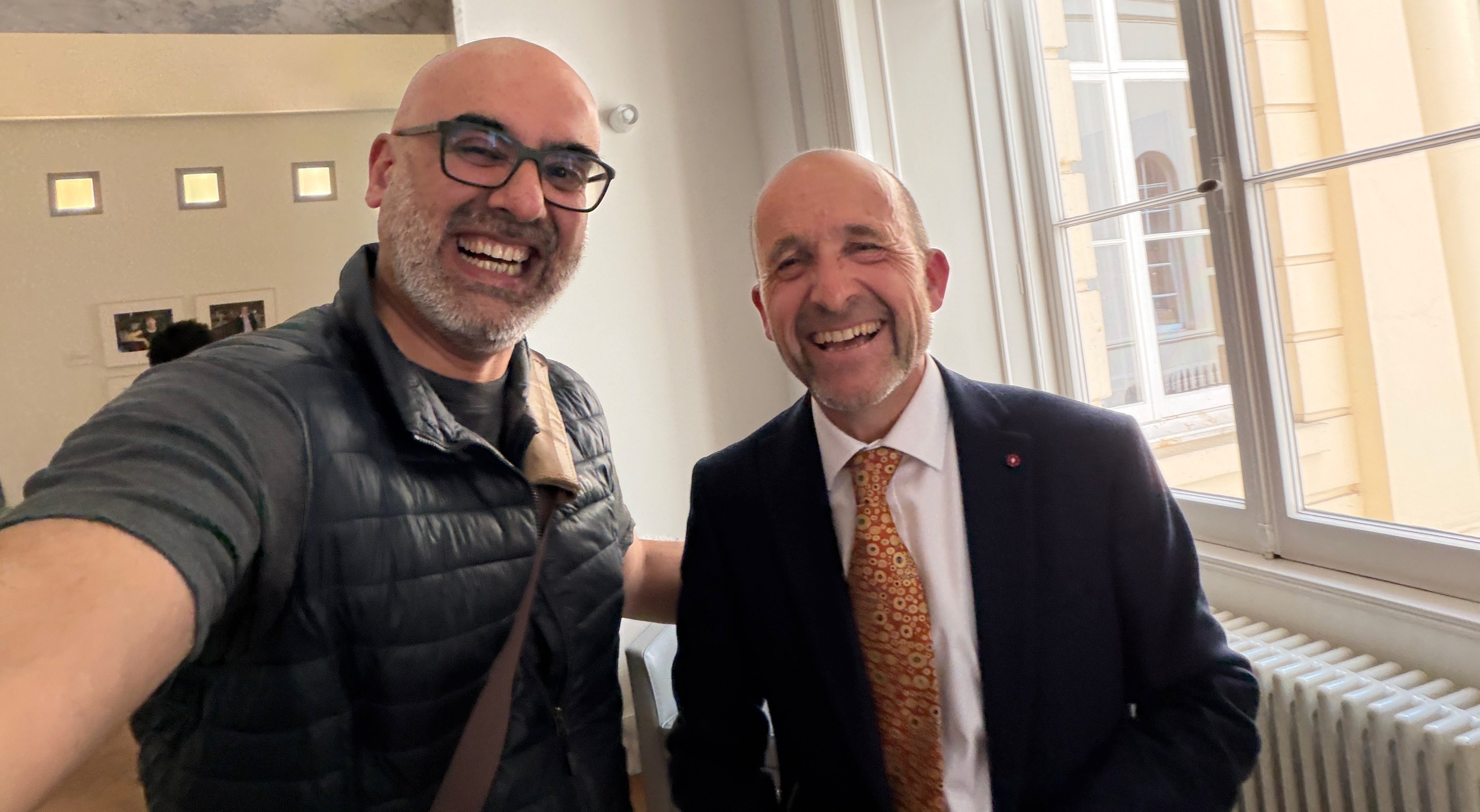
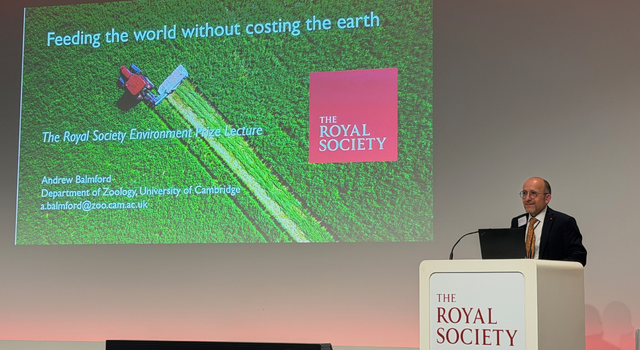
I popped down to Carlton House Terrace yesterday evening for the inaugural Royal Society Environment Prize lecture, where the Environment Medal was awarded to Andrew Balmford for his contributions to conservation science. Andrew gave a tour de force lecture on "Feeding the world without costing the earth".
I've never worked with anyone who can turn data graphs into stories nearly as well as Andrew! His talk is up on YouTube along with the Q&A afterwards, and below are my own (rough) notes and references. Any mistakes are my own!
1 The argument around agriculture supply and demand
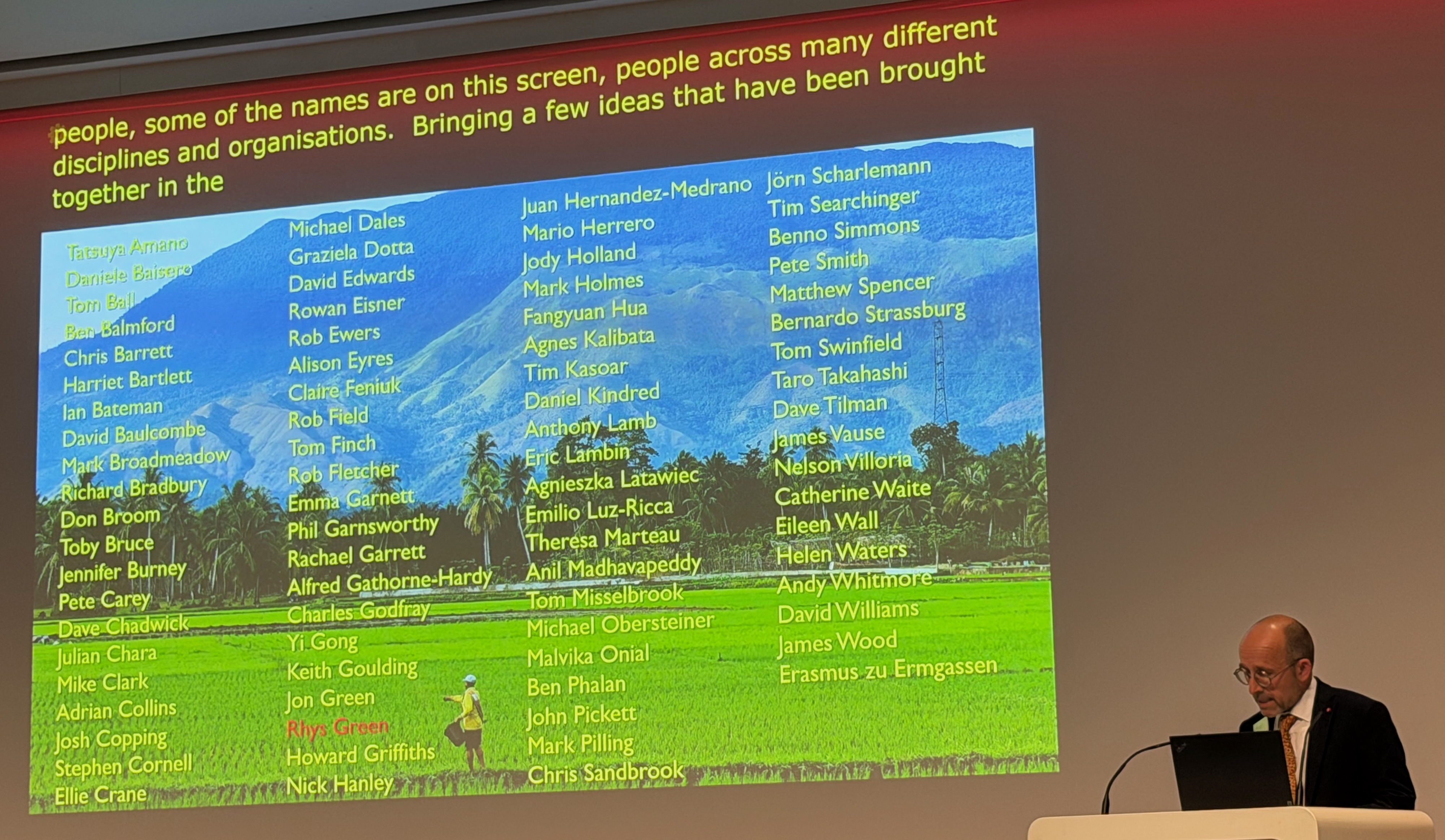
Andrew works with a worldwide set of collaborators; I had a thrill at spotting my name in there! His framing question is "how do we meet humanity's need for resources at the least cost to other species?". We need timber, fish and buildings, and of course food, which is what he chose to focus on since that is where the conflict with biodiversity is sharpest.
His argument came in four parts: the importance of agriculture, demand and waste solutions, potential supply chain solutions, and real world implementation challenges. A recurring theme was that much of the received wisdom that we hear ("organic is good for the planet", "switch to grass-fed beef", "just cut food waste and meat and we'll be fine", etc) all fall apart on contact with the evidence. We learnt that the Royal Society's motto "Nullius in Verba" (take no one's word for it) applies here as well, so Andrew has a bunch of graphs to show us!
2 The extraordinary achievement, and cost, of farming
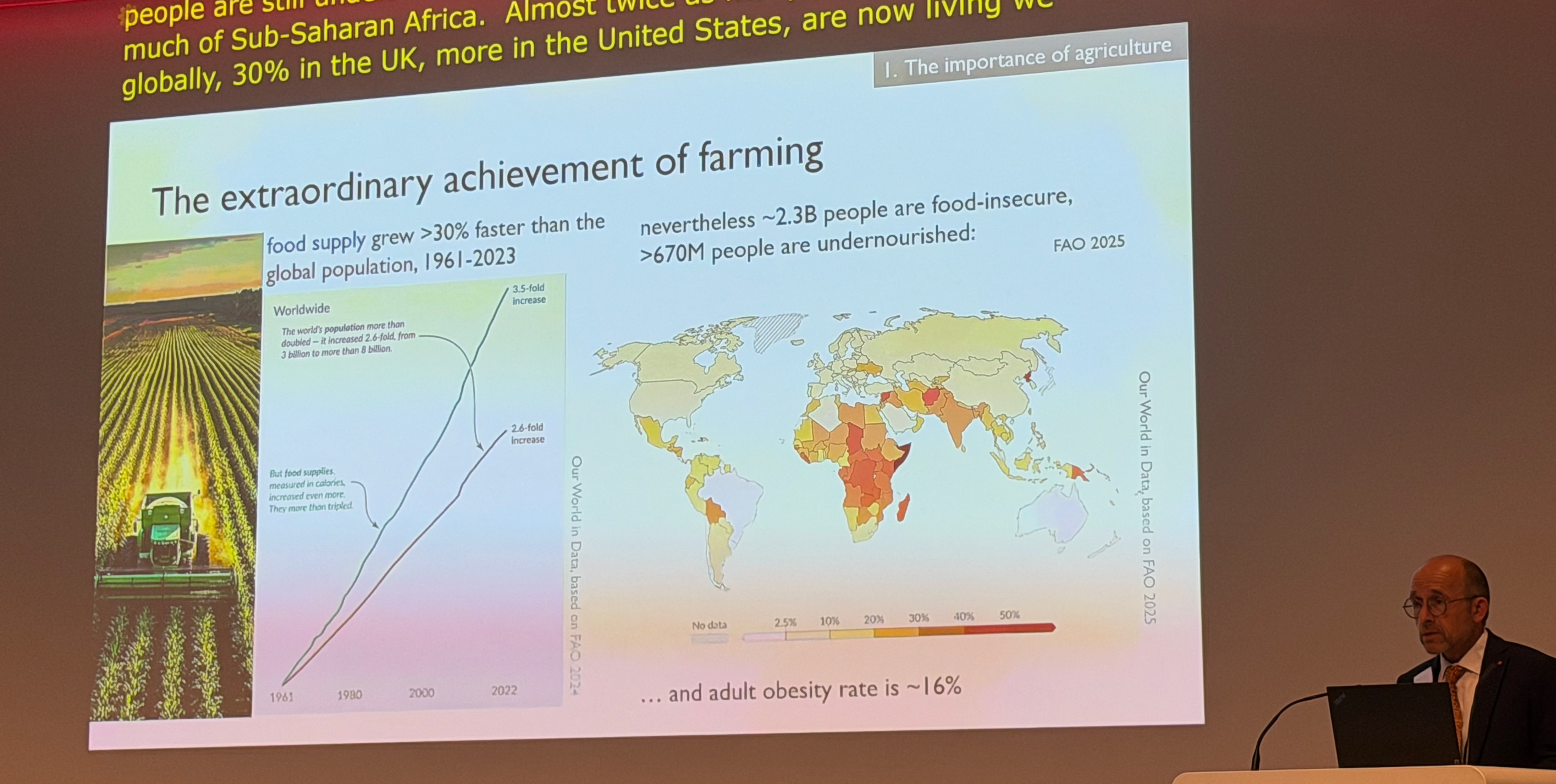
Andrew gave modern agriculture its due. Between 1961 and 2023, global food supply grew more than 30% faster than the population, and per-capita food production is now higher than at any point in history. This ranks among humanity's greatest achievements. Yet at the same time, ~2.3 billion people remain food insecure, over 670 million are undernourished (per FAO figures), and the adult obesity rate sits around 16%. So our greatest achievement is also our greatest challenge to reduce this inequality.
Unfortunately the cost from agriculture to everything else is brutal. The Living Planet Index 2024 reports a 73% average decline across some 35,000 vertebrate populations between 1970 and 2020, and the IUCN Red List also has similarly grim numbers.
This is a rate of extinction not seen since the event that did the (non-avian) dinosaurs in 65 million years ago. Habitat loss to farming (clearance and intensification) now is a danger to 73% of threatened birds, and this ranks ahead even of invasive species. On mid-range projections a few years out, an analysis by Dave Tilman and Yi Gong showed the cropland footprint is set to expand in most countries through to 2075. This sits on top of Tilman's earlier global food demand projections which framed sustainable intensification as the central response. Williams et al. have since gone further and mapped where this expansion is likely to hit hardest, so that conservation can get ahead of it rather than chase it.
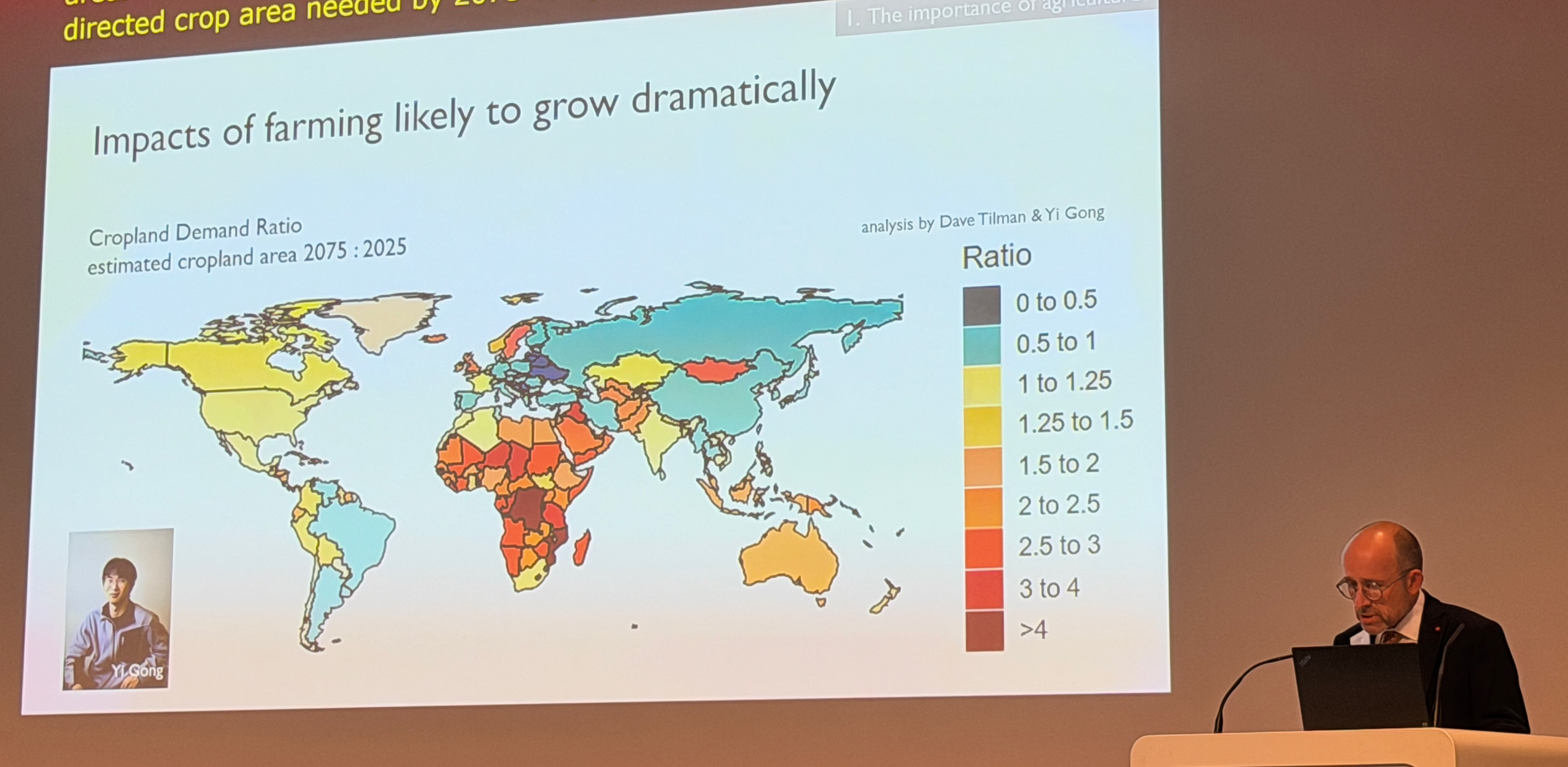
So the first part of his lecture showed that global biodiversity is in deep trouble, and the challenge of meeting human food demand remains the pre-eminent threat to it. Charles Godfray is quoted: if we fail on food we fail on everything.
3 Demand and food waste management is necessary but not sufficient
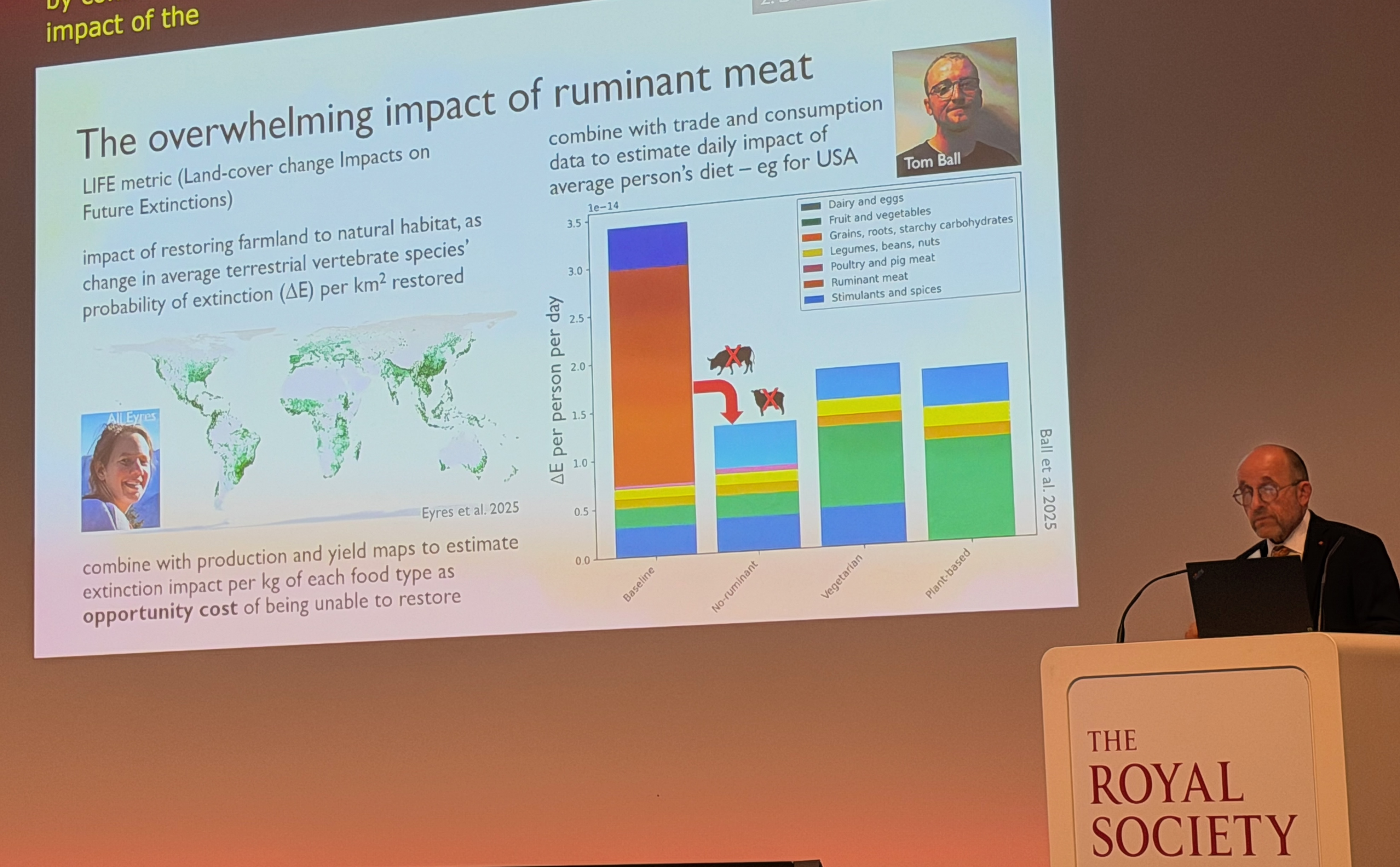
So what can we do to stop this decline? Andrew turned first to the demand side, and showed our LIFE metric. LIFE estimates the change in average terrestrial vertebrate species' probability of extinction per km² of farmland restored to natural habitat, which lets you put an extinction "opportunity cost" on each kilogram of food that we produce (intuitively, the food has to come from some use of land that would otherwise support wildlife).
Once we combine this opportunity cost with food supply chain data, we see that the average diet and ruminant meat dominates the biodiversity costs by a huge margin. Our food-impacts paper showed the extinction costs for choosing where to get a food type from can vary by three orders of magnitude between foods.
Andrew noted that while in some parts of the world meat is a vital protein source, in richer areas there's much more headroom to shift consumption towards more sustainable sources.
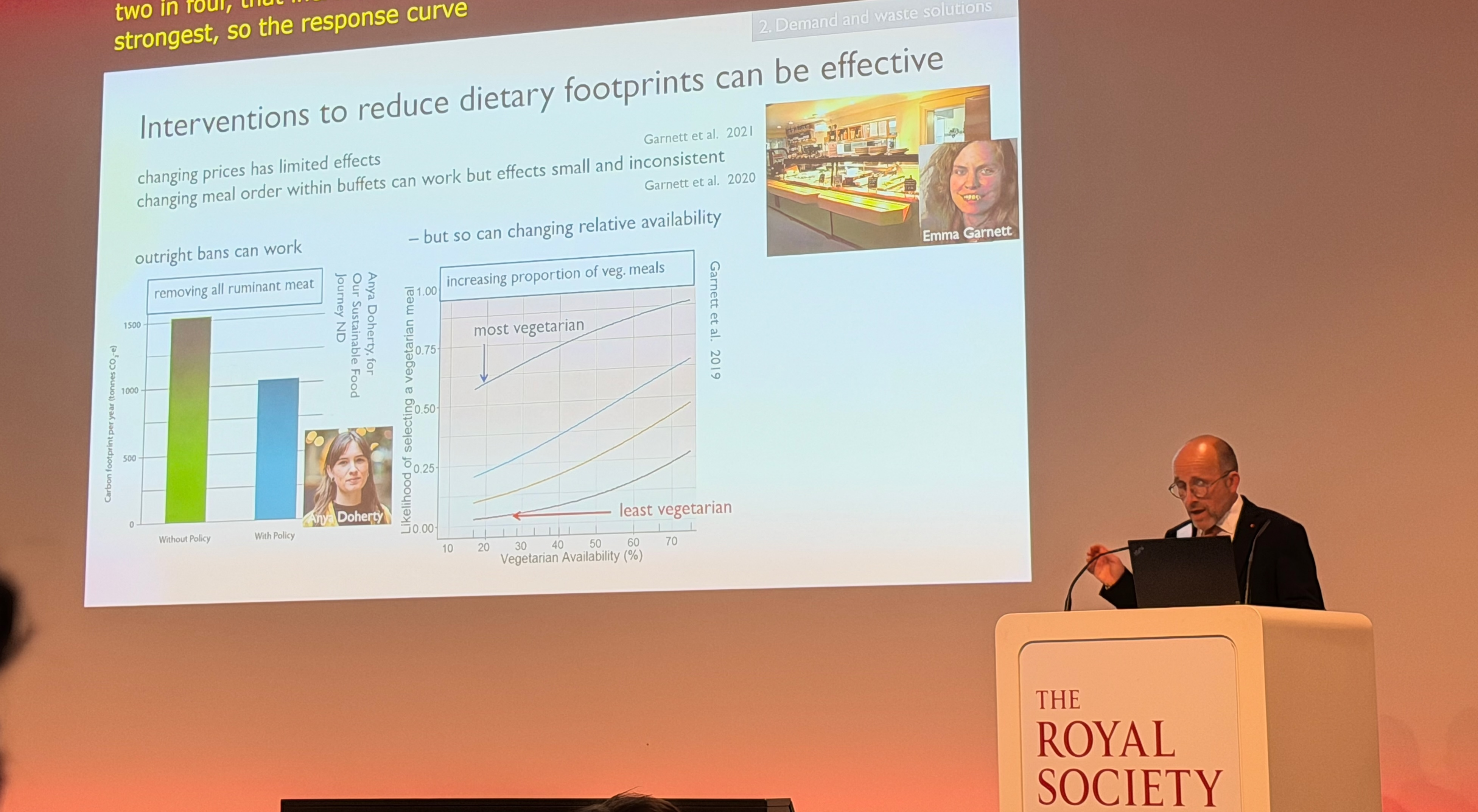
So what interventions work to change food consumption behaviours? Tweaking prices has limited effect; reordering the items in a buffet helps but inconsistently. What works well is changing relative availability, for example going from one-in-four to two-in-four vegetarian options at a buffet lifted uptake substantially. I wrote about this a few years ago in my Cambridge Green Blue musings; see the 'Food consumption and waste' section in that post for more links.
Outright bans work too, but so do partial replacements. Sadiq Khan's restriction on junk-food advertising across the London transport network (see Yau et al. 2022) cut purchased calories by around 7%, and Amsterdam went further by banning meat adverts in public spaces last month.
Some uses of land for crops are basically terrible. Switching aviation to crop-derived fuel would need something like 1.6× more maize than the entire planet can grow, and biofuel demand has already pushed cereal prices up 20–30% in some of the poorest places in the world. Feeding crops to cars isn't a great use of land from a biodiversity perspective!
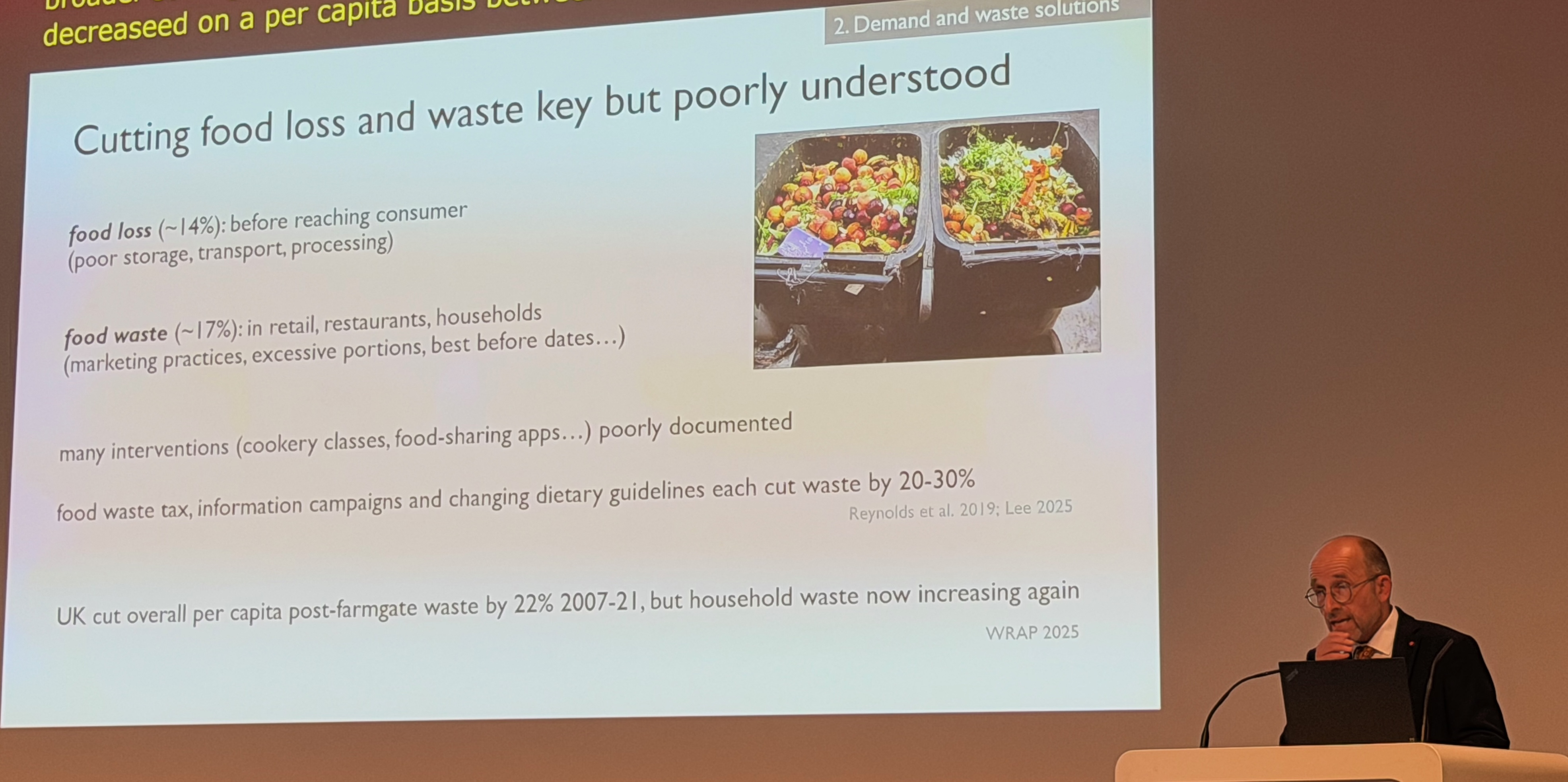
Cutting food loss (~14%, before the consumer) and food waste (~17%, at retail and in the home) would genuinely help. The UK cut per-capita post-farmgate waste by 22% between 2007 and 2021, although household waste is creeping back up since the pandemic (for some reason: I need to find a reference for this).
4 Supply-side: land sparing versus land sharing
However, even with the ambitious diet changes and food waste reduction, the models still show cropland expanding across the world and decimating wildlife habitats! Demand-side measures are necessary but nowhere near sufficient.
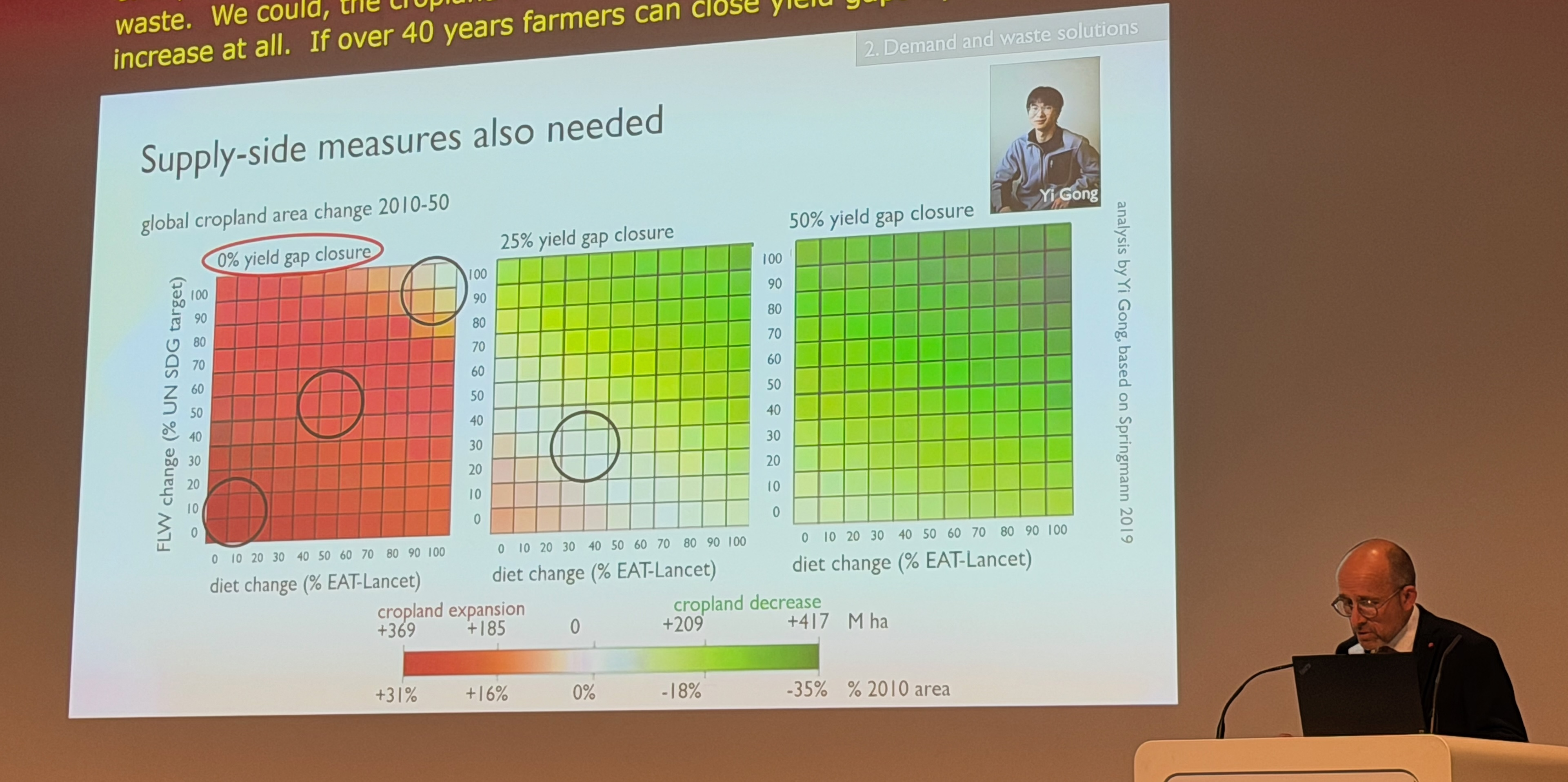
The graphs above show that if we maintain current farming yields, global cropland expansion will just continue unabated (this is bad for wildlife).
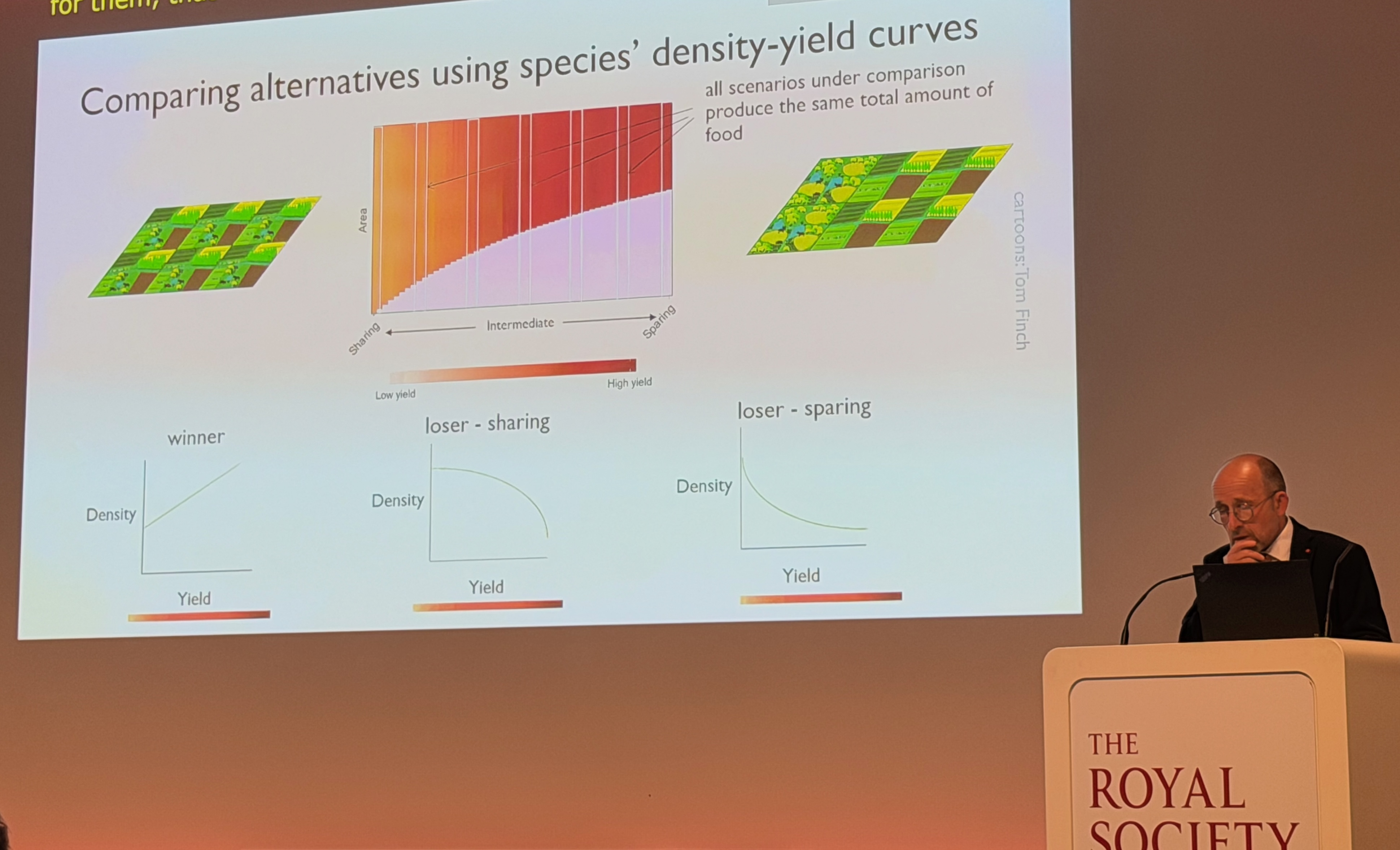
This brought Andrew to the argument he's most associated with: land sparing and sharing, the framing he and colleagues laid out in their foundational 2011 Science paper. If diet and waste alone won't protect wild land, we need to look at how landscapes are affected by farming. This presents a choice between land sharing (wildlife-friendly, lower-yield farming spread across the whole landscape) and land sparing (sustainably higher yields on less land, freeing the rest for intact habitat).
It's important to ensure that we compare land use methods that are matched for total production, using each species' density–yield curve to determine the impact of land use conversion on that species. Some species are "winners" in that they do fine under any farming, but others are the "losers" whose density collapses on farmland and which depend on intact habitat to persist at all. For them, land sparing wins big since it has more intact habitat.
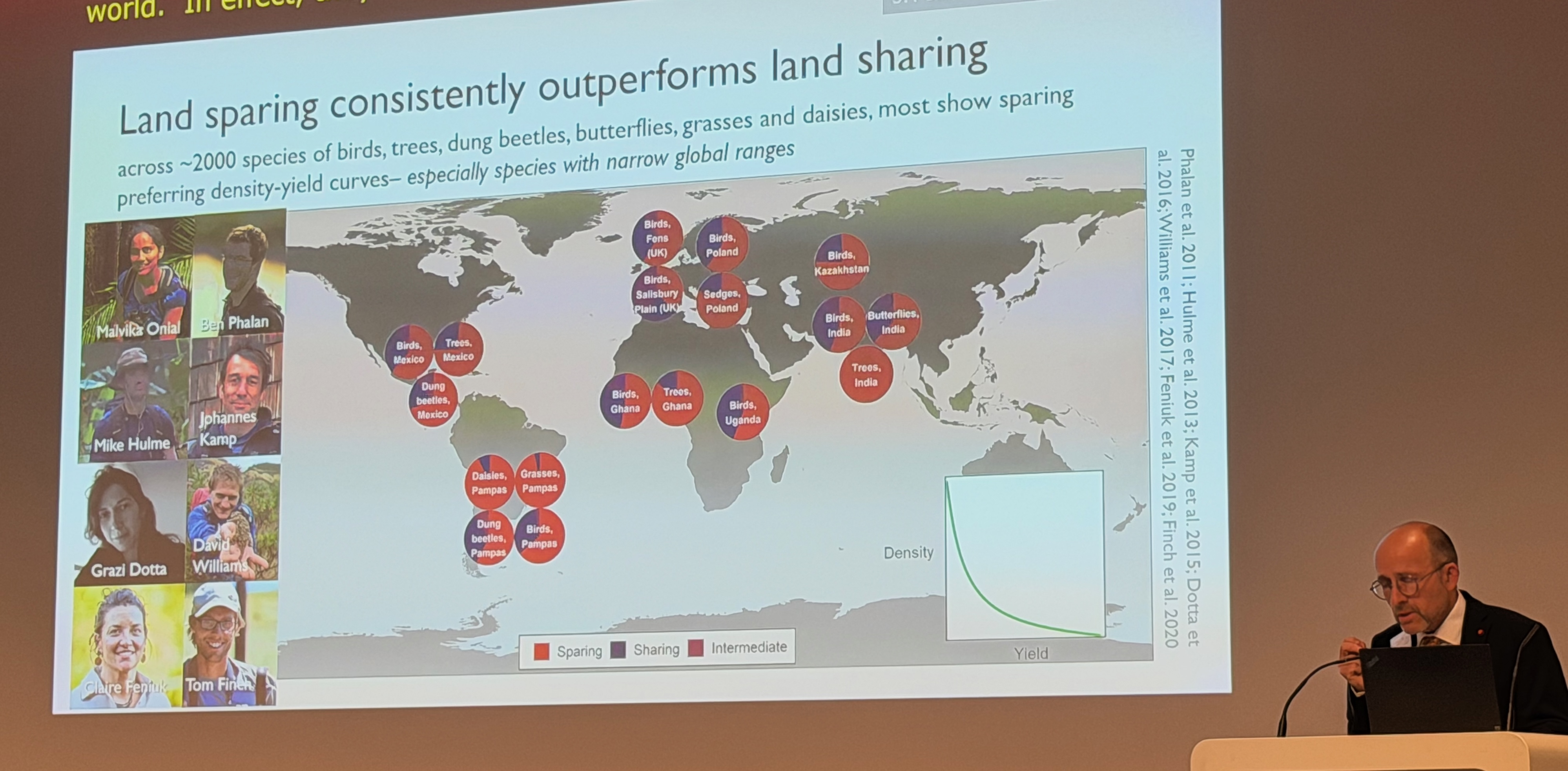
The empirical base of fieldwork was something I hadn't seen before. It's something like 50 person-years of fieldwork across remote parts of the world, going out and surveying thousands of species of birds, trees, dung beetles, butterflies, grasses and daisies!
Most show sparing-preferring density–yield curves, especially species with narrow global ranges. This is something for Shane Weisz and Michael Dales to look at in the RED dashboard; I hadn't considered tagging the AoHs by their habitat sensitivity.
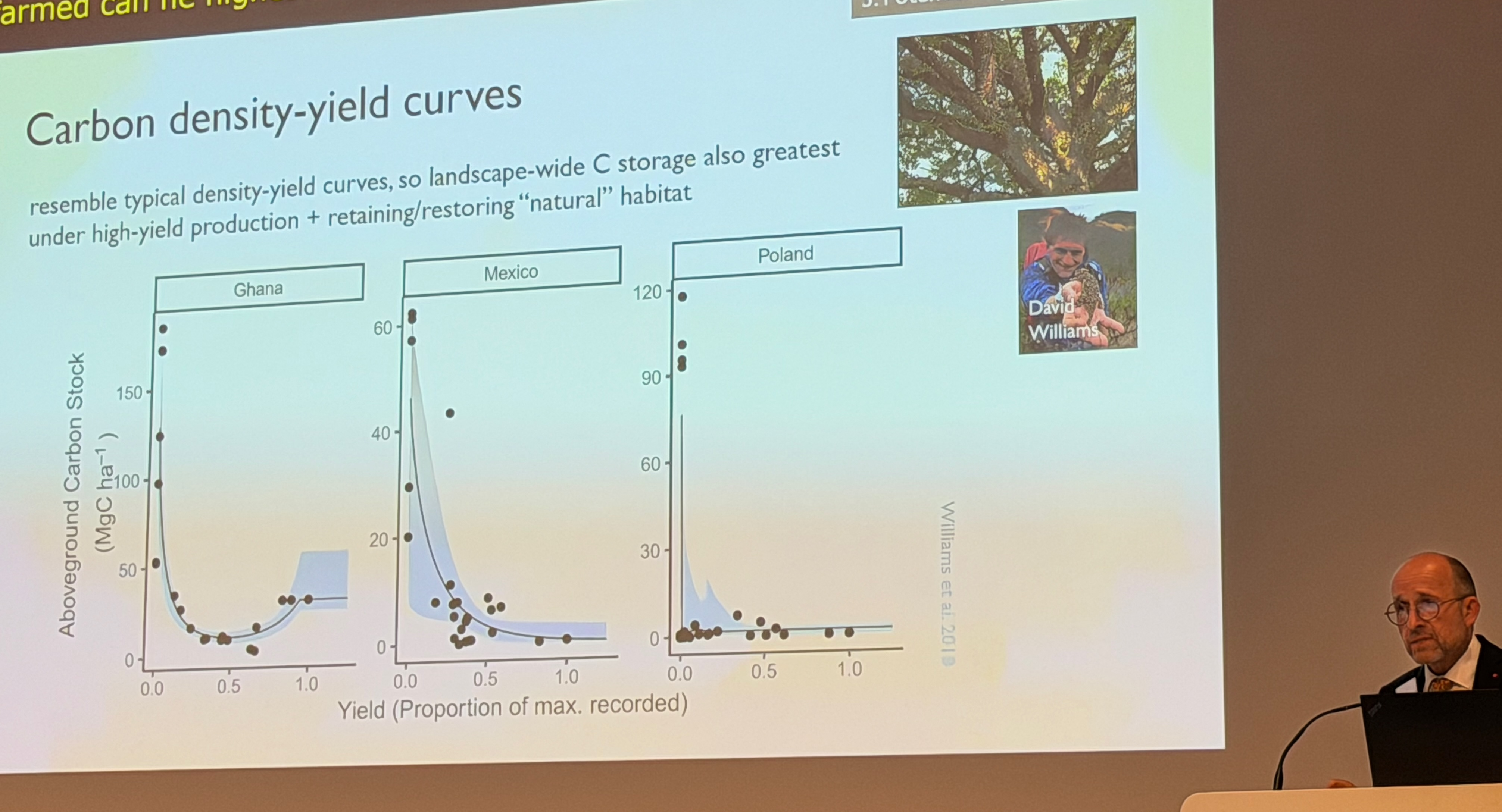
Interestingly, aboveground carbon density–yield curves look much like the biodiversity ones, which suggests a correlation between a healthy ecosystem and its carbon sequestration potential. Landscape-wide carbon storage is greatest under high-yield production plus retained habitat. That's good news at least!
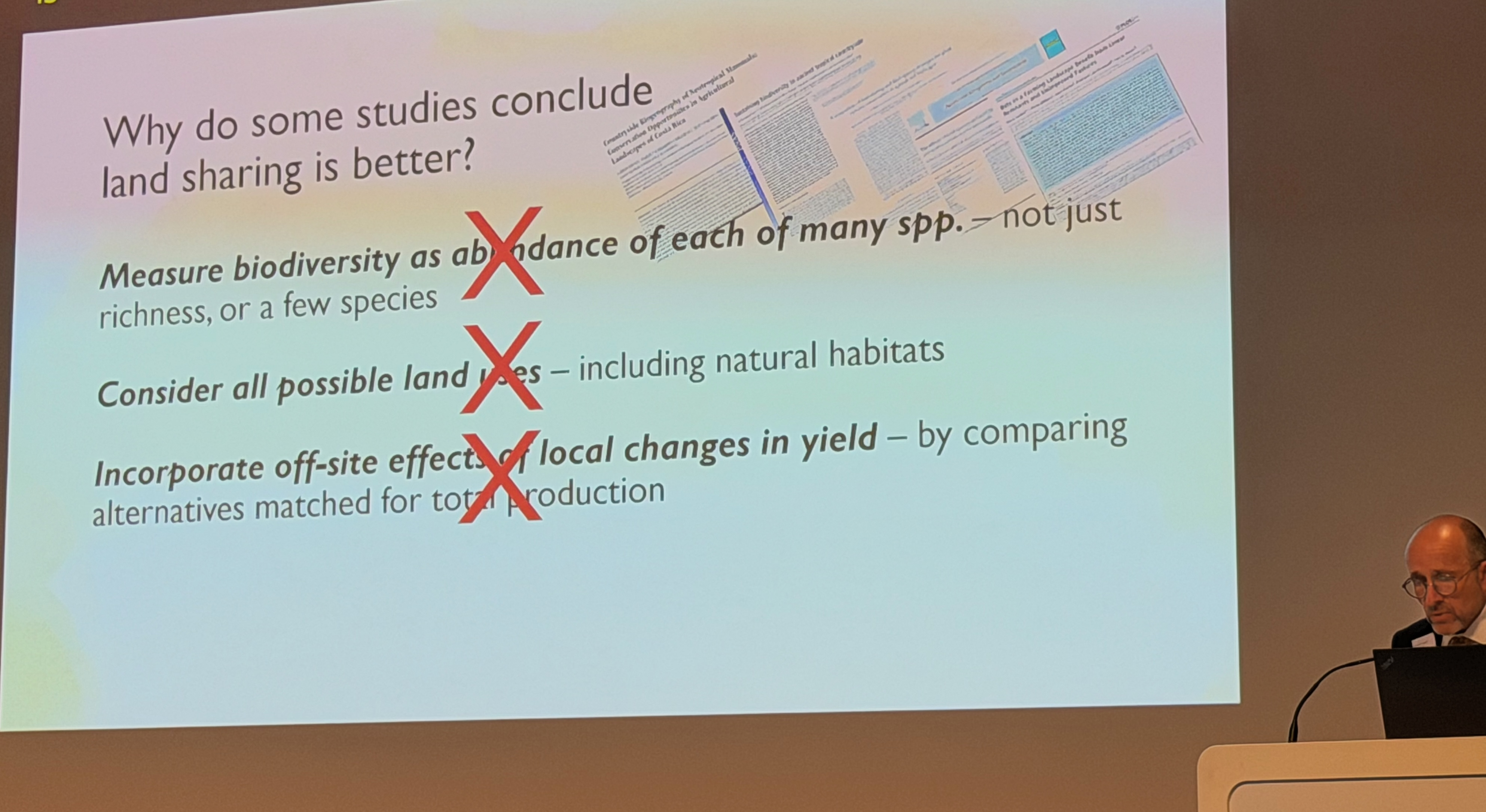
So why do some studies conclude the opposite inference that land sharing is in fact better? Andrew's argument was that these other methods tend to account for landuse incorrectly:
- measure biodiversity as richness or a handful of species rather than abundance of many diverse ones
- ignore intact natural habitat as a baseline
- overlook off-site effects such as biodiversity leakage.
Leakage emerges from the displacement of lost production to elsewhere (which often results in landuse fragmentation from a habitat perspective). Leakage is something we've been quantifying for forest restoration, and it matters enormously since demand for the displaced production won't magically reduce.
For example, Sri Lanka's nationwide fertiliser and pesticide ban of 2021–22 cratered domestic food production, eventually bankrupted the government, resulted in hardship for millions, and is a cautionary tale on reducing yields without planning for displacement.
5 Implementation of sustainable high yields and ensuring land is spared
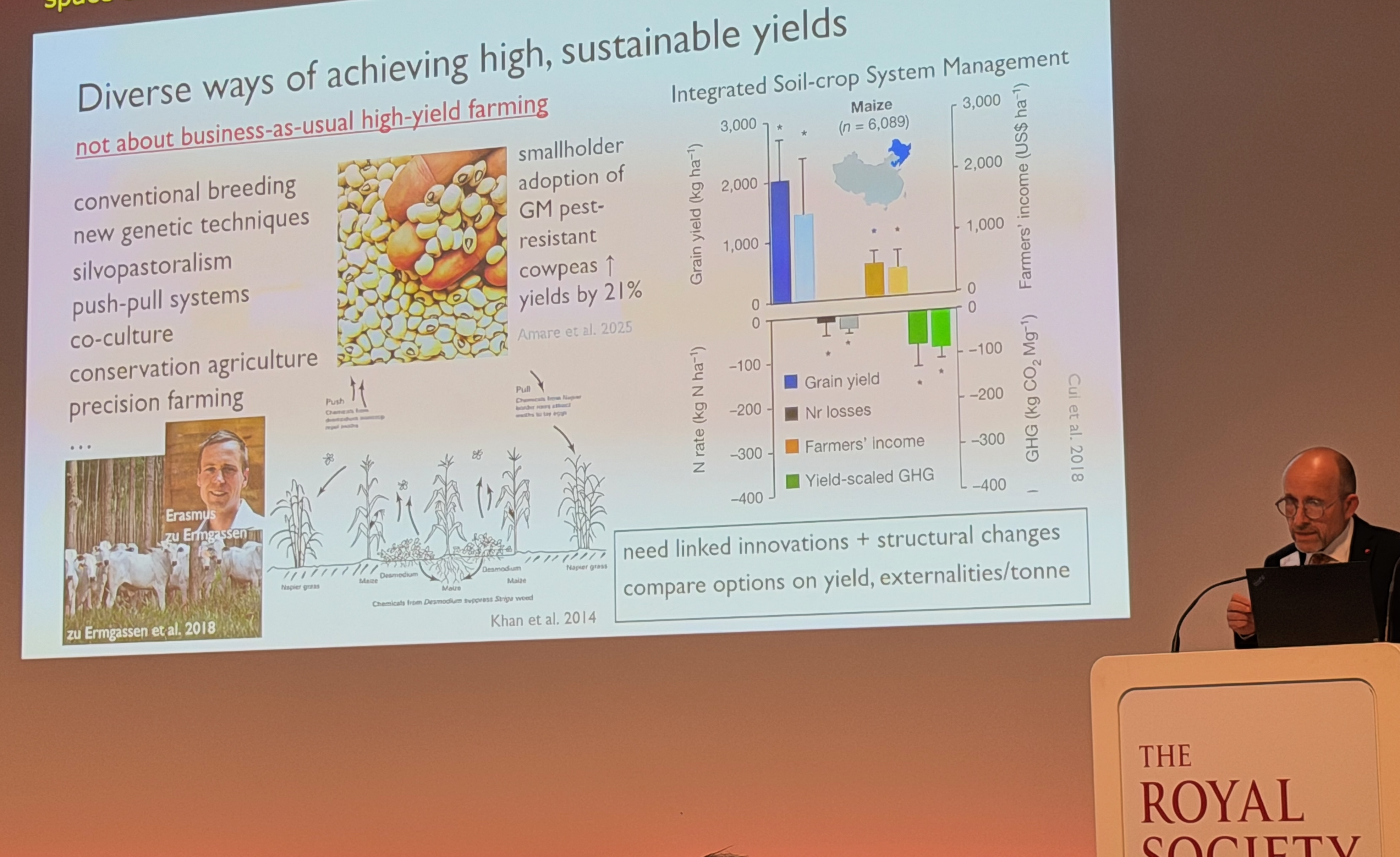
We've learnt that wildlife-friendly farming methods that result in lower yields risk making things worse via leakage. The goal therefore has to be sustainable ways of raising yields in existing farms; not necessarily business-as-usual intensification with high emissions.
Andrew noted that he's got no ideological priors about what these intensification methods should be, and instead we should find the best-of-breed techniques and assess them on the basis of their impact and evidence base. E.g.:
- conventional and genetic breeding (GM cowpeas resistant to pod-borer moths lifted yields 21%)
- silvopastoralism, e.g. the East African push–pull system that cuts maize losses to stem-borers
- co-culture, and precision farming.
A programme working with some 20 million Chinese smallholders delivered large yield gains through targeted agronomic advice (see Cui et al. 2018). The underlying task here of computing options on yield versus externalities per tonne seems like a fun computer science problem too, and one that fits naturally into the 4C and planetary computing pipelines we've been developing for forest carbon. Also the farming data from China is pretty stunning in the scale of their study; I wonder if there's similar info available for Indian farming as this was discussed during the Delhi AI summit as well.
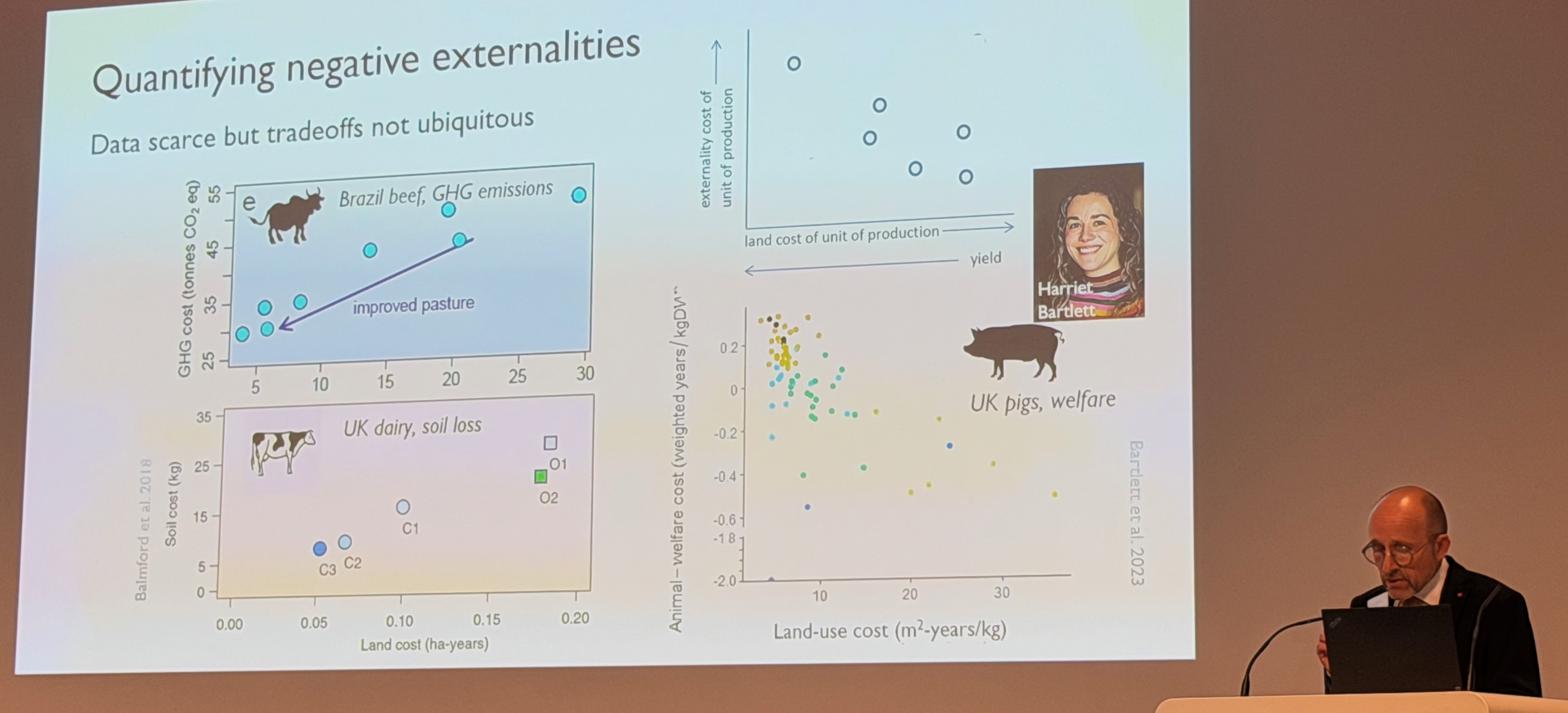
Quantifying damage as 'land cost per tonne' is often counterintuitive. For Brazilian beef, the land-efficient systems also score better on animal welfare and emissions; for UK dairy, land-efficient systems do less soil-loss damage than organic.
A study of UK pig systems finds trade-offs are real but not ubiquitous:
Generally, systems with low land use have low greenhouse gas emissions but high antimicrobial use and poor animal welfare, and vice versa. Some individual systems performed well in all domains but were not exclusive to any particular type of farming system. Our findings suggest that trade-offs may be avoidable if mitigation focuses on lowering impacts within system types rather than simply changing types of farming. -- Trade-offs in the externalities of pig production are not inevitable, Bartlett et al, 2024
I got the message that organic farming is almost always worse for the environment, once you account for the land it uses. Is "Big soil" organic lobbying the "big oil" of biodiversity? (my words, not Andrew's!)
But high yields alone don't spare land. With some intervention you just get price rebound, where lower prices raise demand and land conversion continues. We need incentives or regulation to explicitly link yield gains to habitat retention: eco-certification, credit access, subsidies, and strategically targeted investment in roads that'll result in yield increases without shifting where the farming happens.
Phalan et al. (2014) lay out the policy mechanisms that need to be in place for higher yields to actually translate into spared land rather than just more conversion:
Brazil provides an example of how multiple policy interventions can work together. Natural habitats are conserved through several instruments including protected areas, indigenous reserves, and Forest Code requirements on private lands. Government-subsidized loans are provided to farmers to increase productivity on degraded pastureland. Partly due to these initiatives, and despite widespread noncompliance with the Forest Code, deforestation in the Brazilian Amazon declined steeply after 2004, whereas agricultural production continued to grow. -- How can higher-yield farming help to spare nature?, Science, 2016
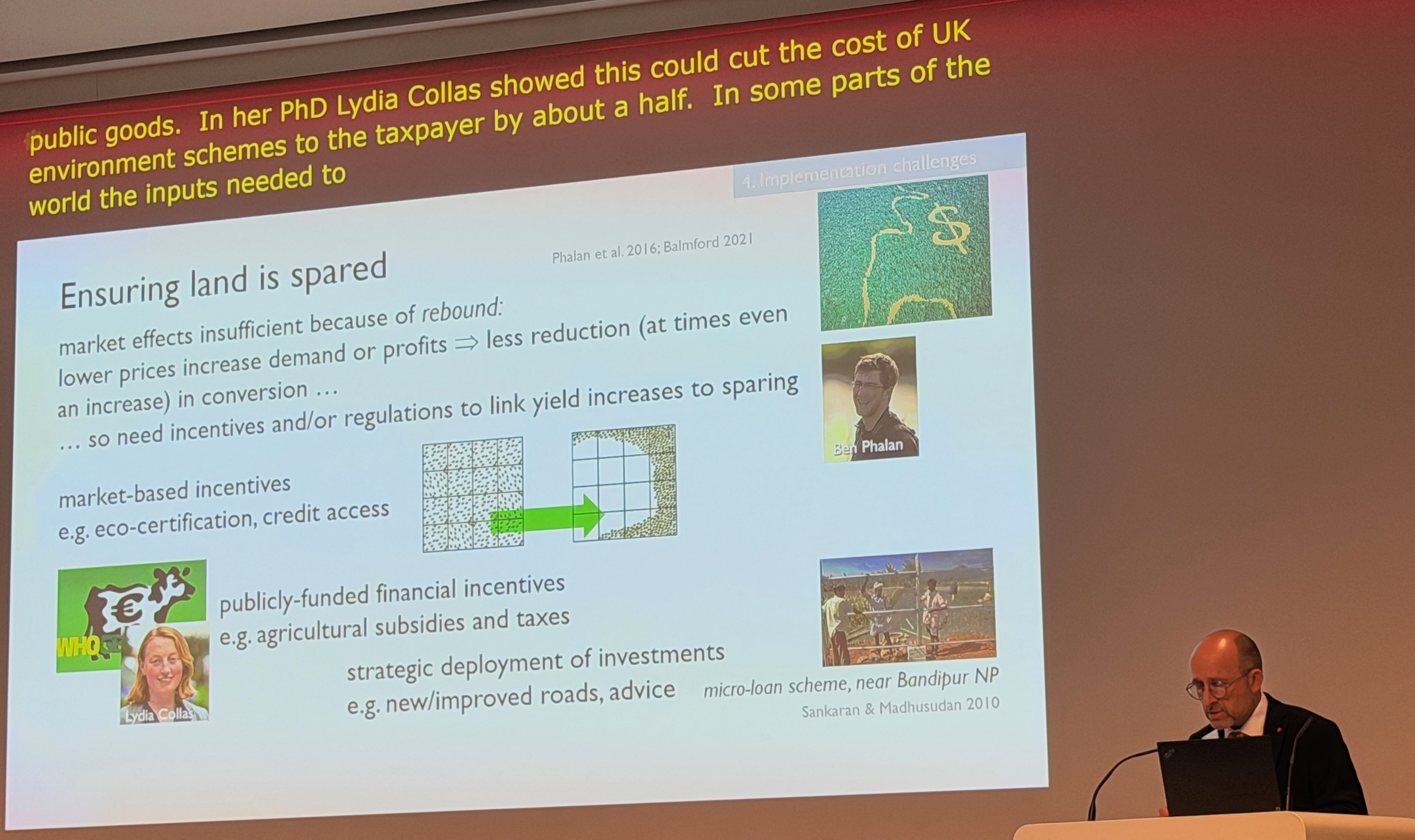
Lydia Collas's PhD showed this kind of design could roughly halve the cost of UK environment schemes to the taxpayer:
I found overwhelming evidence for UK arable farming that land sparing can deliver biodiversity and carbon outcomes at substantially lower cost than land sharing both in terms of taxpayer costs and lost food production. The relative costs of sharing would increase even more with consideration of species that do not tolerate farmland, in a country with a shorter history of agriculture where fewer habitat specialists have gone extinct compared the UK, and if the production required elsewhere to compensate greater volume of food production lost under sharing was taken into account.
[...] I have provided robust evidence that sparing is a much cheaper approach to delivering biodiversity conservation and reducing carbon emissions in the UK. -- A comparison of the costs of delivering conservation through land sharing and land sparing, PhD, 2022
6 The take-home messages for biodiversity
Andrew's closing slide distilled the takehome messages:
- Biodiversity is in deep trouble, and the mundane challenge of meeting human food demand remains the pre-eminent threat.
- Shifting diets, cutting crop-based biofuels and tackling food loss and waste are essential but insufficient: we also have to address farm yields.
- Where wildlife-friendly methods lower yields they risk making things worse; we need sustainable ways of raising yields instead.
- Slowing biodiversity loss will hinge in large part on promoting and regulating sustainable high-yield farming, and linking it explicitly to habitat conservation.
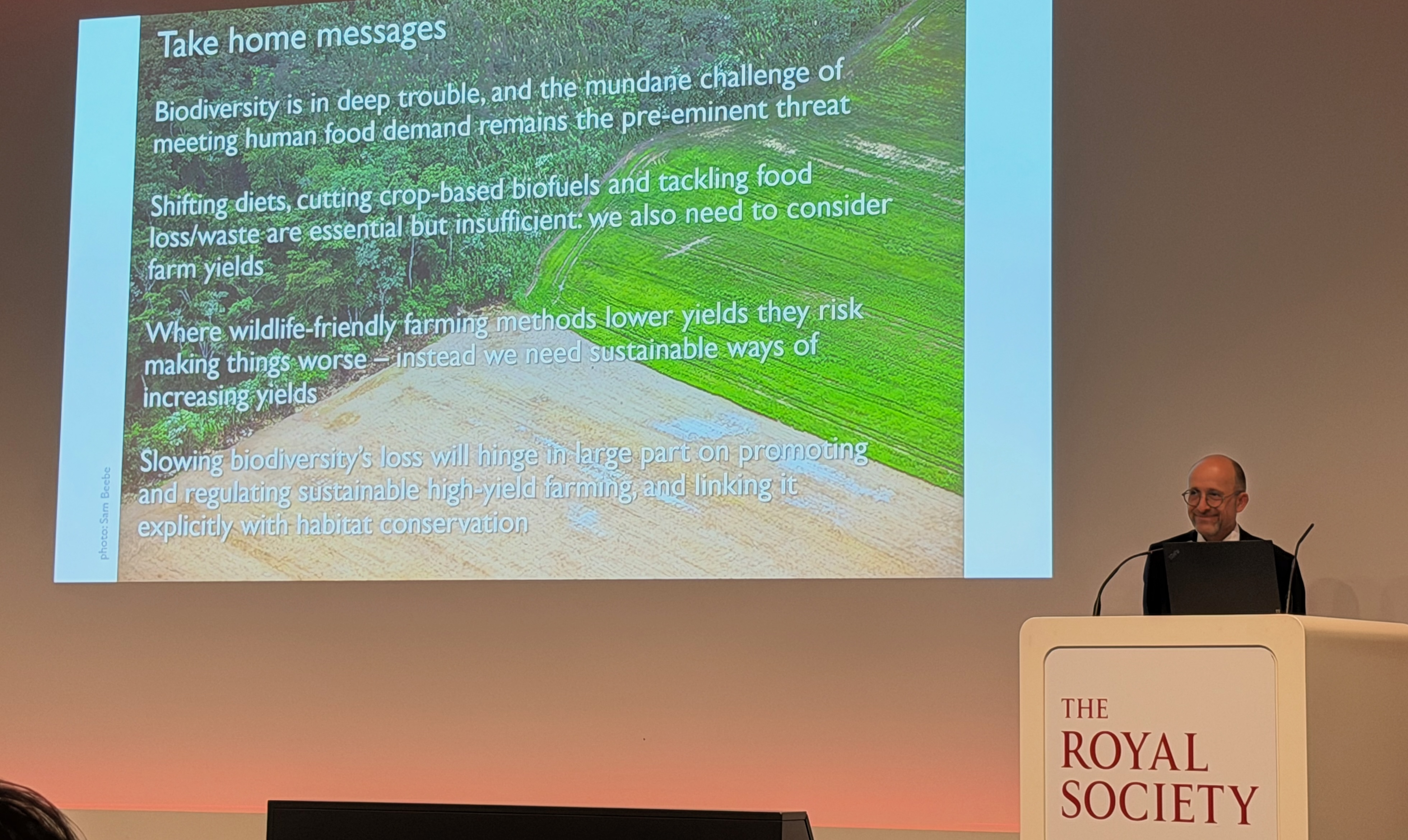
Watching Andrew pull together disparate papers I've worked on (like LIFE and FOOD) into this compelling data-driven narrative for how to balance the world's food needs against nature's needs was thoroughly energizing. Congratulations Andrew on an incredibly well deserved inaugural environmental prize medal!
7 Other chats
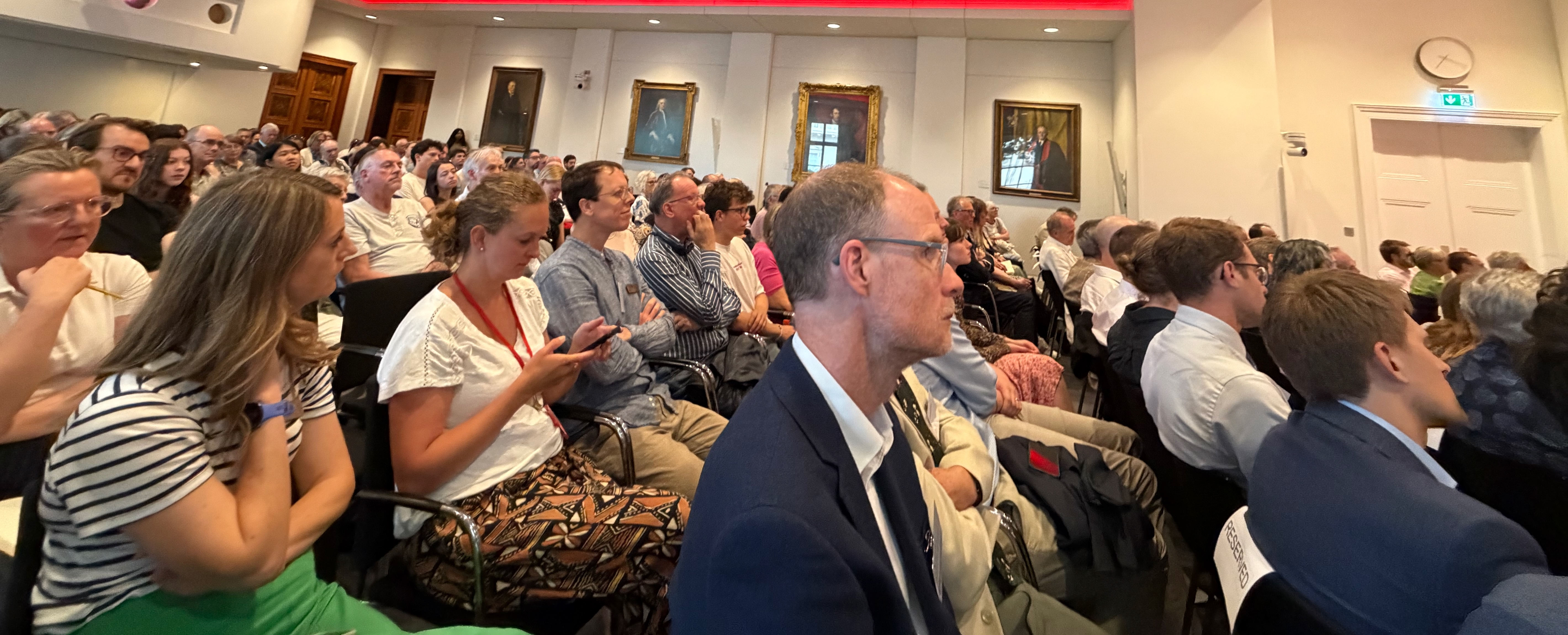
It was a sold out house of friends, colleagues and the general public. At the reception after, I had a bunch of fun conversations about:
- Jonny Hazel introduced me to Sheila Rowan (who hosted the event and awarded Andrew the medal) and she mentioned a paper on how they measured the Earth tides with a MEMS gravimeter, which makes me wonder if we can feed this into Tessera as a weather modeling input!
- Met Andrew's delightful childhood friend Alastair Poole from Bristol who explained to me his work on platelets in the body.
- Caught up with Chris Sandbrook about the social implications of the 30x30 global conservation targets and if we could apply Tessera to it, along with a primer on spatial modeling from Rob Fletcher about his book on the topic which I've ordered a copy of from the library!
- Met Liqing Peng from Hong Kong who told me about her work on the carbon costs of global wood harvests. They have a new carbon harvest model (CHARM), which counts the effect of wood harvests on changes in atmospheric carbon over time as carbon shifts among different storage "pools" such as live vegetation, roots, slash, different wood products and landfills. This immediately made me wonder if we could calculate the effective permanence of wood trade as we did for REDD+ in our recent paper. Also need to investigate the quality of data from the Sustainable Timber Information Exchange, as well as learn about the use of timber in construction to get a better view on the lifecycle involved.
- Also met Matt Betts from Oregon who pointed me to his paper "Forest degradation drives widespread avian habitat and population declines". I learnt that 80% of terrestrial species have forest associated habitat (!) and how sensitive birds are in particular to habitat integrity. And just to complete the massive reading list in front of me, Rob Fletcher also has a new paper out today on "Landscape quality drives ecological responses to habitat loss and fragmentation" which covers the connectivity end of habitat. I'm interested in trying to join the dots here using Tessera at some point; need to talk to Michael Dales about it!