
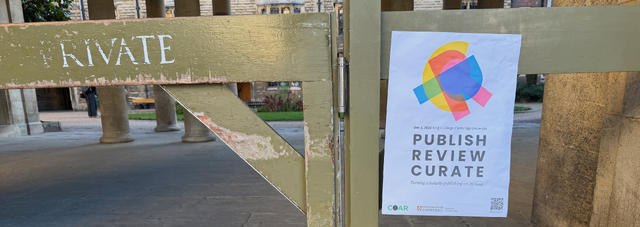
I was not expecting to find a bunch of activist librarians at the lovely spires of King's College Chapel last week, but I was very glad that I did! I gave a talk to the Confederation of Open Access Repositories group that was having a meeting about "Turning scholarly publishing on its head". Luckily, I had my budding Four Ps for Collective Intelligence fresh on my brain, so I discussed it with the assembled librarians. The crowd was a really interesting mix of the open research team at Cambridge, their French equivalents in CNRS, academic researchers like myself and Albert Cardona interested in non-traditional outputs, and of course digital librarians from all over the world.
1 What is COAR about?
The conference was held in the lovely King's College Cambridge, and was described as such:
Tired of long delays, expensive fees, and a lack of transparency about editorial decisions when publishing your articles? Join us at King’s College, Cambridge on December 3rd for an in-depth discussion about a better future for scholarly publishing using the Publish, Review, Curate model. -- Confederation of Open Access Repositories, 2025

The first thing I learnt was the Cambridge Open Research team is distinct from the University library. The OR team is responsible for Apollo that is a permanent repository of scholarly publications here (aka the place where I constantly forget to deposit my papers to be REF-eligible).
This is also distinct from Cambridge Open Engage (where I often drop preprints that aren't suitable for arXiv), which is run by Cambridge University Press (another independent entity that's a big contributor to the solvency of the University).
I'm still a bit muddled up about the exact incentives of all these diverse groups, but they all seem to be working together well, so I don't think I need to know too much more than this!

2 Diamond community-lead publishing
Peter-Sutton Long from the OR team gave an excellent overview of the activities of the OR team, and one thing that caught my eye was that there has been an initiative called "Diamond Open Access Journals at Cambridge" which hosts various journals like the Cambridge Journal for Climate Research or the Cambridge Journal for Visual Culture. These are "hyper-local" journals, but obviously very important to nourish to ensure that any local knowledge is kept alive, that might not otherwise make it into hallowed halls of major publishing houses like Springer.

It looks like Diamond/Cam is a relatively new initiative within the University, so I asked the wisest[1] person I know -- Bill Sutherland -- about the relevance of this to his own work on conservation evidence. Bill has run a diamond open access publication called the "Conservation Evidence Journal" since 2004, and has been managing this ever since!
Back when they set it up, the CEJ was one of very few open journals, but nowadays initiatives like the Cambridge OR one should make it significantly easier to manage. Bill also mentioned that it's getting quite expensive to manage the thousands of articles in CEJ, so I doubly hope to connect the Cambridge OR team with the Conservation Evidence team to see if there could be some helpful sharing of digital platforms there.
The CEJ has been a critical source of causal ground truth for our collaboration with CE on evidence pipelines, so it's really really important that the knowledge about what actions on the ground make a difference is widely available and as open as possible.
3 Betting your career future on a journal editor
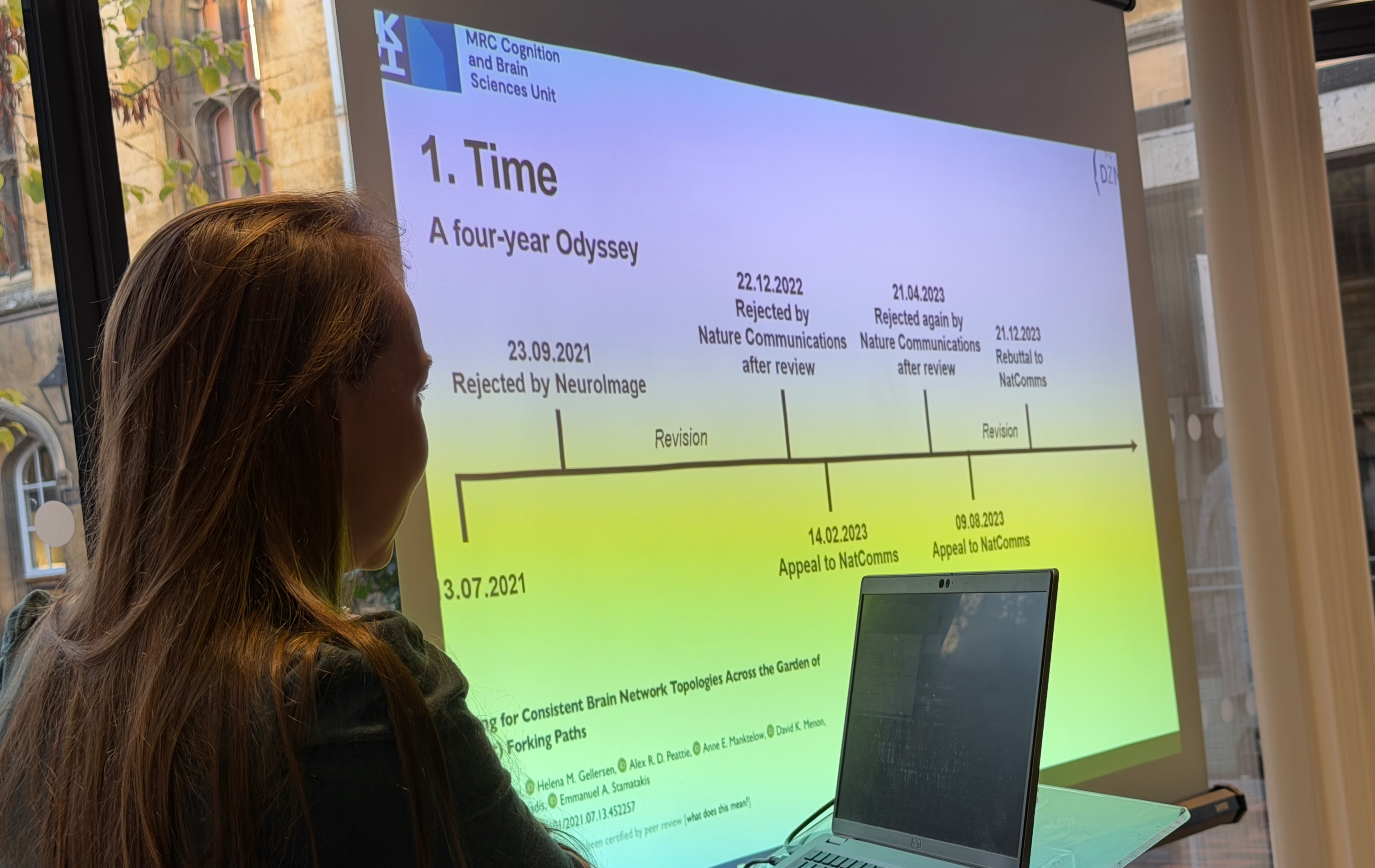
My talk was preceded by the brilliant Helena Gellersen from the Memory Laboratory talking about her own experiences with preprints and open publishing. She had gone through quite an adventure with conventional publishing to get some of her research out, and noted that the length of time it took for an early career research was about the same time a PhD takes here in Cambridge!
Something clearly has to give here, as we also discussed at the Royal Society earlier this year. Stefanie Haustein at that meeting subsequently published this brilliant critique of the dominance of commercial publishers in academia:
The domination of scientific publishing in the Global North by major commercial publishers is harmful to science. We need the most powerful members of the research community, funders, governments and Universities, to lead the drive to re-communalise publishing to serve science not the market. -- The Drain of Scientific Publishing, Nov 2025
The arguments this paper really vibed with what the crowd at the COAR conference was saying: "The drain is four-fold, depriving the research system of Money, Time, Trust and Control". And for early career researchers who have a limited runway in which to get their insights out into the world, there is a critical time gap introduced by editorial decisionmaking gatekeeping peer review.
There are some interesting alternative pathways forming. Just this week, the IJCAI conference is offering a Primary Paper Initiative whereby they charge $100 to submit a paper, but waive the fee for papers in which no author appears on any other paper. All proceeds raised from this will go towards compensating peer reviewers! This is a model that might actually work, especially given the waiver for submitting just one paper.
4 Presenting the four principles
I followed up with my own talk about the 4 principles for collective knowledge networks, which is the first outing of these since I only came up with them a couple of weeks ago. These were some of my takeaways from the discussions that followed:
Firstly, it was amazing to be in a room full of people that care about metadata. Several people commented on how interesting the Rogue Scholar initiative is, so I hope to find a way to get Martin Fenner discussing some his own experiences with topics like subject classification in these COAR forums.
There were some questions about my interest in ATProto instead of ActivityPub. My answer to this is that they will almost certainly converge or be bridged, but the difference is where they start from. ATProto bootstrapped itself centrally via BlueSky and has around 40m users quickly as a result. It is now increasingly supporting alternative implementations and services. This makes it (in my mind) much easier to experiment with protocol evolution without having to update every single endpoint, which is often the case with ActivityPub. That's not to say one is better than the other!
4.1 Towards non-traditional scholarly data
However, I increasingly think that the green fields for open access infrastructure should not be solely focussed on the crowded area of paper publishing, but move to non-traditional scholarly outputs such as datasets, hyperlocal grey literature and code management. These are all areas where my group is spending vast amounts of effort, and is underserved:
- For datasets, publishing the Tessera embeddings involves setting up lots and lots of infrastructure that really ought to be federated. Managing and versioning these openly is much easier if we spread the load; for example the Swiss datacube just republished Swiss embeddings on their own infrastructure, and the Radiant Earth community is also involved. This is geospatial data, but no less valuable as we deploy it around the world, for example with our friends in India working on the CoRE stack for rural resilience.
- For grey literature, the Conservation Evidence Copilots has shown that a huge amount of knowledge isn't "just" available in published form from major publishers, but is also hugely informed by non-English sources. The next step of our CE literature crawl will almost certainly be to the more obscure journals that aren't in the "DOI mainstream".
- For computational pipelines, I found going back to this 2013 paper on Troubling Trends in Scientific Software Use (OA version) to be slightly depressingly unchanged today. We still don't really have a good reputation system for code, and given the giant amount of AI slop being rolled out into codebases worldwide, it's only going to get worse.
So my message to the COAR community after attending their first (and most energising meeting) is to open up to new forms of data mediums, and to craft infrastructure that unlocks learnings from them. I feel that solely going up against the conventional scholarly publishing incumbency is an unnecessary waste of precious energy, as it looks increasingly brittle from a commercial perspective.

4.2 Update 1: MetaROR (2025-12-08)
Minutes after publishing this post, Martin Fenner wrote me with some interesting experiments they've been doing with Rogue Scholar and peer review:
[...] we ran an experiment trying PRC with a blog post together with the MetaROR platform, the result is summarized by Chris Marcum in https://doi.org/10.54900/bymaz-4fw37. And just week we had a demo from CottageLabs regarding their upcoming COAR Notify integration coming to Zenodo and InvenioRDM, and thus Rogue Scholar.
So MetaROR is another way of doing peer review across non-traditional open publishing. So much to look at in 2026!
-
Usefully, also the first person I saw at Espresso Lane this morning.
↩︎︎