
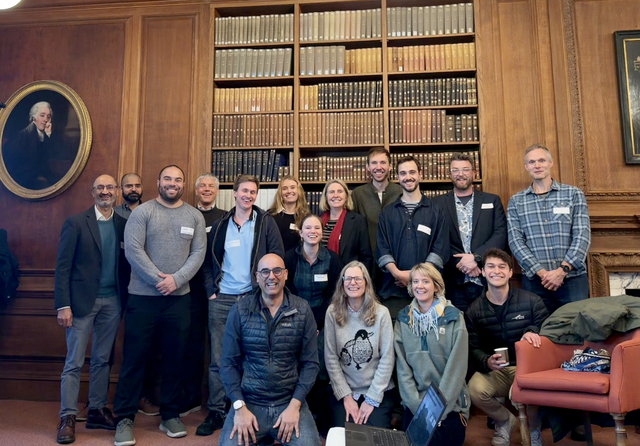
As part of the ARIA Engineering Ecosystem Resilience program, we've been convening a series of workshops here at the Cambridge Conservation Initiative to explore the potential of combining two very radically different approaches to modeling. Joe Millard wrote this to frame the discussion:
Ecology and ecosystems are inherently agent-based. In other words, patterns in biodiversity in both space and time emerge as a function of the local interaction of many types of individual organisms, both with each other and with their abiotic environment.
Generative agent-based models, such as Concordia enable the simulation of multiple interacting large language models. Given LLMs now possess significant ecological knowledge, it is possible that models such as Concordia will enable the meaningful simulation of ecological interactions.
The biotic and abiotic environment in which ecological agents interact in a given ecosystem is likely measurable via remotely monitored earth-observation data. Raw EO data, however, is unwieldy, containing large quantities of information that can be difficult to interpret. Earth-system models, such as TESSERA or AlphaEarth are foundational AI models which compress large quantities of EO data into "embeddings", unambiguous and consistent digital representations of the structure of the Earth’s surface. -- Foundational AI to forecast ecosystem resilience, J. Millard, A. Pili, K. Berthon, R. Fletcher, L. Dicks
We held two separate workshops to explore this; one for a deep-dive into the technical details, and another to invite conservation practitioners to drive our modeling direction in a realistic and positive direction. This was all lead by Lynn Dicks and the stellar organisation of Joe Millard, Katherine Berthon, Arman Pili and Rob Fletcher, with input from me, Srinivasan Keshav and David Coomes. I'll go into each talk next, or you can watch the playlist yourself.
1 The technical workshop
For the technical day, we held it in the lovely Ferguson Nazareth[1] room at Pembroke College, contrasting ancient rows of books with group brainstorms about machine learning for improbably complex simulations!
1.1 TESSERA from the ground up to looking down
We began with Srinivasan Keshav and David Coomes going through TESSERA in some detail, with a particular focus on its use for ecological downstream tasks. Julia P.G. Jones observed that this was the clearest explanation of the utility of TESSERA to a non-machine-learning person that she had heard, and I agree! Do give this a watch if you'd like a gentle intro to geospatial foundation models.
1.2 Concordia: Agent based modelling
Then we switched tacks to something entirely different, with Sasha Vezhnevets and Logan Cross from DeepMind telling us about their approach to generative social simulation:
Concordia is a library to facilitate construction and use of generative agent-based models to simulate interactions of agents in grounded physical, social, or digital space. It makes it easy and flexible to define environments using an interaction pattern borrowed from tabletop role-playing games in which a special agent called the Game Master (GM) is responsible for simulating the environment where player agents interact (like a narrator in an interactive story). -- Concordia on GitHub, 2025
What was fascinating about this is how LLMs just change the game for defining simulations. Instead of having to specify every last thing, the LLMs understand a certain amount of human culture and context by virtue of pre-training, and so can take more nuanced decisions than a discrete simulator. So the "defaults" are intriguingly much more useful for ecological simulations, which are deeply connected and social in nature and extremely difficult to model computationally via brute force methods.
The Concordia source code is all open, so I've started messing around with some local LLM simulations. It's really as easy as specifying some prompts and parallelisation; quite different from conventional agent-based modeling! There was a v2 release this summer and a video tutorial as well.
1.3 Causal modeling for ecosystems
Then Julia P.G. Jones, the host of one of my favourite podcasts "Tuesdays with Team Counterfactual" gave us a dive into why causal modeling is so important for real nature simulations. I've been steadily learning from Julia and Thomas Swinfield over the past five years in 4C about the importance of causal inference to try and find those pesky hidden confounders over lots of observational data.
Julia highlighted just how much more complex the observational and causal variables are in biodiversity vs something like climate, and observed that climate modeling is not analogous to modeling biodiversity and ecosystem services. This is because biodiversiy is highly multi-scale, and local changes will have an impact nearby (unlike the global climate). But it's also possible to construct (quasi-)experimental and natural experiments to test various aspects, which is difficult to do with climate. The discussion of after her talk went on for quite some time, so the second half of the video is also useful I hope.
1.4 The virtual ecologist
Rebecca Spake then connected the dots with ecology and the industry that has driven billions of dollars of investment into machine learning: advertising. This began via her amazing pet turkey (watch the talk!) and then dove deep into how to use causal information to gain predictive power over the outcomes of interventions. It's worth noting that almost all natural experiments in ecology seem to be centered around counterfactuals due to the difficulty of exposing any single organism outside of a habitat, so this puts a lot of importance on robust causal modeling.
Becks went into detail about how conventional individual treatment effects are difficult to test with real-world data, and so a "virtual ecologist" simulation approach is needed to simulate ecosystem responses under both treatment and control. If we could use some of the techniques discussed above like TESSERA and Concordia to make these simulations as high fidelity as possible, then we can dramatically improve the evidence available to motivate expensive on-the-ground interventions to protect some aspect of biodiversity.
1.5 Using AI to understand nature
There were fewer talks in the second practitioners workshop, but no discussion of AI and nature would be complete without Sam Reynolds giving an entertaining[2] talk covering our recent horizon scan and also our work on large scale literature analysis and using conservation evidence to design policymaking frameworks that can rapidly replicate positive interventions usefully around the world.
An interesting term I hadn't heard before is human bycatch resulting from using automated nature monitoring. Issues of privacy and human rights (often for indigenous populations who might not have agency over such monitoring technology) were discussed at length.
1.6 Discussing the opportunity space with conservation practitioners
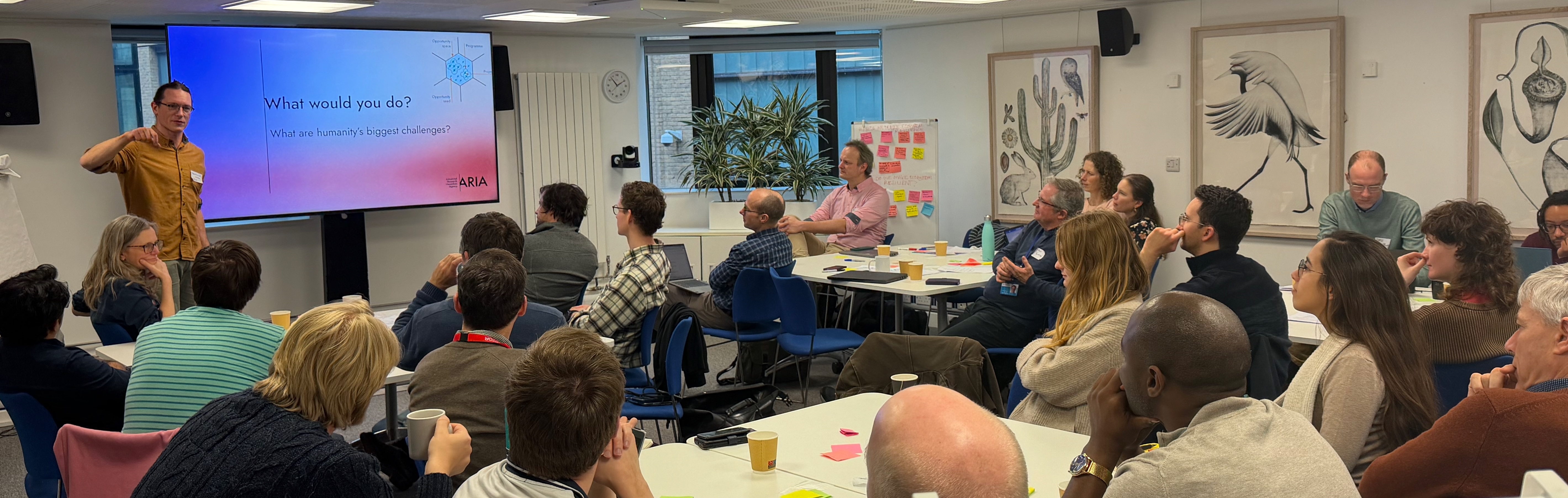
The workshop was also attended by the ARIA programme manager Yannick Wurm, who took the time to explain ARIA's structure and how his program is evolving rapidly as they get feedback from workshops like ours. I am finding interacting with ARIA a breath of fresh air: the workshops I've been to have been well organised and useful beyond just looking for funding by sparking new thoughts. I was initially not going to be taking part in this program at all due to concerns about licensing and IP ownership, but a quick post on social media was picked up and my concern was addressed within days. ARIA has an exceptionally free IPR policy that makes it so much easier for us to maintain our open-source code while being funded from a variety of sources, and I'm appreciative of this.
On the other hand, it also means that we need to keep up with all the changes happening to their opportunity spaces in order to keep abreast of all the changes in thinking that are resulting! I am hosting one last workshop for this opportunity space on the 12th December with Oisin Mac Aodha and Mike Harfoot to go into range mapping. Both workhops will have a proper writeup about our actual discussions and recommendations (which I haven't covered here!), so stay tuned for those ahead of the Christmas break.
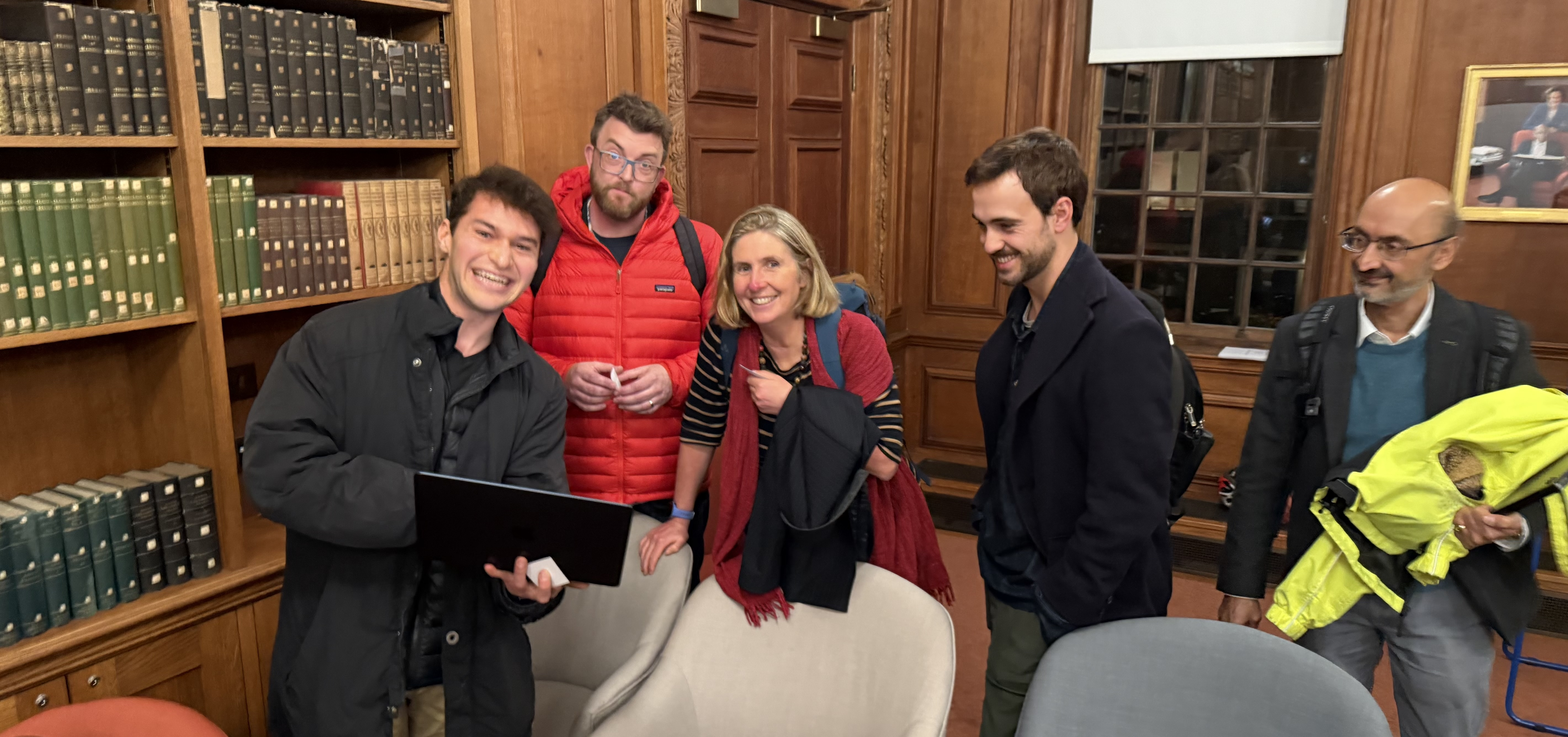
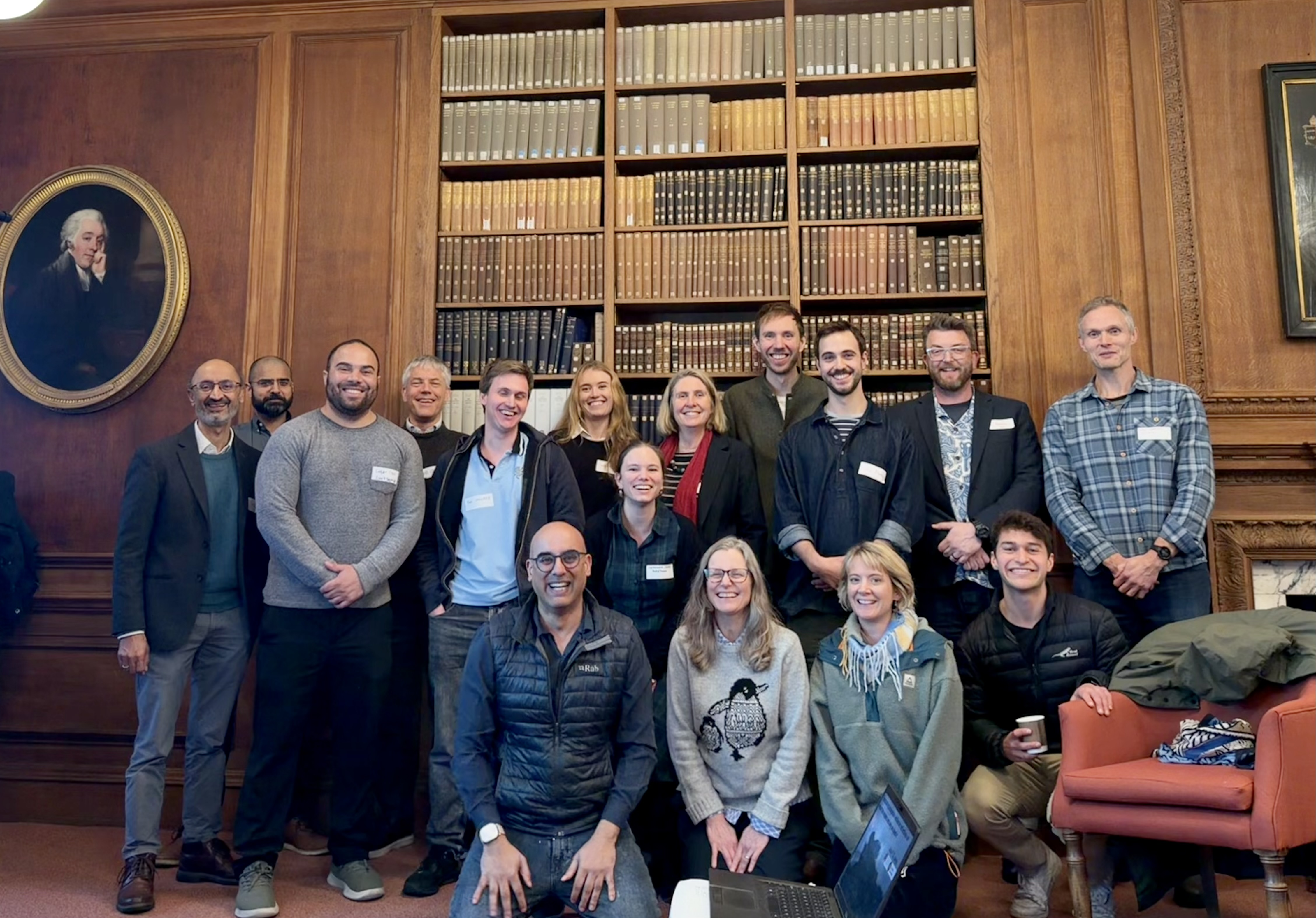
Random fun facts from the workshop:
- Julia P.G. Jones told us that 25% of all penguins are 'British'!
- @sw showed us his experiments towards AI passing the Red List Assessor's exam, which makes me feel better about LLMs now acing our first year computer science course.
- What's the weirdest and more interesting animal we could simulate? Well, naked mole rats turn out to be one of the few eusocial species that have a complex social structure including a reproductive division of labor, separation of reproductive and non-reproductive castes, and cooperative care of young! Also they look really weird. Thanks Lynn Dicks and Rebecca Spake for this introduction to the strangest species I've ever learnt about.