Silviu Petrovan and I had quite a week appearing on the BBC website and a dozen radio and TV shows talking about the applications of AI to saving hedgehogs. I thought I'd jot down a "behind the scenes" so other academics get a sense of what to expect when a research story hits the national news cycle. Mostly, make sure you have a clear couple of days to deal with live media appearances with just a few hours notice and don't wear a rumpled shirt to the office!
1 Being interviewed by the beeb
Zoe Kleinman from the BBC pinged me after hearing from Vultr about the TESSERA v1 geospatial foundation model we've been developing here. I grabbed Silviu Petrovan and Kevin Cochrane from Vultr and we had a brisk 25-minute chat on Teams with Zoe and her producer. This was all very stress-free and just like talking to anyone else, since it wasn't a live segment where every word had to be perfect. Zoe published the article on hedgehogs later that day straight onto the BBC website.
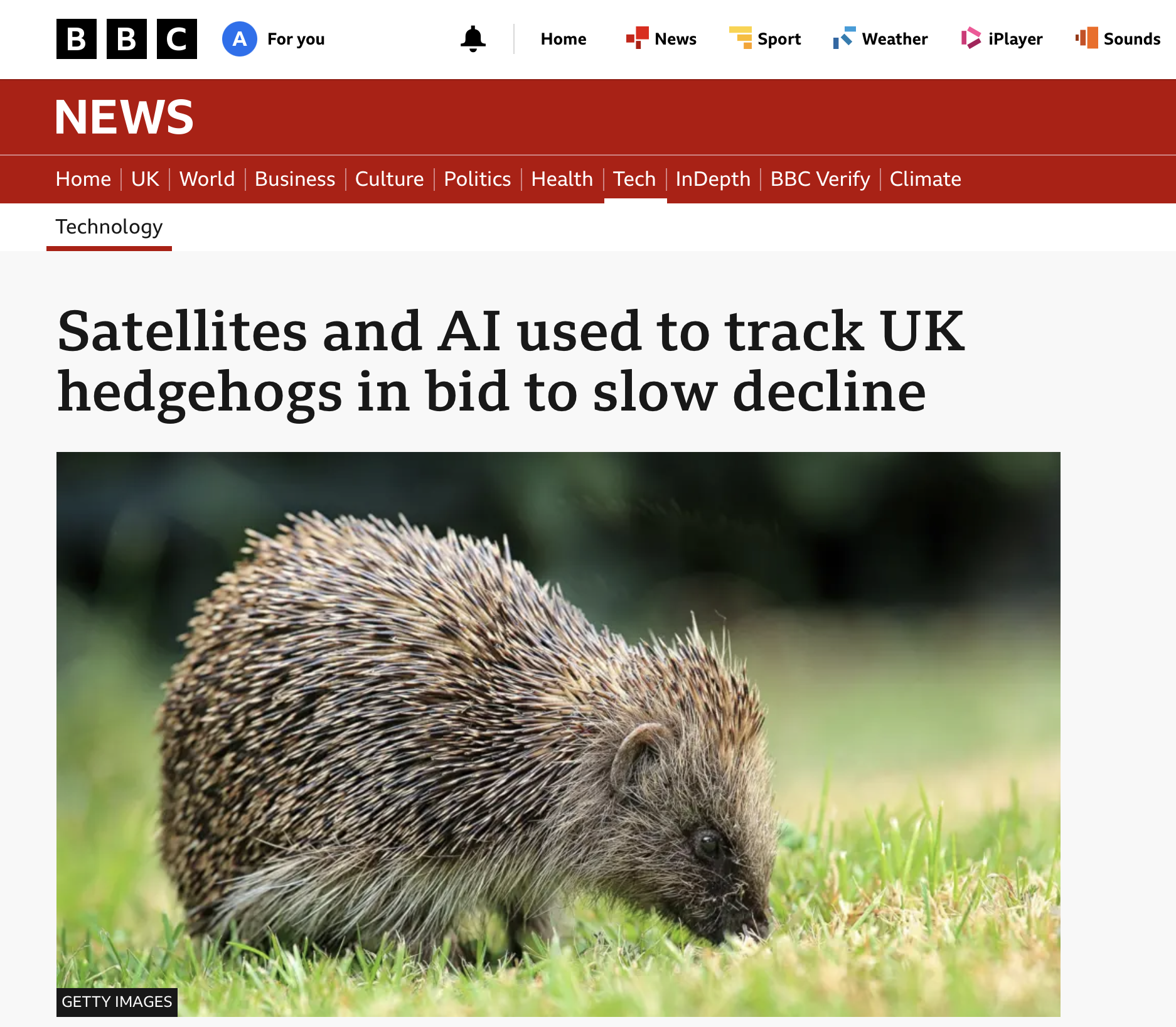
I hadn't realised before this just how widely read the BBC site is, as it has over 95% of UK adults using it and over half a billion unique visitors per month.
To be able to accurately identify the tiny creatures and other objects in image data, the Tessera system had to be trained on vast amounts of data — with around 20 petabytes, or the equivalent of 10 billion standard digital photos, used to build it.
After reaching the limits of the computing power allocated to the university, researchers installed additional processors under their desks to keep the process going. -- Zoe Kleinman, BBC News, May 2026
I chortled when reading that last paragraph about 'under their desks' as I'd mentioned that over dinner to Zoe back at the OpenUK AI Impact Summit roundtable a few months ago that Amanda Brock invited me to. The jury-rigging is, for the record, entirely true, since we've had to cobble together a gigantic storage cluster which we've only recently been able to move offsite.
2 Getting on BBC Radio Live and the Today programme
As soon as the article went live, the University comms office started sending in requests for interviews from TV and radio producers all over the UK!- 06:30 BBC Radio 5 Live with Rachel Burden and Gordon Smart (local clip or on BBC Sounds). I was soaked to the bone after my morning run, and took this one with my teeth chattering, not realising it was to such a massive audience.
- Mid-morning on the BBC Today programme replayed the interview and also a recorded piece from Zoe which is when the real phone-buzzing started. Silviu got his "digihog" term out there, and suddenly every regional radio producer with a slot to fill wanted to hear more.
- BBC Nottingham then held a longer slot with Dino where both Silviu and I came back on for two segments (clip), and also got a chance to talk about how the hedgehog tracking started at Nottingham Trent Uni with Lauren Moore who published the first studies. I also had to nip into BBC Radio Scotland where we discussed hedgerow reconstruction in Scotland briefly, and a few other drivetime slots where hedgehog highways came up along the way.
- BBC Cambridgeshire (clip) then did a brilliantly random hybrid video/radio piece with Louise Hulland where I got to talk about the CCI common room where eavesdropping on random conversations is endless fun (and where I got to hold wombat poo over coffee).
The way these radio sessions work is that a researcher gives you a call ahead of the live slot, checks audio (tip: don't use Airpods as they sound echo-y, just speak normally into the phone handset instead), and then gives you a time for the live slot when they'll phone (over Facetime in my case as I have an iPhone).
When the call comes in, your audio is mixed in with the radio show running in the background (but muted), and then before you know it you're live on national radio with millions of listeners talking to the presenter! They only call a few minutes before, presumably so that you don't get too nervous thinking about it all.
3 Doing TV slots on BBC and ITV
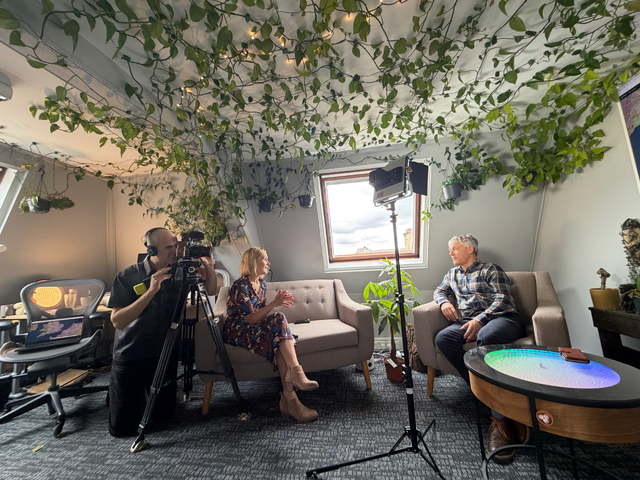
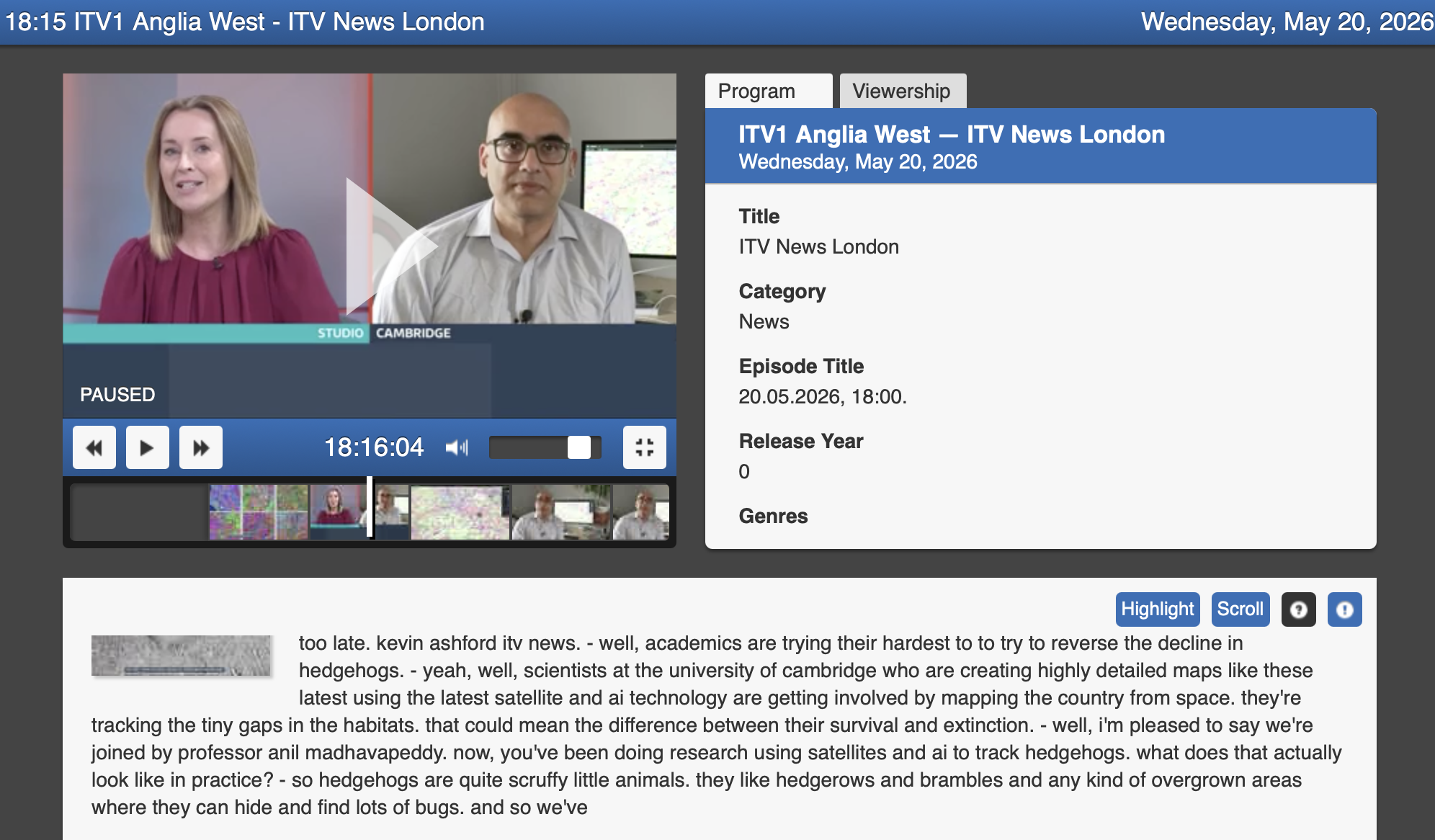
After this, the TV crews showed up to Cambridge to film pieces for television. Since it's exam term and College is in a quiet period we couldn't film onsite as we've done in the past and so used my office. They show up with a fairly portable set of camera and sound equipment and lugged it up the three floors to my office.
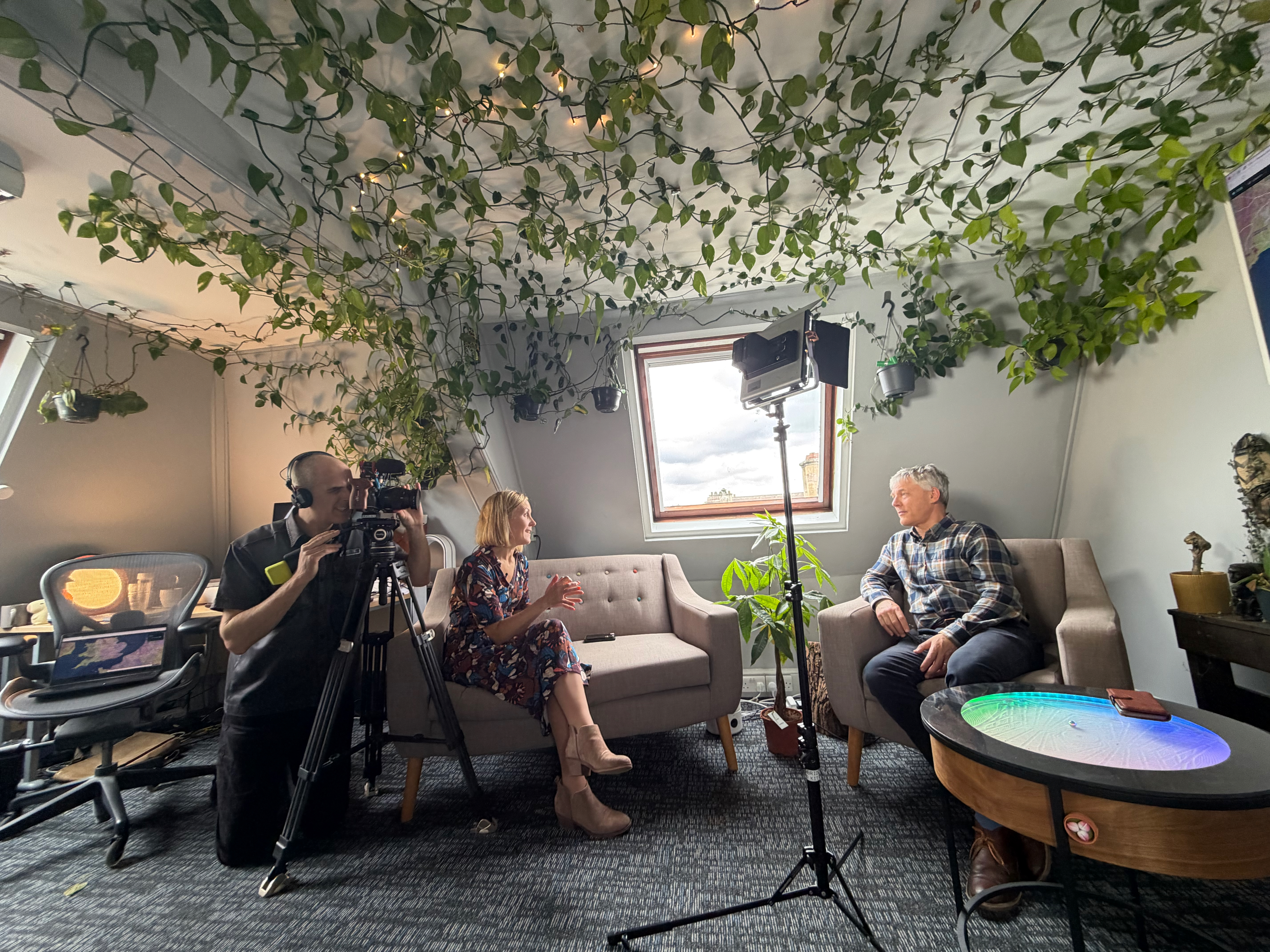
The first TV slot was from BBC Look East, and I grabbed David Coomes and Sadiq Jaffer at short notice from across the road to get some more team voices included.
Having my overgrown plant-filled office did seem like quite a nice idea on paper, but I think it came out less well when actually on TV since it's zoomed in and the light isn't even. I also hadn't reckoned on the sneaky 'reverse' shots the cameraman took which exposed the completely disorganised other half of my office away from the nice curated end!
We had about 30 minutes with the production team as well for this video, since they also doubled as the camera crew. We discussed what shots to take, and they did capture some gorgeous interactive views of the TZE Explorer which you can see in the clip above (and I love the studio intro which zooms in on the parametric UMAP false colour TESSERA map of Cambridgeshire).

ITV turned up later with another very patient cameraman to do a "down the line" piece, which was a quite different structure from the previous one. The presenters were all in the recording studio remotely, and I got wired in with an earpiece to listen in to them. The filming then happened as if I was in their studio, with compositing to make it all work.
The other thing to know is that the university comms office is actually monitoring the media mentions of the University on an ongoing basis, since Cambridge regularly goes viral with some mention in the news almost every day.
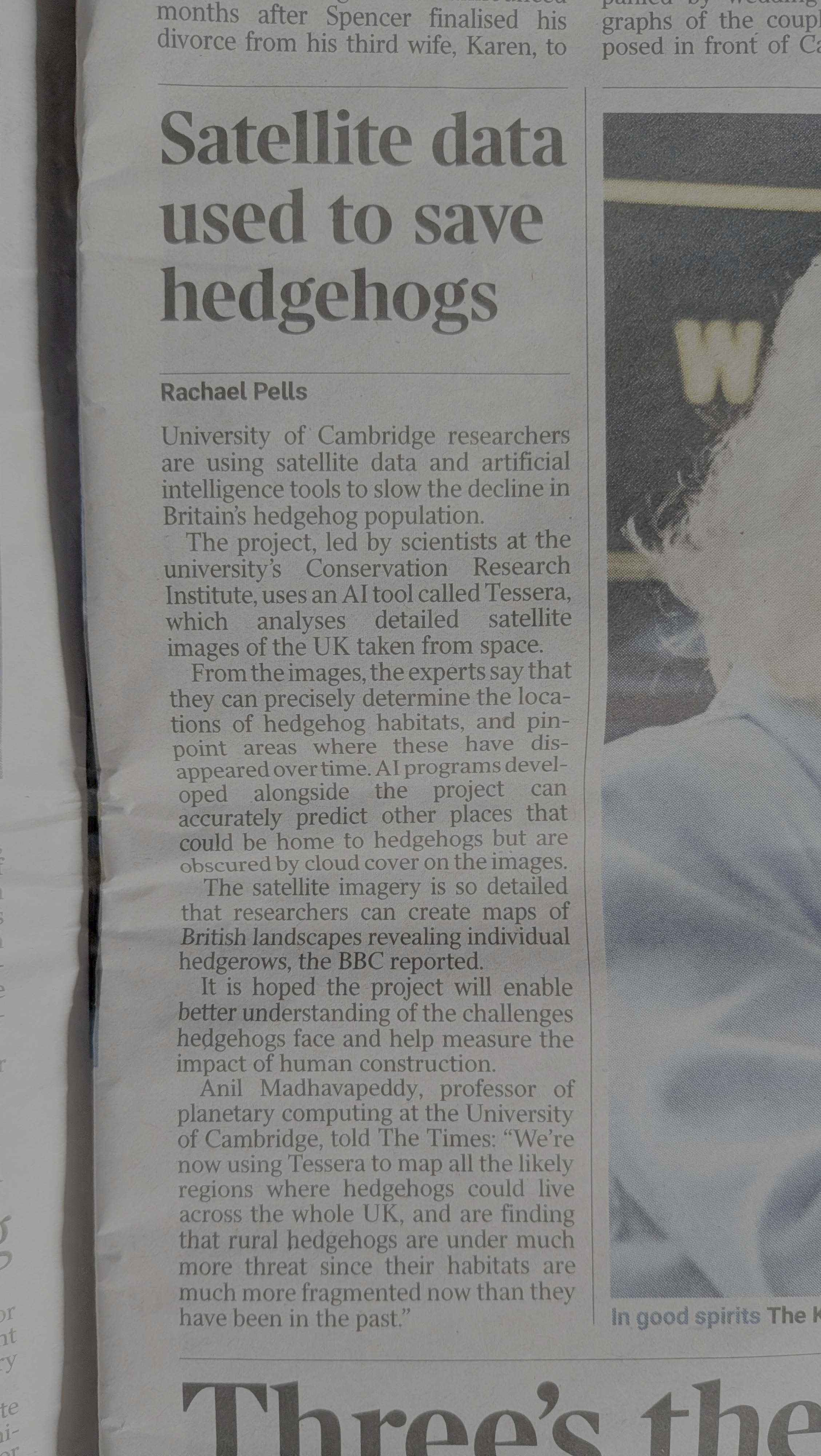
4 In The Times newspaper as well
5 Reflections
The thing I was most worried about, going in, was the science communication standard required for a national audience, especially since climate change messaging is under such threat at the moment. Biodiversity, however, seems to trigger a different (and perhaps more instinctual) response in people, and there was no one denying that there exists a crisis in biodiversity.
Instead, much of the online conversation was about differences in opinion about how to solve the land use problem from conflicting solutions (like should we cull badgers to save the hogs). This feels like an area where TESSERA, Enki and Conservation Evidence could all have a positive impact by making facts about the planet more available, so I feel quite energised about that!
I was very lucky that my collaborators (esp. Silviu Petrovan) in conservation are old hands at this sort of thing, and they kept the focus on the core conservation message which is the thing most of interest to a national audience.
I also think I spent a bit too long talking about the innards of TESSERA, and need to practise a few snappy lines about what it is at its essence. For example, Sadiq Jaffer came up with the term 'satellite fingerprint' to describe a TESSERA 10m tile, which seems hella snappier than '128-dimensional embedding of Sentinel 1 and 2' when doing an elevator pitch.
All in all, I very much enjoyed the experience. It has completely disrupted my already packed work-week, but I must have received a hundred messages from friends who otherwise couldn't care less about my day-to-day research, and it gave the project, department and College something to post about that doesn't involve obscure functional programming! Thank you Zoe Kleinman for taking the time to run this piece!