
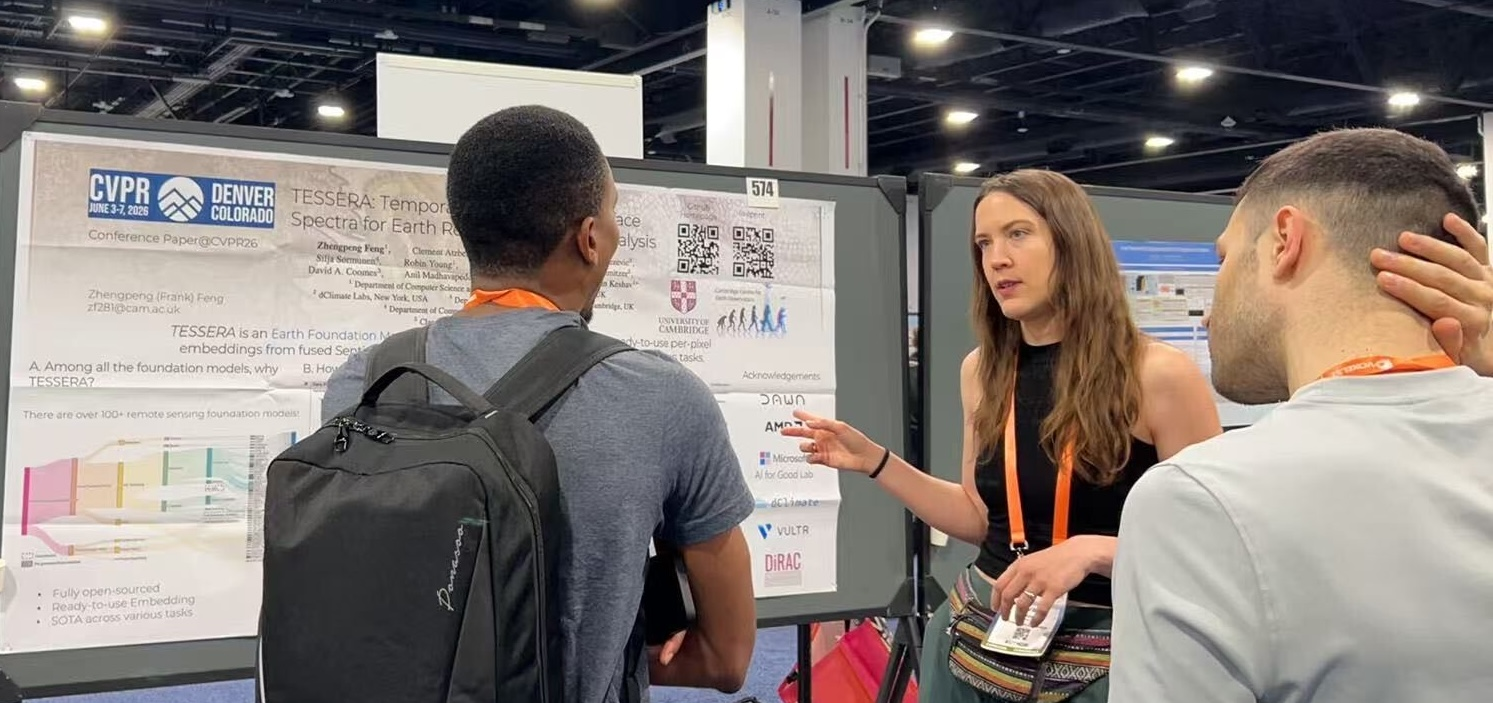
It's continued to be a wild week for TESSERA in the news. Jovana Knezevic is at CVPR2026 in Denver presenting our foundation model paper right now (poster #578 from 11:45am to 1:45pm).
We also ended up on the front page of the European Space Agency in the same week. Teenage me wouldn't have believed this possible!!
1 CVPR 2026 in Denver
Jovana is over in Denver this week presenting our work at CVPR. It's an interesting room for us to be in as TESSERA is a bit distinct from the other models by being a pixel-wise, temporal model that compresses years of Sentinel‑1 radar and Sentinel‑2 optical data into 10m embeddings. This is distinct from other models that train on bigger spatial patches, and is (we think) a simpler and more focussed way of extracting high quality embeddings from noisy earth observation data.
If you're at CVPR, please go and say hi to Jovana!
2 The hedgehog story keeps trotting on
Meanwhile back in the UK, the BBC hedgehog piece made it onto the national breakfast news, which resulted in a barrage of text messages asking me why I was suddenly obsessed with hedgehogs and if I am ok.
I am pleased to report that I am perfectly ok except for now going on 5am runs looking for hedgehog habitats around Cambrideshire, but I think this is a perfectly reasonable thing to do.
The TVEyes monitoring service that the University comms office uses keeps pinging with regional rebroadcasts. I am very much struck by how much mileage the "biodiversity angle" gets compared to the climate-change framing that's more doom-and-gloom...
3 ESA puts us on the Copernicus front page
I was absolutely gobsmacked to see the European Space Agency had written up TESSERA on their homepage:
"Foundation models are the new frontier of AI applied to remote-sensing data." -- Nuno Miranda, ESA's Sentinel-1 Mission Manager, 2026
The ESA piece (along with the phys.org and Cambridge coverage) spends a lot of time on accessibility aspects, which is the bit I care about most. A researcher with a laptop can pull TESSERA embeddings for an arbitrary 10m patch of Earth without needing a GPU cluster (or indeed any registration at all), which opens up real Earth observation work to a much wider set of ecology and conservation groups who'd otherwise be priced out.
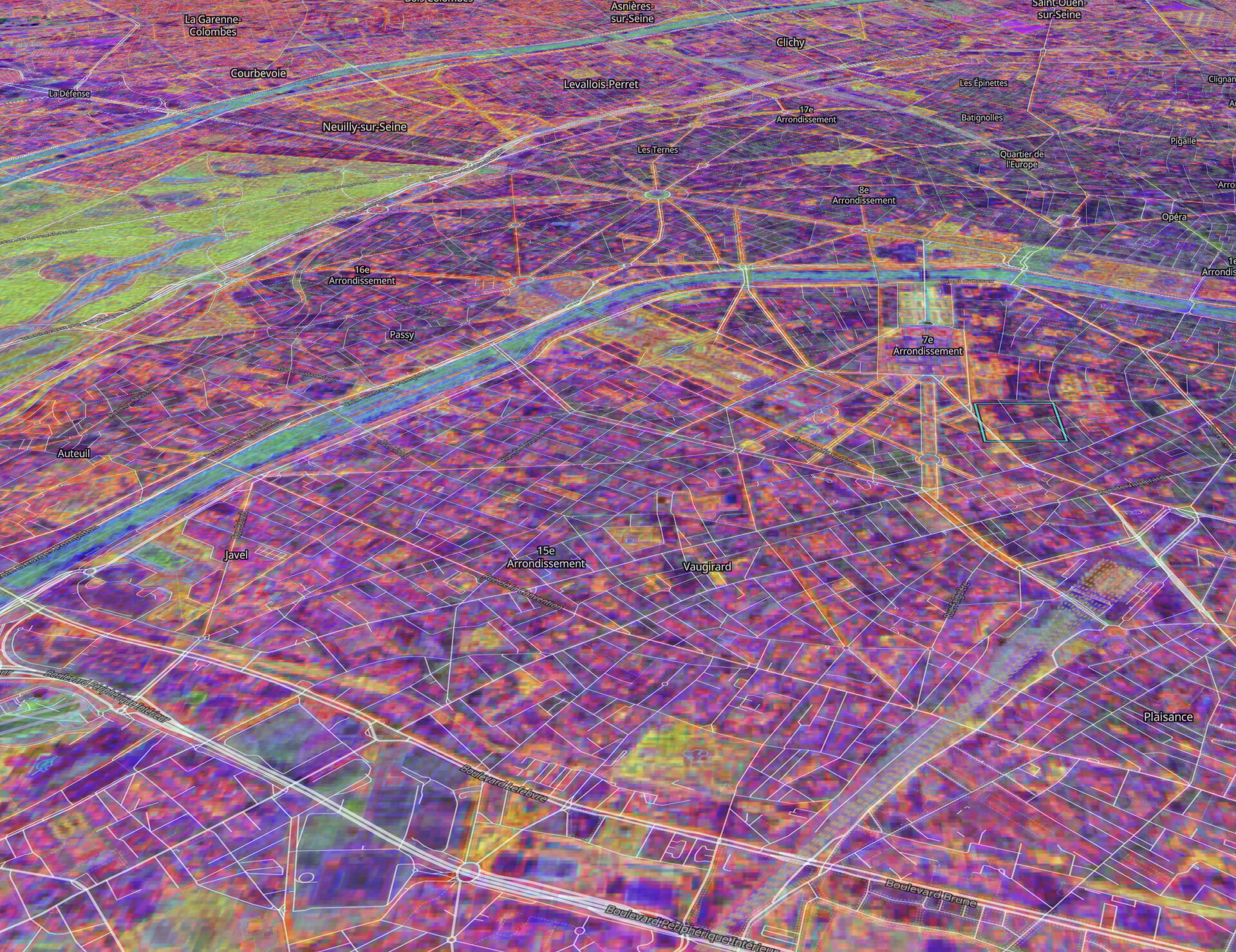
For the hero picture accompanying the ESA piece, I grabbed a screenshot of ESA's own Paris HQ from the TZE Explorer. You can do this yourself using either TZE or TEE or even lash up a script yourself using geotessera.
A day later, Orbital Today ran a piece with a good summary as well and also latched onto the 'fingerprint' term that Sadiq Jaffer came up with for his Pint of Science talk a couple of weeks ago. Coining a good phrase really does pay off; it's all 'fingerprints' and 'digihogs' now!