
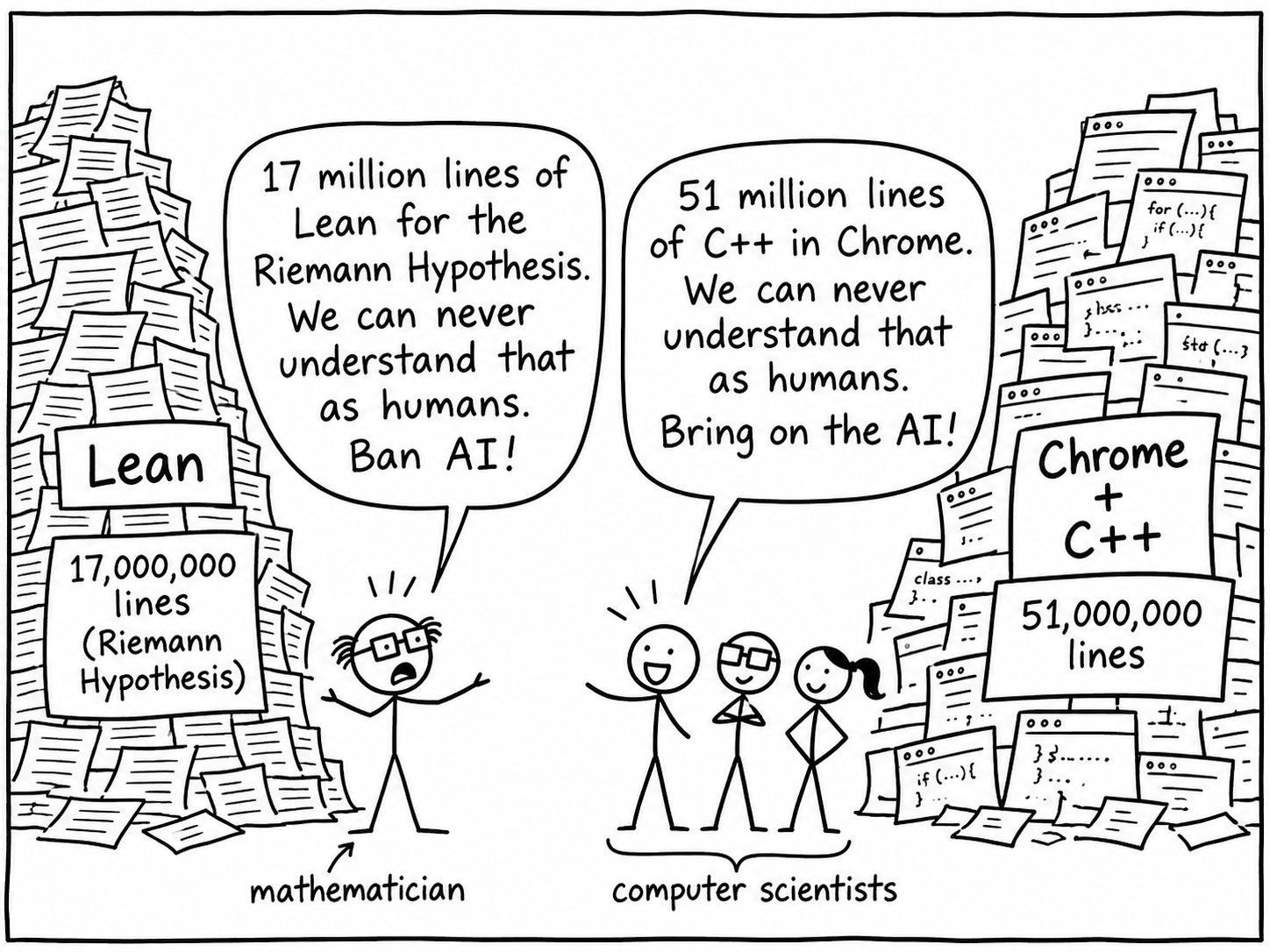
I was glued to the Lean chat as the legendary Riemann hypothesis was cracked via 17 million (!) lines of AI-assisted code last week. This has since been certified correct despite no human (yet) understanding how it works. The future of maths, and much science, is clearly going to involve human-AI boosting.
However, it also struck me deeply just how broken software engineering has been for my entire life! There's always been an imbalance between our understanding of the theory of computation and our relentless drive to deploy software throughout society. We're paying the piper now as all those decades of human-written code turn out to be full of bugs. Since software essentially drives society now, weird things happen like supermarket fridges needing James Bond to secure them. This has led to people like Tim Gowers joining the Pause AI march.
How the hell did we get here? Have we just completely overestimated the human ability to write software? Or will software engineering 'catch up' once LLM harnesses get better?
Software was reasonably under control in pre-AI times when attackers were roughly symmetric with defenders, but all the recent mysteriously correlated outages and disclosed issues (Java, PHP, Linux) all point to an acceleration of security pain in 2027. I only see two ways this can go...
1 Derive everything from specifications
In April this year, I couldn't believe we'd ever formally specify every layer of hardware and software:
I find it hard to believe that we will formally specify all layers of hardware and software and roll them out into production...ever. A Fire Upon the Deep's software archeologists are a profession that's here today and not a scifi trope. -- The Internet needs an antibotty immune system, stat, April 2026
How a few months makes a difference. With the pace of frontier model advances, translating the vast body of existing legacy code seems entirely plausible if we first speedrun towards defining formal specifications for all of our services, and derive all new software from those as well.
That means rebuilding operating system stacks from the ground up and even reengineering instruction sets to match. There are terrible legacy interfaces throughout the stack, largely because our software layers grew so that human groups could scale working on different parts. Other approaches do make it easier though. Unikernels with a libOS linking discipline plus shared memory interconnects are remarkably composable and allow agents to specialise the whole stack at link time, with fewer interfaces making the specification task less daunting.
Having good specs also conveniently takes humans out of the security response patch loop. Attackers are currently bounded only by their desire to break in somewhere, while defenders have to wait on maintainer triage. However, fixes re-derived from a formal spec and machine-checked could work more reliably in a timely fashion. The human job remains writing the interfaces iteratively with an AI.
2 Engineer diversity in deliberately
Historically, software has tended towards a monoculture through reuse, so one bug can screw over vast numbers of hosts. Agents could instead force diversity via novel 'genetic' mechanisms so digital services aren't all simultaneously infected. This works well with formal specifications, since any decent spec allows multiple valid implementations. The Internet's entire philosophy is based around Postel's Law and encouraging hosts to be liberal in what we receive and strict in what we transmit.
The catch, of course, is having just a handful of gated frontier models generating all our software takes us out of the frying pan into an AI controlled fire. The diversity has to extend beyond the code to the models and harnesses too. We seem to have done ok with Internet RFCs not splintering too much, so perhaps formal specs can remain singular. Once that's done, it's time to go let hosts mutate and inoculate each other and generally maximise unpredictability at scale!
3 Digital society is going to have to change
To answer my opening question, I don't think better harnesses and models alone will let software engineering catch up, as they just produce mountains of slop code. We need both of the above; formal specifications that let hosts finally be strict about what they receive instead of liberally accepting whatever shows up, while diversity ensures that things that the specs (inevitably) don't capture doesn't break everywhere, everywhere all at once.
The real upheaval here will be to social coding though. Open source communities have run on social contracts of human review and trust built up over decades, and every single one I'm a member of is struggling under matters of AI disclosure and trust.
At least humans aren't out of a job yet though! Somebody still has to decide what our specs contain, as we have done for decades with RFCs. There's also plenty of new computer science research needed! We need to figure out how to debug diversity when no two nodes run the same code, and on how to force simplicity on systems that agents maintain, and ultimately how we settle the blame games when things do go wrong...
(Thanks to Dave Scott, KC Sivaramakrishnan, Thomas Gazagnaire and Sadiq Jaffer for helpful conversations about this post, and to Yaron Minsky for triggering this line of thought with his eBPF observations)

Nnathcd133 comments · 124 pointsWas software just always too complex for humans?
Was software just always too complex for humans?
LLichenStone10 repliesAlan Kay, 2015 - https://youtu.be/NdSD07U5uBs?t=592 "What's the expense of getting simplicity? ... one of the things that's worked the best the last three or fo…
__doctor_loveIt's not that people won't do it, the incentives are not there. We get compensated for building things not maintaining them.
Wwhinvik4 repliesWow this is the most interesting thing I have read all day. Thanks for posting it!
Ssoon_to_be_sb3 repliesI didn't get it, can you please explain?
Ssdwr2 repliesPeople like simple foundations instead of slightly-more complicated ones. The slightly-more complicated ones work better.
Llemonwaterlime1 replyMore that the simplicity leads to complication. That’s the issue. The sophisticated solution is more complex, not more complicated. That makes it simpler to u…
Ssoon_to_be_sbIsn't this the idea "Everything should be as simple as possible, but not any simpler"..
RRationPhantoms2 repliesWhat a brilliant orator but do you feel like this advice is too abstract to gain anything meaningful from it? I can not telegraph or distill the thing Alan Kay …
IitsrathercompleHe is right, but in a way someone is right to claim our current physics theories are wrong or incomplete at best. It's one thing to see the problem, and that's …
AahartmetzC vs Rust memory management is maybe a real-world example. malloc and free are simple building blocks, but difficult to use correctly. Rust lifetimes are harder…
SspartacusnachoSmart data structures/objects and dumb algos/processes
Hhypfer9 repliesAnswering the Headline: Not really, no. Things are the way they are not because they would be difficult but because various systemic incentives and goals fought…
Mmentalgear7 repliesThe systemic incentives were acceptable risk / effort. It's not that engineers 30, 40, 50, ... years ago didn't know the potential risks of the hard- or softwar…
MMuromec5 repliesbut business executives found them acceptable, and those companies that provided the best 'bang for you bucks' with acceptable risk surfaced. that does not expl…
Oozim3 replieswith enough eyeballs all bugs are shallow We never had enough eyeballs for all the software open or closed source. Don’t mix up complexity with just high amou…
TTerr_2 repliesI'd also caution that the saying relies on an implicit understanding that "eyeballs" is proportional to independently-minded reviewers. Running a thousand copie…
DDetrytus1 reply“With enough eyeballs all bugs are shallow” has always been a fallacy. Having source code in the open does not help, because “no one reads anything anymor…
Ppreg_matchOpen source definitely helps but it doesn’t solve the problem. There are, actually, many security researchers who audit the Linux kernel. It’s a great learn…
Ffc417fc802s/business executives/people with common sense/ is how I resolve that one. It's easy to end up lost out in the weeds with edge cases when you're the one buildin…
CCM30I'd also say this is why software engineering seems so much more precarious than other types of engineering, or other fields in general. Software is constantly …
MMuromecI believe it's like with rivers. We just keep adding stuff until we can't deal with complexity anymore and adding stuff takes too much time to get enough value.…
Ggt0One major problem is that we have knowingly made software overcomplicated over the past few decades. Plan 9 exists, but we all use enormous Linux distros instea…
Ddgoodell1 replyI think it was a business decision to make it too complex for humans. I don’t think fundamentals were prioritized as much as features, resulting in a fragile …
NnecovekThe difference is that people will look at the "software bridge", and decide that it could really use a 16-lane roundabout in the middle of it. And software eng…
Aanalog3150 repliesTake this from a rank amateur "scientific" programmer. I write functions with maybe a half dozen lines, then I piece them together. Sometimes my programs work, …
1141131 replySoftware engineers like to over-complicate code in the same way that structural engineers like to over-complicate buildings.
MMuromecIt's the architects. The love doing things like Sluishuis because it's cool . So next time you see a bug and an architect, hit the architect first.
Sspoiler2 repliesI think a lot of the complexity comes with having to handle unknowns or weird edge conditions, most of which are there because code runs on hardware which follo…
Lloup-vaillant1 replyA lot, yes, but far from most. Most of the complexity I've seen in most programs I worked with so far was avoidable complexity, caused by under- and over-engine…
Ppreg_matchThe main purpose of OOP is not actually to make code simpler or easier to understand, it’s to make code more maintainable. I know that sounds like the same th…
Ddude250711> When I ask AI to write code with similar functionality, it's about 10x more code. Using AI is still a skill in 2026. You do not have to one-shot it, you can p…
AaetherspawnIn python yes, but if you add or use only static types it clears this all up and the LLM will generate short, optimal code without edge case fluff.
Jjrmg14 repliesI write functions with maybe a half dozen lines, then I piece them together. Sometimes my programs work, sometimes they don't, and I fix them. I think you might…
SstingraycharlesThis is accurate, and it’s also that the code of those projects evolved over years, sometimes decades, of time, often by multiple people iteratively improved …
HHappyDreamerspend longer in the debugger or inserting and reading logs Id say more time writing tests and doing code review, than debugging and looking at logs.
Aasdff2 repliesThere is stuff that just is not done at all in scientific coding that is routine in more "I majored in this in undergrad" sort of coding roles. For example, typ…
Ggorgolo1 replyNot true, lots of scientific code is not written in python but C and other static type languages.
AasdffI guess there is a line in the sand then between scientific code that is written by people who use C, and scientific code that is written by people who will nev…
Ccadamsdotcom8 repliesMost - maybe all - professional programmers I've worked with spend longer in the debugger or inserting and reading logs Don't say debugger! A debugger is a tool…
ZZanfaI’m not gonna argue against the importance of testing, but what you described here is completely orthogonal to the use of a debugger. If anything, it would be…
Sskydhash5 repliesTry to do all of those stuff with embedded programming, or kernel programming, or desktop programming. A debugger may be your only tool to investigate the cause…
Hhirvi742 repliesEver been a situation where you only have access to print statements and no debugger, logs, etc? I'll never take a debugger for granted.
Sskydhash1 replyI have. But if there’s a debugger, why not use it? printf statements can be quite noisy especially when dealing with multiple threads. And they can take quite…
Hhirvi74But if there’s a debugger, why not use it? That's pretty much the issue. I have been in situations where one was not accessible one, i.e., T-SQL gives me Viet…
Ccadamsdotcom1 replyThis still does not make a debugger the best use of your time. Consider: The only way to debug is to repro the crash. If you can repro the crash you can write a…
JjrmgOkay, you write the test case and it fails. Now what?
EEggpantsDebuggers teach you how the computer really works. Your list is for someone who treats it like a black box.
Mmetalcrow12 repliesIsn't defensive code just outright better to do? Sure if you're making scripts for single use or small one-offs, it's unneeded. But the moment you make a usable…
Rradlad2 repliesThere are other takes. Notably, the Robustness Principle: https://en.wikipedia.org/wiki/Robustness_principle
Ccowlevel1 replyTurns out that's good for prototypes and experiments, bad for production systems - the internet has a ton of jank where some early robustness principle ossified…
RradladI've never been particularly convinced by the robustness principle, after cutting my teeth on PHP and Perl. But some are.
Ccowlevel6 repliesCode with the necessary level of defense isn't defensive code, it's just code. It becomes defensive when you add too much defense. Like C programmers writing if…
AAnimalMuppet5 repliesDepends on what it's code for . For aircraft software, "just letting it crash" can be unpleasantly literal.
Ccowlevel4 repliesFor aircraft software neither approach is acceptable. You can't have crashes, you can't have exceptions, you can't have error codes, you can't have any other wa…
AAnimalMuppet3 repliesYou can't have error codes? I have never seen anything saying that you can't. (If there is something I have missed, feel free to cite it.) Of course you can hav…
Ccowlevel2 repliesDo you know what happened the last time a plane dropped packets it thought were invalid? Nobody noticed and it just kept receiving them until it (by chance) dec…
CcontravariantYou need to balance this using the robustness principle by being very strict in the code you've written yourself. If you're constantly checking the output of yo…
PpopkkksidhdNo, absolutely not. If you don’t understand the ways in which your code will be used, you need to fix that. Defensive programming is just lazy - and more impo…
Rrf15my experience has been similar, working for over 20 years as an egineer: engineers like to talk too much, even with their code.
Ttayo42I feel like alot of code complexity comes from making it testable in practice. To make unit testing possibly you need so many ways to hook into things and you n…
Ppxc2 repliesI have a computer science degree and have bounced around security engineering, software engineering, and DevOps roles. I currently produce code for a living, al…
BBaloogaExactly. Here is what I have found in my own project. Because I hadn't explicitly told the LLM (Hi Claude!) to not create a brand new build tool, it created a b…
Rrstuart4133It's rare that you can compare LLM output to a human's, but I got the opportunity. It was some one-off throwaway code to scrape some websites, to find a good de…
Ccataflam2 repliesLikewise when I look at the code for well respected open source projects. It's good code in terms following accepted practices, but hard to read because there's…
Aanalog311 replyNo offense taken at all. What I realized at some point is that I really didn't want to do software development, and am at a place where I have the luxury of say…
PpopkkksidhdParent said “probably has more bugs” but the correct answer is we can’t really say. I spend half my day ripping out defensive LLM programming that would n…
EEkarosDefensive coding often is added because shit happens. So you need to take in account lot of scenarios you did not even consider at first. My latest example is v…
AantonvsSorry, but what you're describing sounds like ignorance in your part. Code that needs to run in production environments has to deal with all sorts of issues tha…
Vvrighterin a lot of software, handling failures is vastly more complex than doing the thing properly and assuming everything will go right, and is usually a significant…
BbreatheoftenI think this outcome is more a consequence of software ecosystem and legacy debt than necessarily a pure fault of the coding agents ... Building on piles of san…
Wworried_individthe high levels of abstraction until you get to what the algorithm actually does is a real criticism even inside software engineering circles. java enterprise a…
VvikloveI tell my engineering friends: "Engineers like to over-complicate things." Maybe the AI has picked up on this and is serving it back to us. This is why no one l…
TthelaxiankeyI am a scientific programmer also (but with some enterprise experience). I just added some information about my preferred style to Agents.md and it reduced the …
RRunSet"There are two ways of constructing a software design: One way is to make it so simple that there are obviously no deficiencies, and the other way is to make it…
AameliusThe always changing requirements are what make it too complex for humans.
Bbob10297 repliesWhat makes software complex is how long it takes to develop. Building a process that can accurately represent an incomplete software solution over time is an un…
Hhirvi746 repliesWhat makes software complex is how long it takes to develop. That seems somewhat tautological. Software is complex because of the large amount of time that is n…
Ggopher_space5 repliesI believe op is referring to the collapse of this tautology. Now that software no longer takes as much time to develop we’re left staring at overly complicate…
Hhirvi744 repliesIs modern day LLM output really that much less complicated than the code of yore? I am fairly isolated from the realm of LLM development.
Tthrow-the-towelIt very much isn't, if anything it's more complicated. AI sure loves its ceremony.
Ggopher_space2 repliesComplexity feels like a function of how much time I spend on planning, and planning with LLMs lets me be more comprehensive in the same amount of time. At the c…
Hhirvi741 replyInteresting, I might have to try to method out. I have really only played with LLMs. I have never tried to use one for anything truly important in terms of deve…
Ggopher_spaceI fully believe LLMs write better than code than I do. Linters also write better code than you do. Both of them just sit there until you start working on someth…
Yyyyk20 repliesNo, and users of this site know better. Humans built massive reliable software system. Inasmuch as anything was 'too complex', it was the choice to rely on unde…
Bbgun2 repliesJust because it’s humanly possible to build complex systems correctly doesn’t mean they’re likely to evolve that way while under human oversight. There ar…
Llayer81 replyI don’t see how AI leads to complex systems being built more correctly, at least at the current state of affairs. Regarding the standards not met: That’s be…
Wwritten-beyondIt doesn't. Standards are dropping, fast. There's is no way to get what you wanted exactly from an LLM, you will 100% capitulate to the response if it comes wit…
Ccowlevel12 repliesHuman software is not massively reliable. Anyone who has used a computer knows this is true.
Wwritten-beyond2 repliesIf human software wasn't massively reliable then no one would bother using any computing device.
Ccowlevel1 replyAre you talking about how one in a billion is next Tuesday because computers run so fast, and one in a billion is pretty good reliability? Or are you actually m…
OowebmasterThe point is quite clear. Software works so well it changed everything in society the past 20 years. Saying software is unreliable makes zero sense.
HhoneycrispyI use a computer, and no this isn't true. Why are AI enthusiasts trying so hard to pretend software was terrible up until last year? There was good software and…
Bbyward6 repliesMaybe you’ve heard of this operating system called Windows XP? It had a pretty good run.
CcowlevelYep, until late in its life it bluescreened all the time, I had to reinstall it several times.
Mmikewarot4 repliesI had about 20 Windows XP workstations under my care... they would blue-screen when you needed them most, right before you printed the document you were done wi…
Jjurgenburgen3 repliesSounds like XP could have used some defensive checks instead of crashing the whole OS.
Mmikewarot1 replyOnly an idiot would put device drivers in a kernel, like they all do.
SskydhashMost device drivers are just shuffling data back and forth according to some protocol. The actual user facing logic can be outside the kernel. This is why I lik…
YyyykIt's code running at kernel level, it has access to nearly everything, it's very unlikely there's a place a check could have been added. Later Windows editions …
Aagumonkeydepends on what class of software. some are, trains are complex yet operate 24/7 with almost no failure. mainstream computing and webapps on the other hand..
Sspiderice3 repliesHumans built massive reliable software system Where? Lol All of our massive "reliable" software is currently being torn apart by AI. All the vulnerabilities tha…
JJabrovWhat, and AI is writing bug-free software? The browser you're using, the OS you're using, the firmware linking it to your hardware, the networking stack allowin…
Yyyyk'Reliable' does not indicate no bugs, much less no security bugs (plenty of people deprioritize those). It indicates working correctly for years even without su…
WwatwutHere, back in the real world where internet was working for decades and planes were flying for decades. Reliable does not mean perfect. "Humans are able to crea…
Aadrianmonk1 replyI'm not following the reasoning how specs improve security issue response. The idea is that a formal spec exists and AI generates code from that. Then when an a…
Ccodedrift_Yeah, because it's probabilistic all the way down, adding stuff to the spec doesn't change the outcome. "If the spec plus the AI is sufficient to generate softw…
SssrcMaybe for some software systems it was. For most systems, the problem was just professional immaturity caused by the eternal September state the profession is i…
TthrowawayffffasNo, the main problem is the acceptance of undefined behavior and refusal to move to datastructures that spend a couple of words to keep track of their size. Ser…
AadverblyHot take but I think the idea that software is too complex for humans is ridiculous. It's like saying that cars are too complex for people. You can use a thing …
Ddoug_durhamYes, and users of this site agree. Software complexity has always been at the edge of human abilities. This is why there have been countless attempts at managin…
SsocketclusterI think one of the most profound changes I've observed on the tech side is the definition of 'modularity'; in the past, ideal modularity implied that the code c…
RrandallsquaredSpecification has its place, but even with "perfect" pieces of software, the interaction of them, together with their interaction with the physical hardware, me…
PprestonvasquezHistorically, software has tended towards a monoculture through reuse, so one bug can screw over vast numbers of hosts. Agents could instead force diversity via…
YyepyouknoMany handle it just fine.
Ddasil003This part seems incredibly naive: translating the vast body of existing legacy code seems entirely plausible if we first speedrun towards defining formal specif…
MmikewarotOur biggest software problem is that the design of our operating systems relies on ambient authority, which was fine for single PCs without networks, and softwa…
00xbadcafebeeHow the hell did we get here? Two ways: 1) Software-based businesses optimize for profit, not quality. Physical-world engineering is as good as it is because of…
LlibrasteveThe post states “That means rebuilding operating system stacks from the ground up” I think that’s right and I think Omarchy is making headway on that.
RrgloverNo. Humans just go out of their way to make everything unnecessarily complex, get frustrated, have a tantrum, then recreate the same mess with a different set o…
Jj45Building/Implementing software is often about learning the actual complexity and solving it.
OopemWas human body just always too complex for humans?
JJoeAltmaierDoing it in half the code takes less time, builds faster, can be taught faster, less code to execute (runs faster? maybe). So maybe four to eight times advantag…
Xxkcd-sucksNo and yes; business logic and requirements are too complex because they encompass all the messiness and logical inconsistency of human endeavor. To which "1. D…
Mmaxrev17It’s just how quickly you can deploy the resource right? Models are not bad but you can deploy tonnes of energy quickly. With people you can’t deploy as qui…
00c3ca83Betteridges law of headlines strikes again.
Ccowlevel"Engineer diversity in deliberately" - garden-path sentence found in the wild! (So a forest-trail sentence?) https://en.wikipedia.org/wiki/Garden-path_sentence
JjerfYes and no. The "yes" is that we are frankly barely able to cognitively keep up with even simple software. With our attention being able to be allocated to 7 +/…
AAIShill1012 repliesYea I agree with the article wholly. This new era of AI assisted or driven coding is going to help us extend our capability way beyond anything humans could've …
Ddingaling911At the moment, oversight is still heavily required. Before, we used to write code and machines converted it to binary. Now we will write designs and machines wi…
Oonion2kThis new era of AI assisted or driven coding is going to help us extend our capability way beyond anything humans could've built. For individuals, sure. I'm fai…
Eex-aws-dudeI mean if you zoom out the whole lesson we keep learning over and over with AI/ML is “we are not smart enough to design this function”