
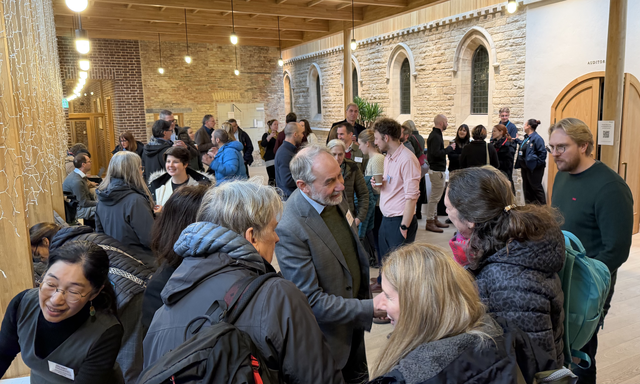
I ended up the India family trip with a successful navigation of getting everyone back to Ireland in one piece, and then with just a few hours was back in Cambridge to help host the big Conservation Evidence conference at Pembroke!
1 Conservation Evidence conference
Luckily, I had pretty much no actual work to do beyond show up and smile, as the catering staff at Pembroke are beyond outstanding as are the Conservation Evidence team.
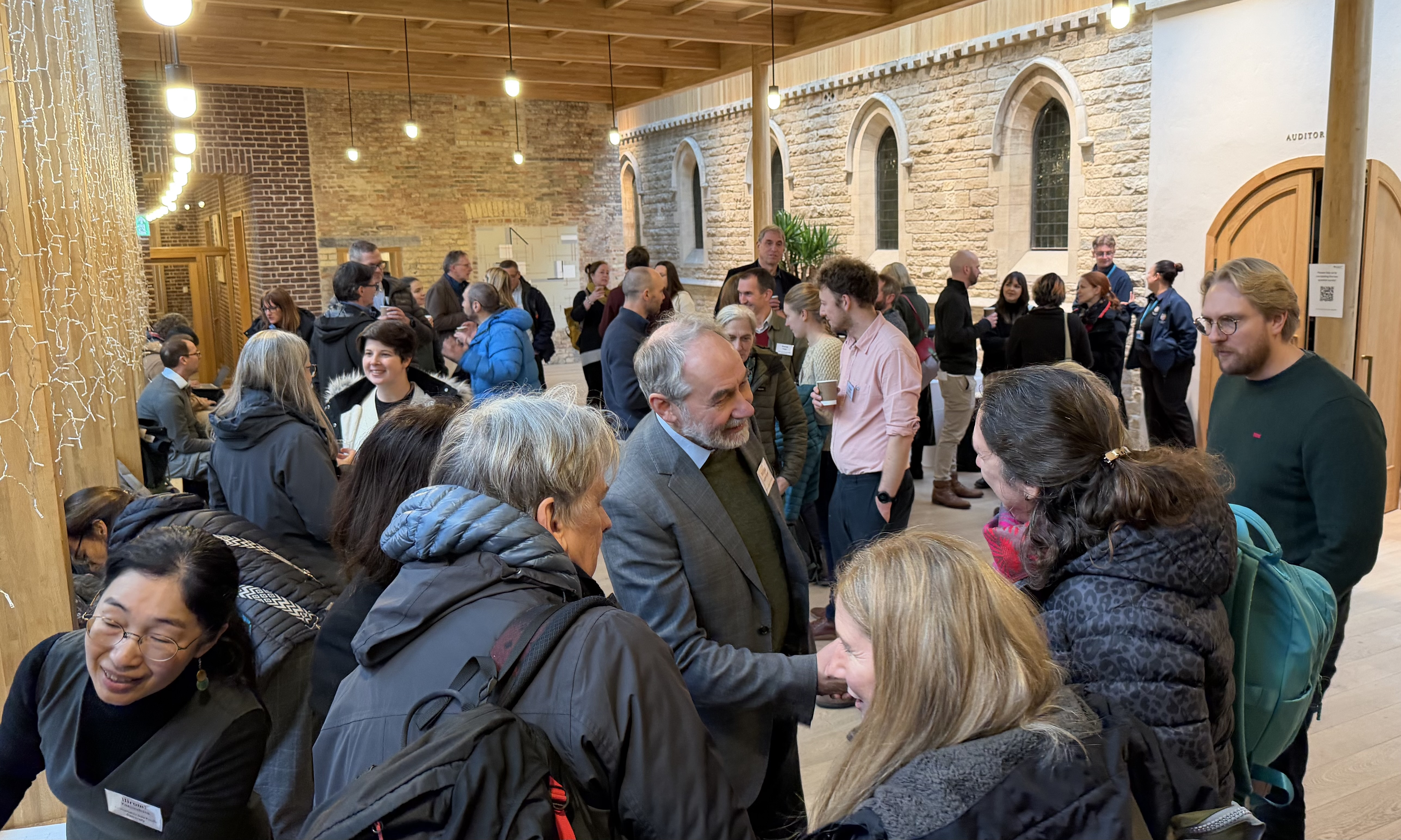
You can see my talk here or read the roundup:
2 Five uses for the LIFE metric
I also wrote up some notes on our new paper on five ways to use the LIFE metric for conservation decision-making, which just came out in Biological Conservation. Well done Alison Eyres!
3 The FP Launchpad takes off
I've been working with KC Sivaramakrishnan for a while on helping him craft the FP Launchpad and he announced it to the public!
The Functional Programming (FP) Launchpad at IIT Madras aims to build research and educational capacity for crafting efficient, reliable and trustworthy software with mathematical guardrails. As AI coding agents make software increasingly accessible and enable its production at unprecedented scale, they also introduce far-reaching consequences for civic society. In this context, the centre is founded on the belief that discovering future software engineering best practices requires sustained feedback loops between research and real-world systems, as well as educational structures that cultivate a new generation of maintainers for foundational software. -- FP Launchpad manifesto, 2026
All three of the illustrative projects are of huge interest to me:
- An open-source, verifiable voting system for general elections, built on top of Shakti RISC-V processor, MirageOS unikernels and O(x)Caml.
- A programmable public infrastructure for environmental planning, combining TESSERA’s satellite-derived representations with CoRE Stack data and compositional functional models in O(x)Caml to support auditable indicators and scenario analysis for India’s water and habitat systems.
- A formally verified runtime system for O(x)Caml in O(x)Caml guaranteeing memory safety and functional correctness properties. The focus will also include formal verification of tools for debugging and observability, such as eBPF-based tracing, continuous runtime contract checking, and deterministic record and replay.
The official launch of the centre is in early April, so I'll report back in a few months when I head over to Chennai!
Fun links:
- I had an email exchange with Alex Bradbury about his excellent analysis of Per-query energy consumption of LLMs which is well worth a read.
- I got hilariously anonymously quoted in the BBC as a result of my dinner conversation with Zoe Kleinname: "A month later, I had dinner with a university professor who told me he had a GPU – a powerful computer processor used to drive AI – under his desk. And as it churned away, it was also keeping his office warm."