# Royal Society's Future of Scientific Publishing meeting
*2025-07-14 — note*
I was a bit sleepy getting into the Royal Society [Future of Scientific
Publishing](https://royalsociety.org/science-events-and-lectures/2025/07/future-of-scientific-publishing/)
conference early this morning, but was quickly woken up by the dramatic passion
on show as publishers, librarians, academics and funders all got together for a
"frank exchange of views" at a meeting that didn't pull any punches\!
These are my hot-off-the-press livenotes and only lightly edited; a more cleaned up version will be available
from the RS in due course.
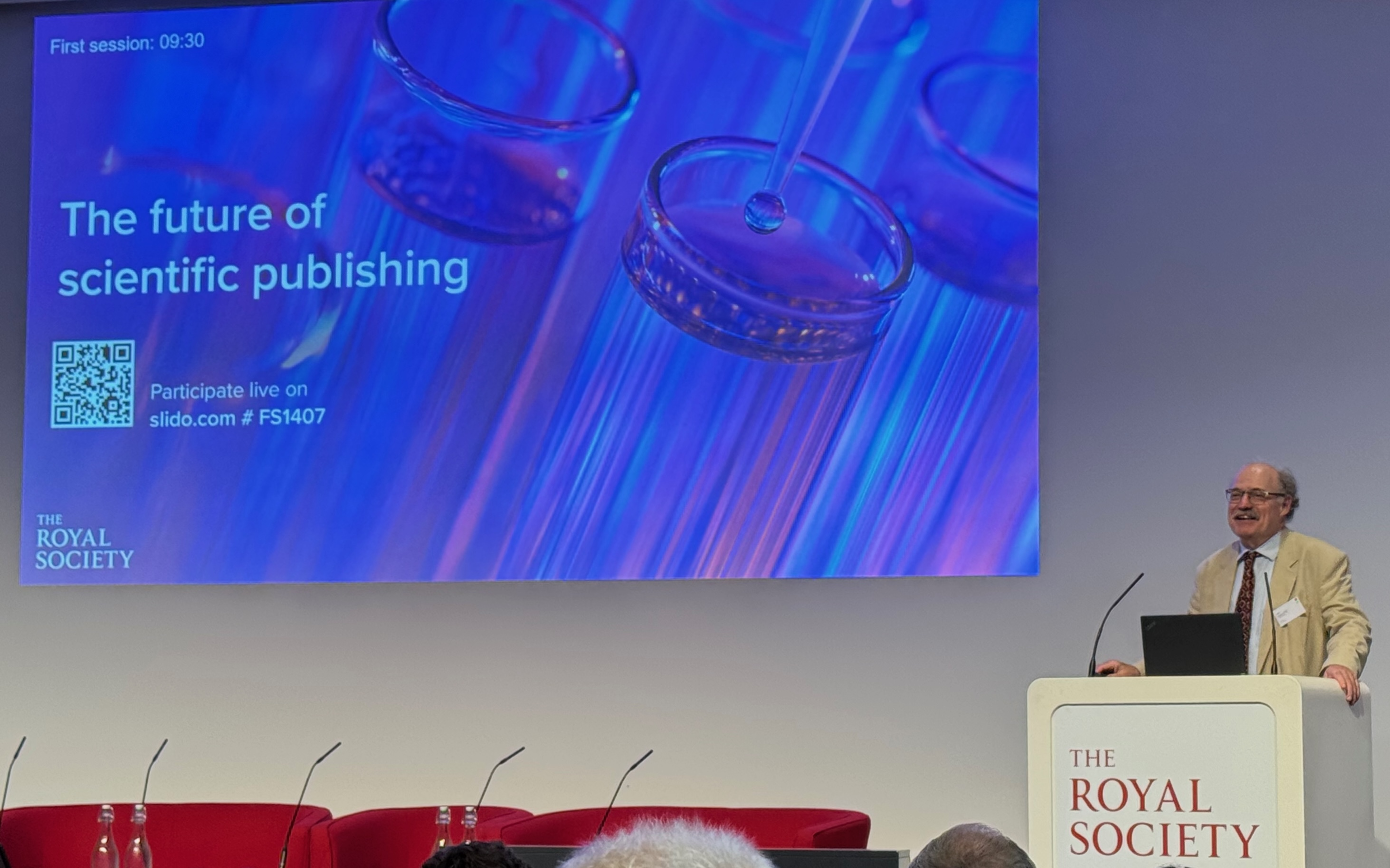
Sir Mark Walport FRS opens up the conference
## Mark Walport sets the scene
Sir Mark Walport was a delightful emcee for the proceedings of the day, and
opened how important the moment is for the future of how we conduct science.
Academic publishing faces a perfect storm: peer review is buckling under
enormous volume, funding models are broken and replete with perverse
incentives, and the entire system groans with inefficiency.
The Royal Society is the publisher of the world's oldest continuously published
scientific journal [Philosophical Transactions](https://royalsocietypublishing.org/journal/rstb)
(since 1665) and has convened this conference for academies worldwide. The
overall question is: what *is* a scientific journal in 2025 and beyond?
Walport traced the economic evolution of publishing: for centuries, readers
paid through subscriptions (I hadn't realised that the [early editions of the RS](https://royalsociety.org/blog/2015/03/philosophical-transactions-the-early-years/)
used to be sent for free to libraries worldwide until the current commercial
model arrived about 80 years ago).. Now, the pendulum has swung to open access
that creates perverse incentives that prioritize volume over quality. He called
it a "smoke and mirrors" era where diamond open access models obscure who
_actually_ pays for the infrastructure of knowledge dissemination: is it the
publishers, the governments, the academics, the libraries, or some combination
of the above? The profit margins of the commercial publishers answers that
question for me...
He then identified the transformative forces that are a forcing function:
- LLMs have [entered](https://anil.recoil.org/papers/2025-ai-poison) the publishing ecosystem
- The proliferation of journals has created an attention economy rather than a knowledge economy
- [Preprint](https://openreview.net/) archives are reshaping how research is shared quickly
The challenges ahead while dealing with these are maintaining metadata
integrity, preserving the scholarly archive into the long term, and ensuring
systematic access for meta-analyses that advance human knowledge.
## Historical Perspectives: 350 Years of Evolution
The opening pair of speakers were unexpected: they brought a historical and
linguistic perspective to the problem. I found both of these talks the
highlights of the day! Firstly [Professor Aileen
Fyfe](https://www.st-andrews.ac.uk/history/people/akf) drew upon her research
from 350 years of the Royal Society archives. Back in the day, there was no
real fixed entity called a "scientific journal". Over the centuries, everything
from editorial practices to publication methods over to dissemination means
have transformed repeatedly, so we shouldn't view the status quo as set in stone.
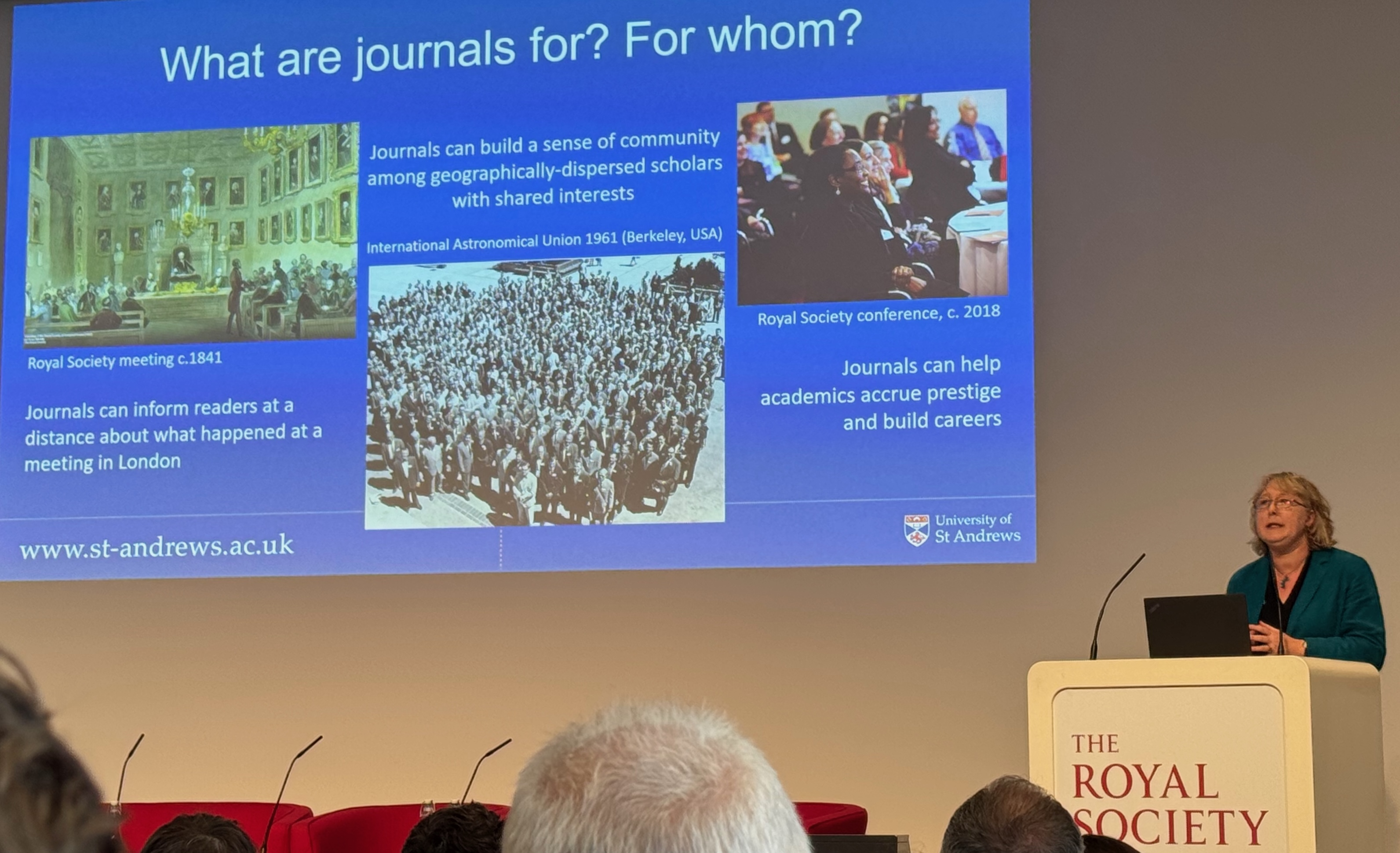
Professor Aileen Fyfe talks publishing history
While the early days of science were essentially people writing letters to each
other, the post-WWII era of journals marked the shift to "scale". The tools for
distance communication (i.e. publishing collected issues) and universities
switching from being teaching focused over to today's research-centric
publishing ecosystem were both key factors. University scientists used to
produce 30% of published articles in 1900; by 2020, that figure exceeded 80%.
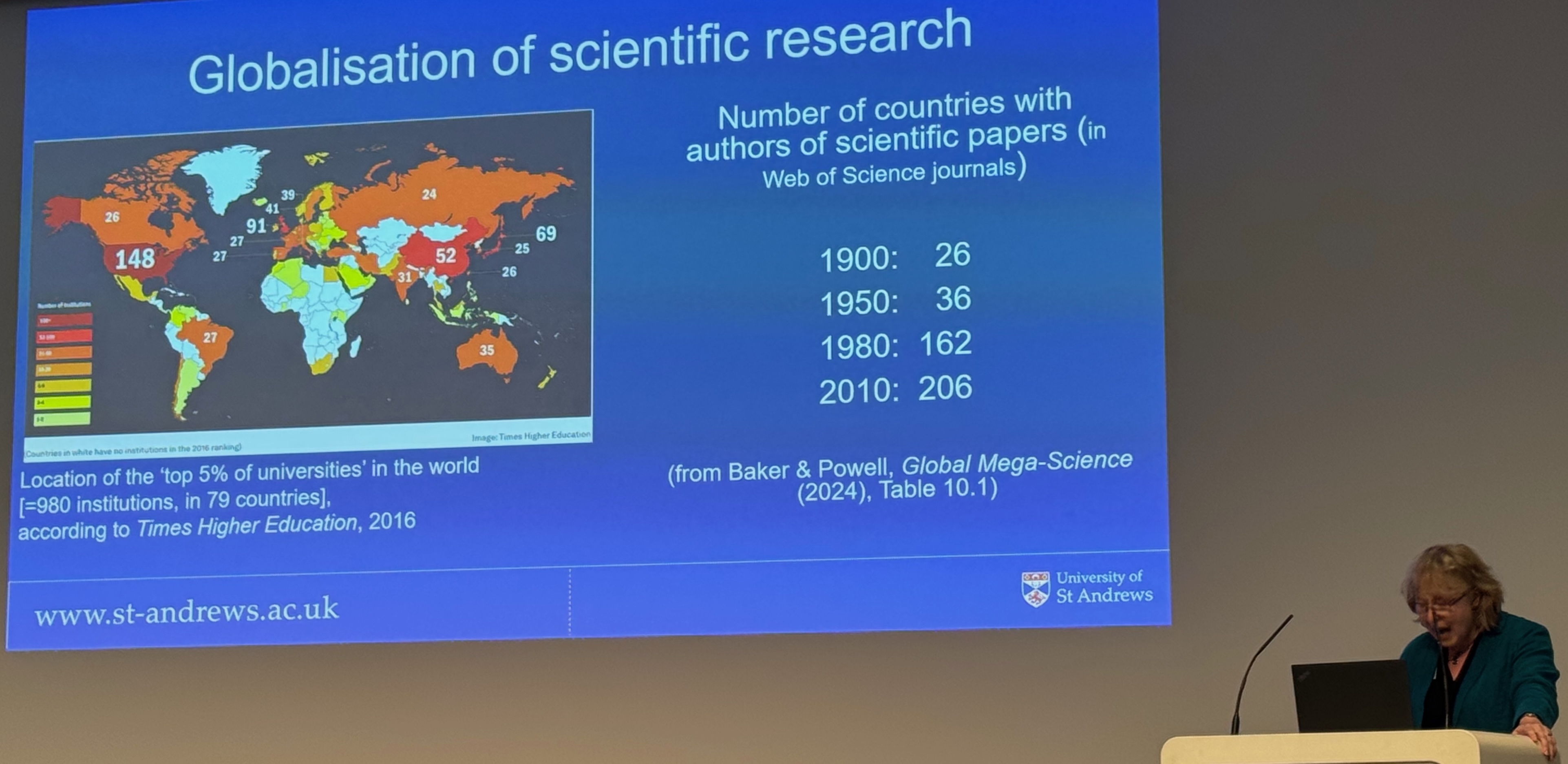
This parallels the globalization of science itself in the past century;
research has expanded well beyond its European origins to encompass almost all
institutions and countries worldwide.
Amusingly, Prof Fyfe pointed out that a 1960 Nature editorial asked *"[How many more new
journals?](https://www.nature.com/articles/186018a0)"* even back then! The 1950s
did bring some standardization efforts (nomenclature, units, symbols) also
though citation formats robustly seem to resist uniformity. English was also
explicitly selected as the "[default language for
science](https://en.wikipedia.org/wiki/Languages_of_science), and peer review
was also formalised via papers like *"[Uniform requirements for manuscripts submitted to biomedical journals](https://journals.sagepub.com/doi/10.1177/000456327901600179)"* (in 1979). [US Congressional hearings](https://nsf-gov-resources.nsf.gov/pubs/1977/nsb77468/nsb77468.pdf)
with the NSF began distinguishing peer review from other evaluation methods.
Professor Aileen Fyfe shows the globalisation of research over the years
All of this scale was then "solved" by financialisation after WWII. At the turn of the
20th century, almost no journals generated any profit (the Royal Society
distributed its publications freely). By 1955, financial pressures and growing scale of submissions forced a
[reckoning](https://journals.sagepub.com/doi/10.1177/0073275321999901), leading
to more self-supporting models by the 1960s. An era of mergers and acquisitions
among journals followed, reshaping the [scientific information system](https://serials.uksg.org/articles/259/files/submission/proof/259-1-259-1-10-20150210.pdf).
[Professor Vincent Larivière](https://www.universiteitleiden.nl/en/staffmembers/vincent-lariviere#tab-1) then took the stage to dispel some myths of English monolingualism in scientific publishing. While [English offers some practical benefits](https://garfield.library.upenn.edu/essays/V1p019y1962-73.pdf), the reality at non-Anglophone institutions (like his own Université de Montréal) reveals that researchers spend significantly more time reading, writing, and processing papers as non-native language speakers, and often face higher rejection rates as a result of this.
This wasn't always the case though; Einstein published primarily in German, not English\!
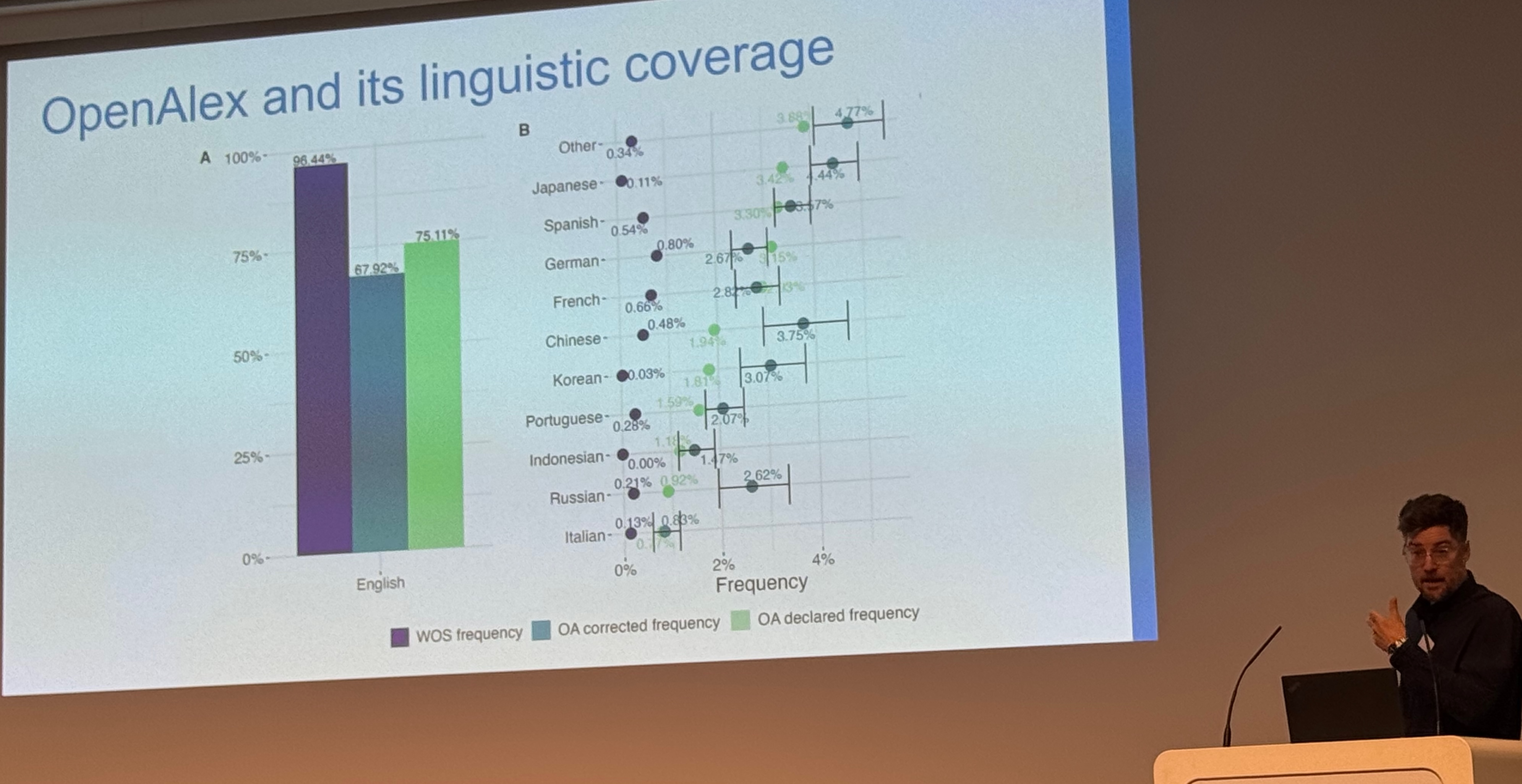
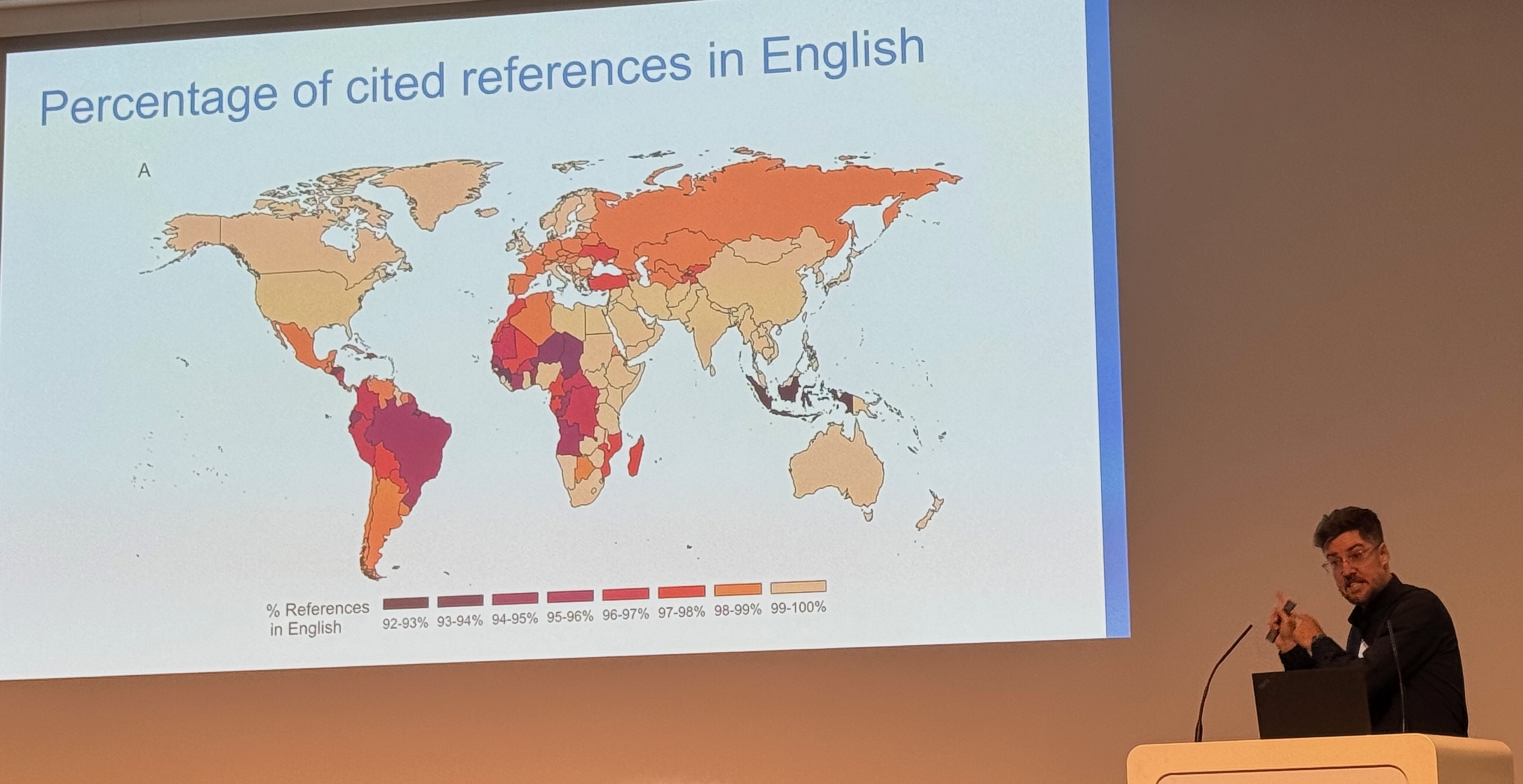
He went on to note that today's landscape for paper language choices is more
diverse than is commonly assumed. English represents only 67% of publications,
a figure whic itself has been inflated by non-English papers that are commonly
published with English abstracts. Initiatives like the [Public Knowledge
Project](https://pkp.sfu.ca/2025/03/05/ojs-workshops-indonesia/) has enabled
growth in Indonesian and Latin America for example. Chinese journals now
publish twice the volume of English-language publishers, but are difficult to
index which makes Lariviere's numbers even more interesting: a growing majority
of the world is no longer publishing in English! I also heard this in my trip
in 2023 to China with the Royal Society; the scholars we met had a sequence of
Chinese language journals they submitted too, often before "translating" the
outputs to English journals.
Professor Lariviere uses OpenAlex to show non-English linguistic breakdowns
All this leads us to believe that the major publisher's market share is smaller than commonly believed, which gives us reason for hope to change! Open access adoption worldwide currently varies fairly dramatically by per-capita [wealth and geography](https://ourworldindata.org/grapher/scientific-publications-per-million), but reveals substantive greenspace for publishing beyond the major commercial publishers. Crucially, Larivière argued that research "prestige" is a socially constructed phenomenon, and not intrinsic to quality.
In the Q\&A, Magdalena Skipper (Nature's Editor-in-Chief) noted that the private sector is reentering academic publishing (especially [in AI topics](https://www.science.org/content/article/china-tops-world-artificial-intelligence-publications-database-analysis-reveals)). Fyfe noted the challenge of tracking private sector activities; e.g. varying corporate policies on patenting and disclosure mean they are hard to infdex. A plug from [Coherent Digital](https://coherentdigital.net/) noted they have catalogued 20 million reports from non-academic research; this is an exciting direction (we've got [30TB of grey literature](https://anil.recoil.org/ideas/grey-lit-crawl) on our servers, still waiting to be categorisd).
Professor Lariviere shows how uneven citations are across languages and geographies
## What researchers actually need from STEM publishing
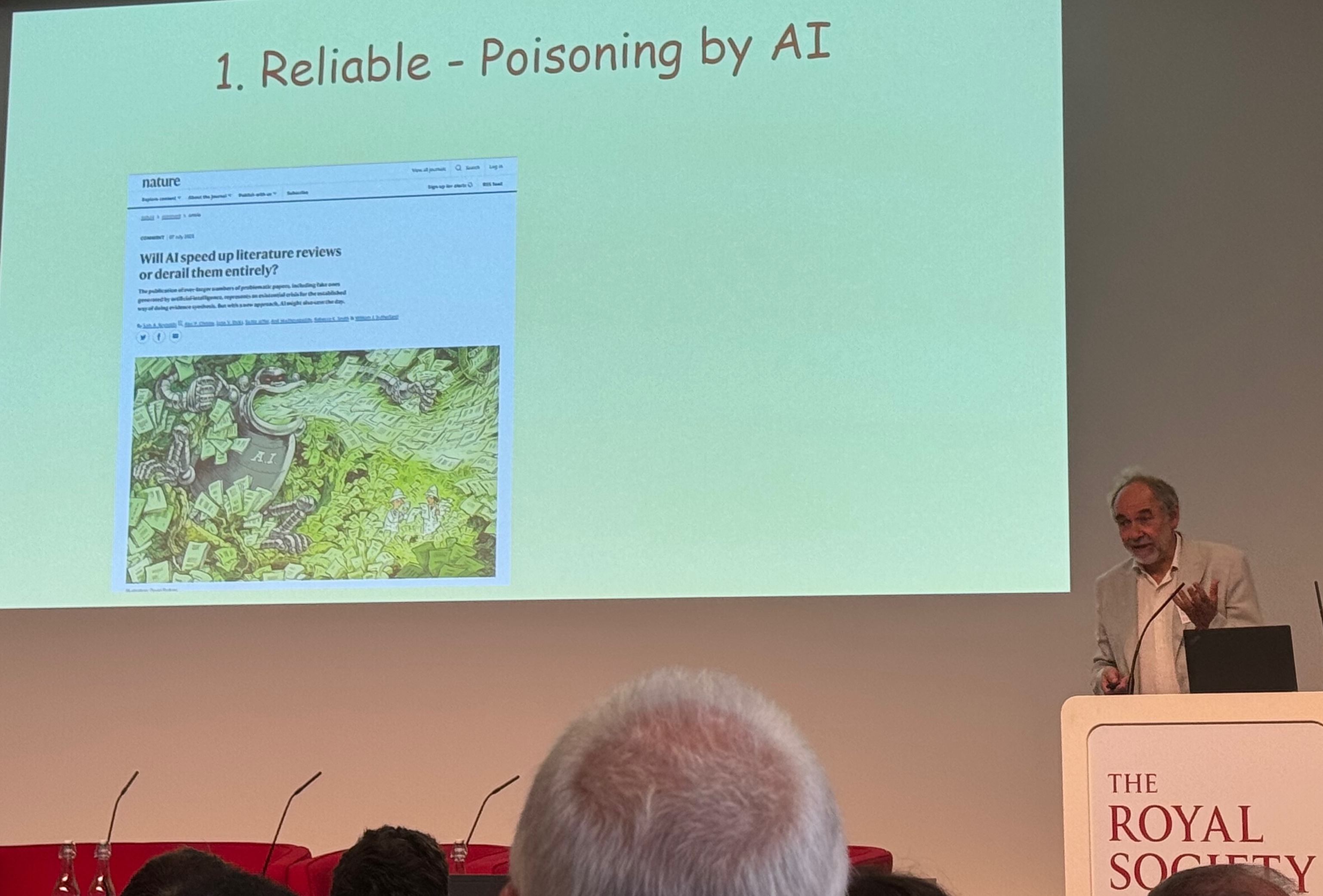
Our very own [Bill Sutherland](https://www.zoo.cam.ac.uk/directory/bill-sutherland) opened with a sobering demonstration of "AI
poisoning" in the literature, referencing [our recent Nature
comment](/static/papers/2025-ai-poison.pdf). He did the risky-but-catchy
generation of a plausible-sounding but entirely fabricated conservation study
using an LLM and noted how economically motivated rational actors might quite
reasonably use these tools to advance their agendas via the scientific record.
And recovering from this will be very difficult indeed once it mixes up with
real science.
Bill talks about our recent AI poisoning piece
Bill then outlined our [emerging approach to subject-wide synthesis](https://anil.recoil.org/projects/ce) via:
- **Systematic reviews**: Slow, steady, comprehensive
- **Rapid reviews**: Sprint-based approaches for urgent needs
- **Subject-wide evidence synthesis**: Focused sectoral analyses
- **Ultrafast bespoke reviews**: AI-accelerated with human-in-the-loop
Going back to what ournals are *for* in 2025, Bill then discussed how they were
originally vehicles for exchanging information through letters, but now serve
primarily as stamps of authority and quality assurance. In an "AI slop world,"
this quality assurance function becomes existentially important, but shouldn't
necessarily be implemented in the current system of incentives. So then, how do
we maintain trust when the vast majority of submissions may soon be
AI-generated? *(Bill and I scribbled down a plan on the back of a napkin for
this; more on that soon!)*
Bill also does a cheeky advert for his Conservation Concepts channel!
### Early Career Researcher perspectives
[Dr. Sophie Meekings](https://www.york.ac.uk/psychology/staff/postdocs/meekings,-sophie/) then took the stage to discuss the many barriers facing early career researchers (ECRs). They're on short-term contracts, are dependent on others people's grant funding, and yet are the ones conducting the frontline research that drives scientific progress. And this is _after_ years spent on poorly paid PhD stipends\!
ECRs require:
- clear, accessible guidelines spelling out each publishing stage without requiring implicit knowledge of the "system"
- constructive, blinded peer review\*\* that educates rather than gatekeeps
- consistent authorship conventions like [CRediT](https://www.elsevier.com/researcher/author/policies-and-guidelines/credit-author-statement) (Contributor Roles Taxonomy)
Dr. Meekings then noted how the precarious nature of most ECR positions creates cascading complications for individuals. When job-hopping between short-term contracts, who funds the publication of work from previous positions? How do ECRs balance completing past research with new employers' priorities? [Eleanor Toye Scott](https://www.cst.cam.ac.uk/people/eft20) also had this issue when joining my group a few years ago, as it took a significant portion of her time in the first year to finish up her previous publication from her last research contract.
If we're going to fix the system itself, then ECRs need better incentives for PIs to publish null results and exploratory work, the councils need to improve support for interdisciplinary research that doesn't fit traditional journal boundaries (as these as frontiers between "conventional" science where many ECRs will work), and recognition that ECRs often lack the networks for navigating journal politics where editors rule supreme.
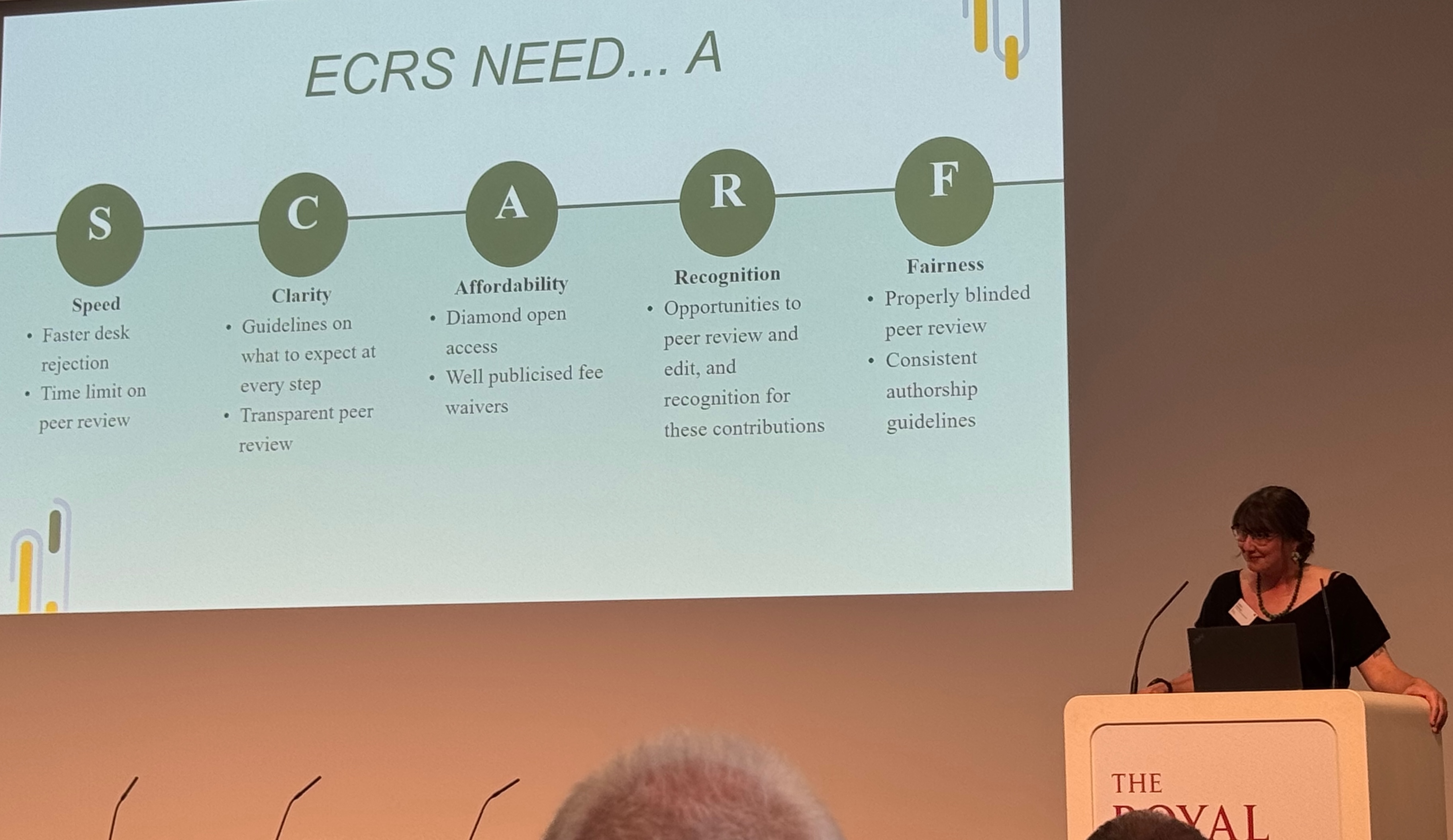
Dr. Meekings summarized ECR needs with an excellent new acronym (SCARF) that drew a round of applause\!
- **S**peed in publication processes
- **C**larity in requirements and decisions
- **A**ffordability of publication fees
- **R**ecognition of contributions
- **F**airness in review and credit
Dr Sophie Meekings' SCARF principles for ECRs
The audience Q\&A was quite robust at this point. The first question was about how might we extend the evidence synthesis approach widely?
[Bill Sutherland](https://www.zoo.cam.ac.uk/directory/bill-sutherland) noted that we are currently extending this to education working with [Jenny Gibson](https://www.educ.cam.ac.uk/people/staff/gibson/). Interconnected datasets _across_ subjects are an obvious future path for evidence datasets, with common technology for handling (e.g.) retracted datasets that can be applied consistently. [Sadiq Jaffer](https://toao.com) and [Alec Christie](https://profiles.imperial.ac.uk/a.christie) are supervising [projects on evidence synthesis](https://anil.recoil.org/notes/eeg-interns-2025) this summer on just this topic here in Cambridge.
Another question was why ECRs feel that double blind review is important. Dr. Meekings noted that reviewers may not take ECR peer reviews as seriously, but this coul dbe fixed by opening up peer review and assigning credit _after_ the process is completed and not during. Interestingly, the panel all like double-blind, which is the norm in computer science but not in other science journals. Some from the BMJ noted there exists a lot of research into blinding; they summarised it that blinding doesn't work on the whole (people know who it is anyway) and open review doesn't cause any of the problems that people think it causes.
A really interesting comment from Mark Walport was that a grand scale community project could work for the future of evidence collation, but this critically depends on breaking down the current silos since it doesn't work unless everyone makes their literature available. There was much nodding from the audience in support of this line of thinkin.g
## Charting the future for scientific publishing
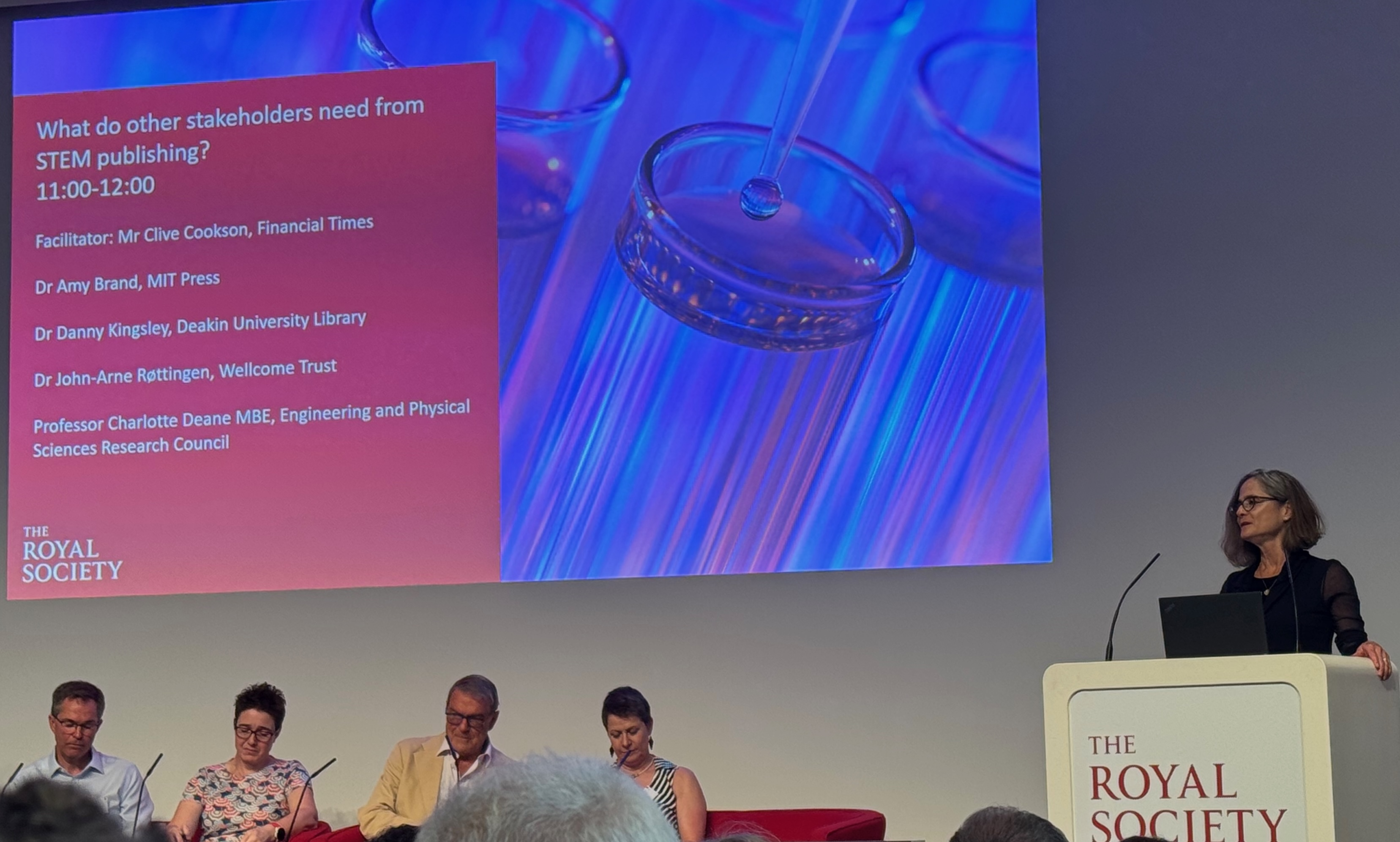
The next panel brought together folks from across the scientific
publishing ecosystem, moderated by Clive Cookson of the Financial Times. This
was a particularly frank and pointed panel, with lots of quite direct messages
being sent between the representatives of libraries, publishers and funders\!
Amy Brand from MIT Press opens the panel
Amy Brand (MIT Press) started by delivered a warning about conflating "open to
read" with "open to train on". She pointed out that when MIT Press did a survey
across their authors, many of them raised concerns about the reinforcement of
bias through AI training on scientific literature. While many of the authors
acknowledged a moral imperative to make science available for LLM training,
they also wanted the _choice_ of making their own work used for this. She urged
the community to pause and ask fundamental questions like "AI training, at what
cost?" and "to whose benefit?". I did think she made a good point by drawing
parallels with the early internet, where Brand pointed out that lack of
regulation accelerated the decline of non-advertising-driven models. Her
closing question asked if search engines merely lead to AI-generated summaries,
why serve the original content at all? This is something we discuss in our
[upcoming Aarhus paper on an Internet ecology](https://anil.recoil.org/papers/2025-internet-ecology).
[Danny Kingsley](https://experts.deakin.edu.au/66981-danny-kingsley) from Deakin University Library then delivered a biting perspective as a representative of libraries. She said that libraries are "the ones that sign the cheques that keeps the system running", which the rest of the panel all disagreed with in the subsequent discussion (they all claimed to be responsible, from the government to the foundations). Her survey of librarians was interesting; they all asked for:
- Transparent peer review processes
- Unified expectations around AI declarations and disclosures
- Licensing as open as possible, resisting the "salami slicing" of specific use. We also ran across this problem of overly precise restrictions on use while [building our paper corpus](https://anil.recoil.org/papers/2025-ai-poison) for [CE](https://anil.recoil.org/projects/ce).
Kingsley had a great line that "publishers re monetizing the funding mandate",
which [Charlotte Deane](https://www.stats.ox.ac.uk/~deane/) later also said was the most succinct way she had heard
to describe the annoyance we all have with the vast profit margins of
commercial publishers. Kingsley highlighted this via the troubling practices
in the IEEE and the American Chemical Society by charging to place repositories
under green open access. Her blunt assessment was that publishers are not
negotiating in good faith. Her talk drew the biggest applause of the day by
far.
After this, [John-Arne
Røttingen](https://wellcome.org/about-us/our-people/staff/john-arne-rottingen)
(CEO of the Wellcome Trust) emphasised that funders depend on scientific
discourse as a continuous process of refutations and discussions. He expressed
concern about overly depending on brand value as a proxy for quality, calling
it eventually misleading even if it works sometimes in the short term. Key
priorities the WT have is ensuring that reviewers have easy access to all
literature, to supporting evidence synthesis initiatives to translate research
into impact, and controlling the open body of research outputs through digital
infrastructure to manage the new scale. However, his challenge lies in
maintaining sustainable financing models for all this research data; he noted
explicitly that the Wellcome would not cover open access costs for commercial
publishers.
Røttingen further highlighted the Global Biodata Coalition (which he was a
member of) concerns about US data resilience and framed research infrastructure
as "a global public good" requiring collective investment and fair financing
across nations. Interestingly, he explicitly called out UNESCO as a weak force
in global governance for this from the UN; I hadn't even realised that UNESCO
was responsible for this stuff\!
Finally, [Prof Charlotte Deane](https://www.stats.ox.ac.uk/~deane/) from the EPSRC also discussed what a scientific
journal is for these days. It's not for proofreading or typesetting anymore and
(as [Bill Sutherland](https://www.zoo.cam.ac.uk/directory/bill-sutherland) also noted earlier), the stamp of quality is key. Deane
argued that "research completion" doesn't happen until someone else can read it
and reasonably verify the methods are sound; not something that can happen
without more open access. Deane also warned of the existential threat of [AI poisoning](https://anil.recoil.org/notes/ai-poisoning) since "AI can make fake papers at a rate humans can't
imagine. It won't be long before mose of the content on the Internet will be AI
generated".
The audience Q\&A was _very_ blunt here. [Stefanie Haustein](https://uniweb.uottawa.ca/view/profile/members/2846) pointed out that we
are pumping of billions of dollars into the publishing industry, many of which
are shareholder companies, and so we are losing a significant percentage of
each dollar spent. There is enough money in the system, but it's very
inefficiently deployed right now\!
[Richard Sever](https://www.linkedin.com/in/richardsever) from openRxiv asked
how we pay for this when major funders like the NIH have issued a series of
_unfunded_ open data mandates over recent years. John-Arne Rottingen noted that
UNESCO is a very weak global body and not influential here, but that we need
coalitions of the willing to build such open data approaches from the bottom
up. Challenging the publisher hegemony can only be done as a pack, which lead
nicely onto the next session after lunch where the founder of
[OpenAlex](https://openalex.org/) would be present\!
## Who are the stewards of knowledge ?
After lunch (where sadly, the vegetarian options were terrible but
luckily I had my trustly Huel bar!), we reconvened with a panel debating
who the stewards of the scientific record should be. This brought together
perspectives from commercial publishers (Elsevier), open infrastructure advocates (OpenAlex),
funders (MRC), and university leadership (pro-VC of Birmingham).
[Victoria Eva](https://www.elsevier.com/people/victoria-eva) ([SVP from
Elsevier](https://researcheracademy.elsevier.com/publication-process/open-science/open-access-end-user-licenses))
opened by describing the "perfect storm" facing their academic publishing
business as they had 600k more submissions this year than the previous year.
There was a high level view on how their digital pipeline "aims to insert
safeguards" throughout the publication process to maintain integrity. She
argued in general terms to view GenAI through separate lenses of trust and
discoverability and argud that Elsevier's substantial technological investments
position them to manage both challenges well. I was
[predisposed](https://www.theguardian.com/science/2017/jun/27/profitable-business-scientific-publishing-bad-for-science)
to dislike excuses from staggeringly profitable commercial publishers, but I
did find her answers to providing bulk access to their corpus unsatisfying.
While she highlighted their growing open access base of papers, she also noted
that the transitionon to open access cannot happen overnight (my personal
translation is that this means slow-walking). She mentioned special cases in
place for
[TDM](https://www.elsevier.com/en-gb/about/open-science/research-data/text-and-data-mining)
in the Global South and healthcare access (presumably at the commercial
discretion of Elsevier).
[Jason Priem](https://jasonpriem.org/) from [OpenAlex](https://openalex.org/)
(part of [OurResearch](https://ourresearch.org/)) then offered a radically
different perspective. I'm a huge fan of OpenAlex, as we use it extensively in
the [CE](https://anil.recoil.org/projects/ce) infrastructure. He disagreed with the conference framing of
publishers as "custodians" or "stewards," noting that these evoke someone
maintaining a static, old lovely house. Science *isn't* a static edifice but a
growing ecosystem, with more scientists alive today than at any point in
history. He instead proposed a "gardener" as a better metaphor; the science
ecosystem needs to nourish growth rather than merely preserving what exists.
Extending the metaphor, Priem contrasted French and English garden styles:
French gardens constrain nature into platonic geometric forms, while English
gardens embrace a more rambling style that better represents nature's inherent
diversity. He argued that science needs to adopt the "English garden" approach
and that we don't have an information overload problem but rather "[bad
filters](https://www.cnet.com/culture/shirky-problem-is-filter-failure-not-info-overload/)"
(to quote Clay Shirky).
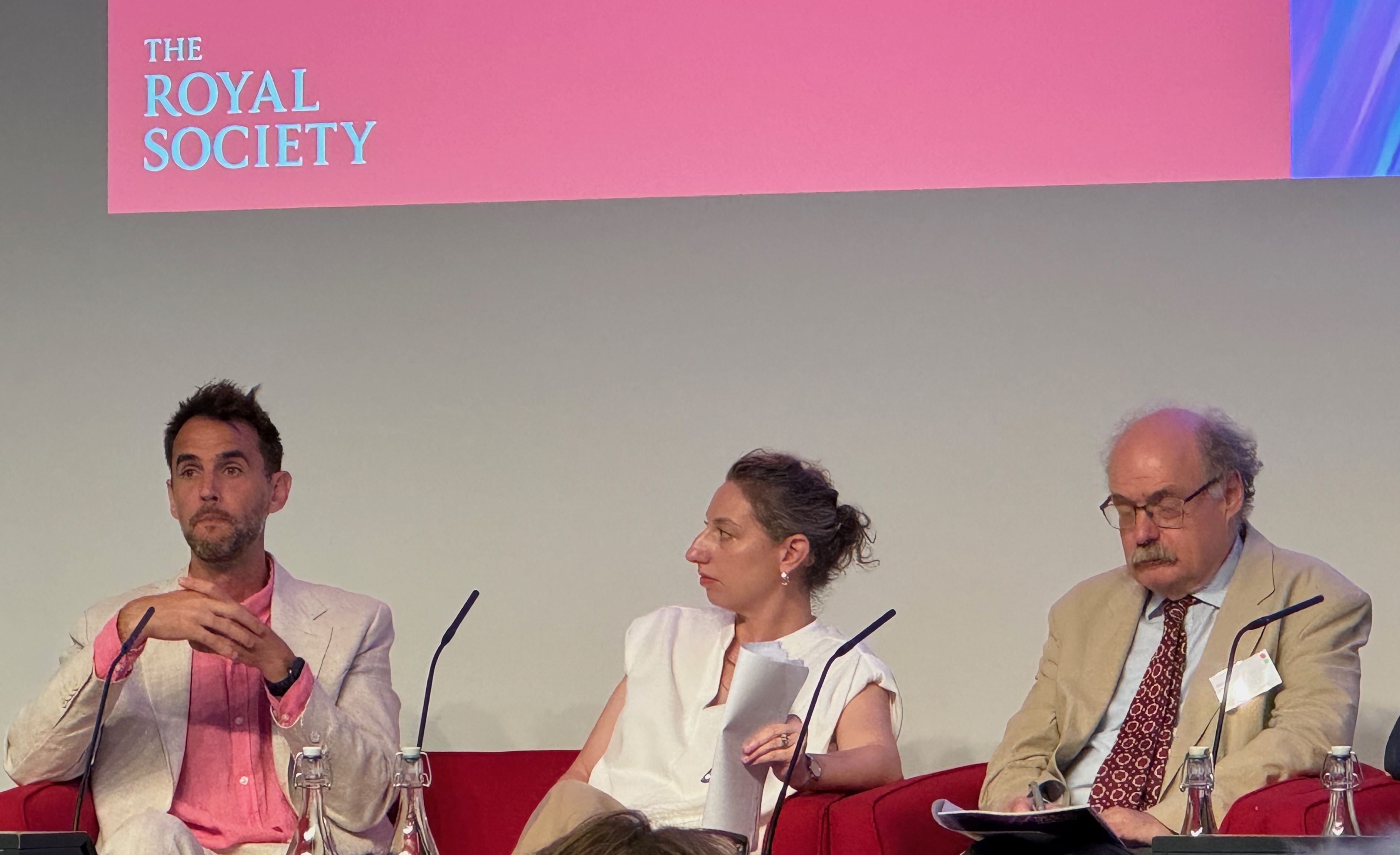
Jason Priem (OpenAlex), Victoria Eva (Elsevier) and Mark Walport in the panel
Priem advocated *strongly* for open infrastructures since communities don't just produce papers: also software, datasets, abstracts, and things we don't envision yet. If we provide them with the "digital soil" (open infrastructure) then they will prosper. OpenAlex and [Zenodo](https://zenodo.org/) are great examples of how such open infrastructure hold up here. I use both all the time; I'm a huge fan of Jason's work and talk.
[Patrick Chinnery](https://www.ukri.org/people/patrick-chinnery/) from the Medical Research Council brought the funder perspective with some numbers: publishing consumes 1 to 2% of total research turnover funds (roughly £24 million for UKRI) . He noted that during the pandemic, decision-makers were reviewing preprint data in real-time to determine which treatments should proceed to clinical trials and decisions had to be reversed after peer review revealed flaws. He emphasised the the need for more real time quality assurance in rapid decision-making contexts.
[Adam Tickell](https://en.wikipedia.org/wiki/Adam_Tickell) from the University of Birmingham declared the current model "broken", and not that each attempt at reform fails to solve the *basic problem of literature access* (something I've faced myself). He noted that David Willetts (former UK Minister for Science) couldn't access paywalled material while minister of science in government (!) which significantly influenced [subsequent government policy](https://www.gov.uk/government/news/government-to-open-up-publicly-funded-research) towards open access.
Tickell was scathing about the oligopolies of Elsevier and Springer, arguing their [profit margins](https://www.researchprofessionalnews.com/rr-news-world-2025-2-elsevier-parent-company-reports-10-rise-in-profit-to-3-2bn/) are out of proportion with the public funding for science. He noted that early open access attempts from the [Finch Report](https://ioppublishing.org/news/spotlight-on-the-finch-report/) were well-intentioned but ultimately insufficient to break the hegemony. Perhaps an opportunity for a future UK [National Data Library](https://anil.recoil.org/notes/uk-national-data-lib)...
Tickell closed his talk with an observation about the current crisis of confidence in science. This did make me think of a [recent report on British confidence in science](https://bsky.app/profile/hetanshah.bsky.social/post/3lttyexntps2y), which shows the British public still retains belief in scientific institutions. So at least we're doing better than the US in this regard for now\!
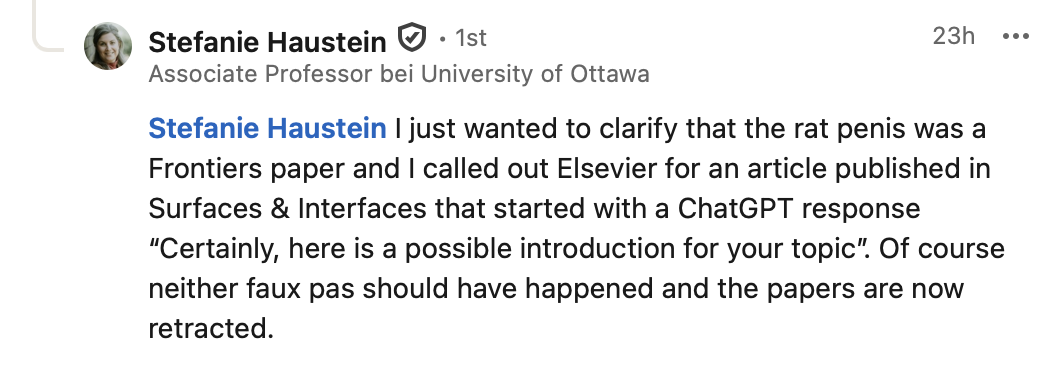
Stefanie Haustein points out ChatGPT-related content in response to Elsevier's comments on stage.
The Q\&A session opened with Mark Walport asked how Elsevier manages to publish so many articles. Victoria Eva from Elsevier responded that they receive 3.5m articles annually with ~750k published. Eva mentioned something about "digital screening throughout the publication process" but acknowledged that this was a challenge due to the surge from paper mills. A suggestion of paying peer reviewers was raised from the audience but not substantively addressed. [Stefanie Haustein](https://www.scholcommlab.ca/stefanie-haustein/) once again made a great point from the audience about how Elsevier could let through [AI generated rats with giant penises](https://www.vice.com/en/article/scientific-journal-frontiers-publishes-ai-generated-rat-with-gigantic-penis-in-worrying-incident/) with all this protection in place; clearly, some papers have been published by them with no humans ever reading it. This generated a laugh from the audience, and an acknowlegment from the Elsevier rep that they needed to invest more and improve.
## How to make open infrastructure sustainable
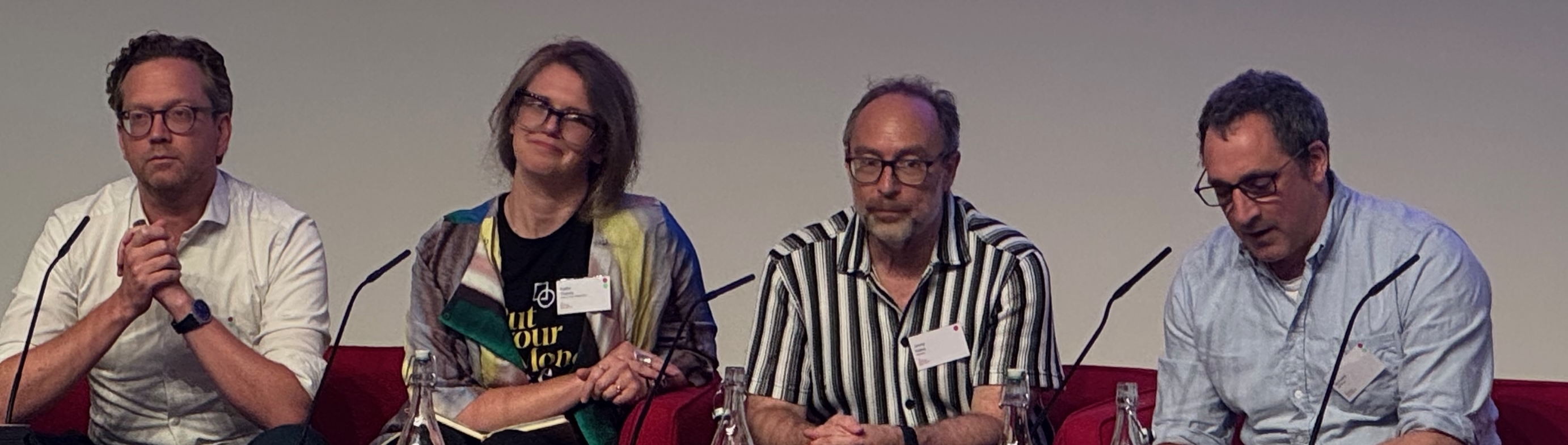
My laptop power ran out at this point, but the next panel was an absolute treat as it had both [Kaitlin Thaney](https://kaythaney.com/) and [Jimmy Wales](https://en.wikipedia.org/wiki/Jimmy_Wales) of Wikipedia fame on it\!
Hylke Koers, Kaitlin Thaney, Jummy Wales and Ian Mulvany
Jimmy Wales pointed out an interesting point from his "seven rules of trust" is that a key one is to be personal with human-to-human contact and not run too quickly to technological solutions. Rather than, for example, asking what percentage of academic papers showed evidence of language from ChatGPT, it's more fruitful to ask whether the science contained within the paper is good instead of how it's written. There are many reasons why someone might have used ChatGPT (non-native speakers etc) but also many reasons unrelated why the science might be bad.
Kaitlin Thaney pointed out the importance of openness given [the US assault on
science](https://www.motherjones.com/politics/2025/07/trump-war-assault-national-science-foundation-american-innovation-greatness-education/)
means that the open data repositories can be replicated reasonably as well.
Ian Mulvaney pointed out that Nature claims to have invested \$240m in research
infrastructure, and this is a struggle for a medium sized publisher (like his
own [BMJ](https://www.bmj.com/)). Open infrastructure allows sharing and
creation of value to make it possible to let these smaller organisations
survive.
When it comes to policy recommendations, what did the panel have to say about a more trustworthy literature?
- The [POSI principles](https://www.ccsd.cnrs.fr/en/posi-principles/) came up as important levels.
- Kaitlin mentioned the [FOREST framework](https://www.nextgenlibpub.org/forest-framework) funded by Arcadia and how they need to manifest in concrete infrastructure. There's an implicit reliance on infrastructure that you only notice when it's taken away! Affordability of open is a key consideration as well.
- Jimmy talked about open source software, and what generally works is not one-size-fits-all. Some are run by companies (their main product and they sell services), and others by individuals. If we bring this back to policy, we need to look at preserving whats already working sustainably but support it. Dont try to find a general solution but adopt targeted, well thought through interventions instead.
*I'm updating this as I go along but running out of laptop battery too\!*
Synopsis: Live notes from Royal Society conference on scientific publishing challenges including peer review crisis, AI poisoning threats and open access economics.
Words: 3906
DOI: 10.59350/nmcab-py710
## Related
- [.plan-26-06: Vivas, ARIA and interviews](https://anil.recoil.org/notes/2026w6) (note, 2026-02-08)
- [Dear ACM, you're doing AI wrong but you can still get it right](https://anil.recoil.org/notes/acm-ai-recs) (note, 2025-12-22)
- [Publish, Review, Curate to upend scholarly publishing](https://anil.recoil.org/notes/coar-prc) (note, 2025-12-08)
- [Four Ps for Building Massive Collective Knowledge Systems](https://anil.recoil.org/notes/principles-for-collective-knowledge) (note, 2025-11-23)
- [Steps towards an Ecology for the Internet](https://anil.recoil.org/papers/2025-internet-ecology) (paper, 2025-08-01)
- [Is AI poisoning the scientific literature? Our comment in Nature](https://anil.recoil.org/notes/ai-poisoning) (note, 2025-07-08)
- [Will AI speed up literature reviews or derail them entirely?](https://anil.recoil.org/papers/2025-ai-poison) (paper, 2025-07-01)
- [EEG internships for the summer of 2025](https://anil.recoil.org/notes/eeg-interns-2025) (note, 2025-06-28)
- [Thoughts on the National Data Library and private research data](https://anil.recoil.org/notes/uk-national-data-lib) (note, 2025-02-17)
- [Conservation Evidence Copilots](https://anil.recoil.org/projects/ce) (project, 2024-01-01)
- [Crawling grey literature for conservation evidence](https://anil.recoil.org/ideas/grey-lit-crawl) (idea, 2024-01-01)
---
Canonical: https://anil.recoil.org/notes/rs-future-of-publishing
Type: note
Tags: royalsociety, evidence, publishing, ai, livenotes