# Royal Society meeting on ecological/commercial risks
*2024-10-04 — note*
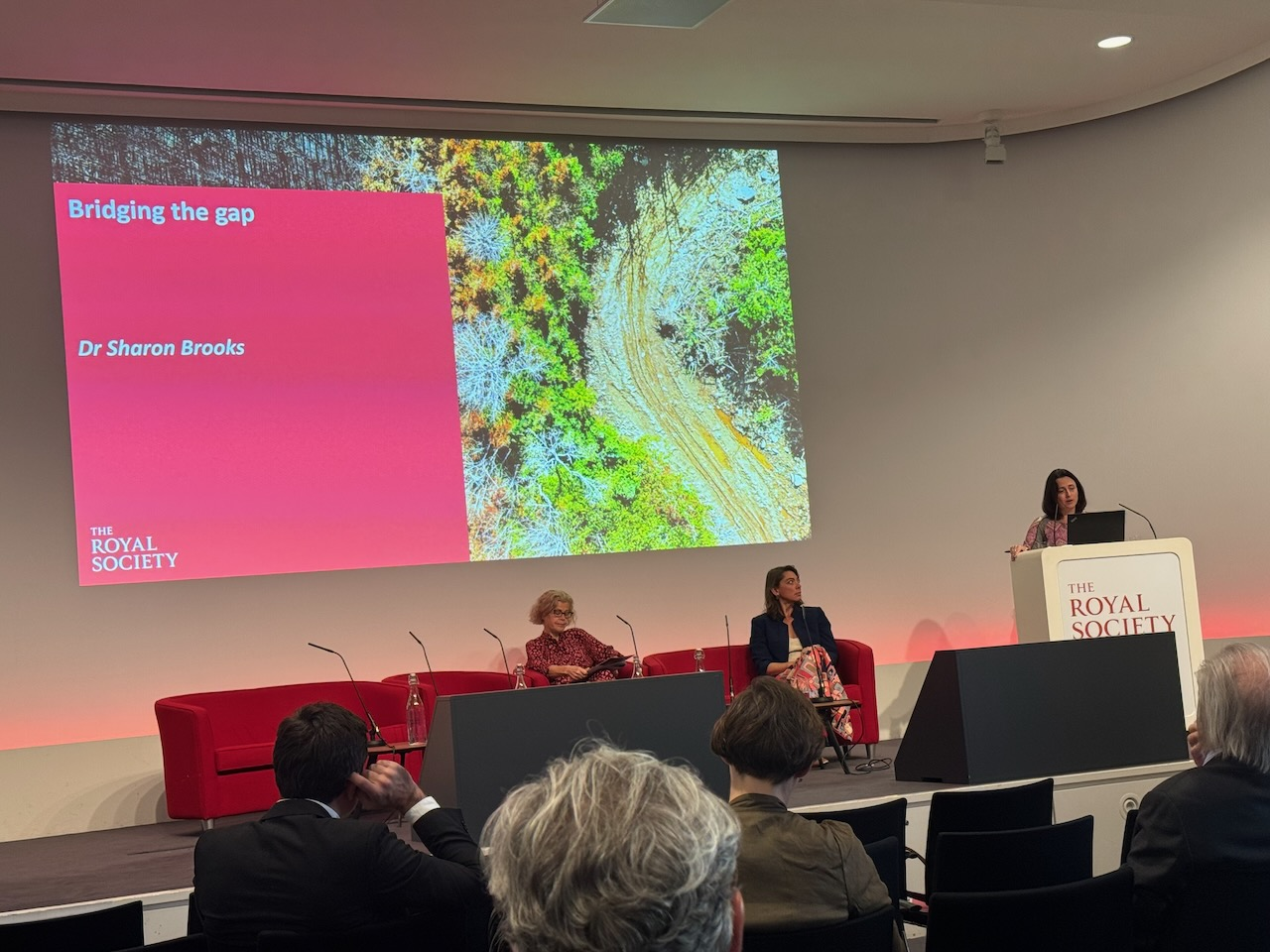
I'm at the Royal Society this morning for the 2 day programme on ["How does ecological risk related to commercial risk?"](https://royalsociety.org/science-events-and-lectures/2024/10/ecological-and-commercial-risk/), and am reporting on the [morning session](https://royalsociety.org/-/media/events/2024/10/ecological-risk/programme-booklet.pdf). The full program is being [livestreamed](https://www.youtube.com/watch?v=gVuxzand8RE) so please do dial in if the below notes seem interesting to you. I put this note up almost live, so any errors below are my own.
*(Update: partial [day 2 notes](#daytwo) now available below)*
## Opening Keynote by Sir Partha Dasgupta
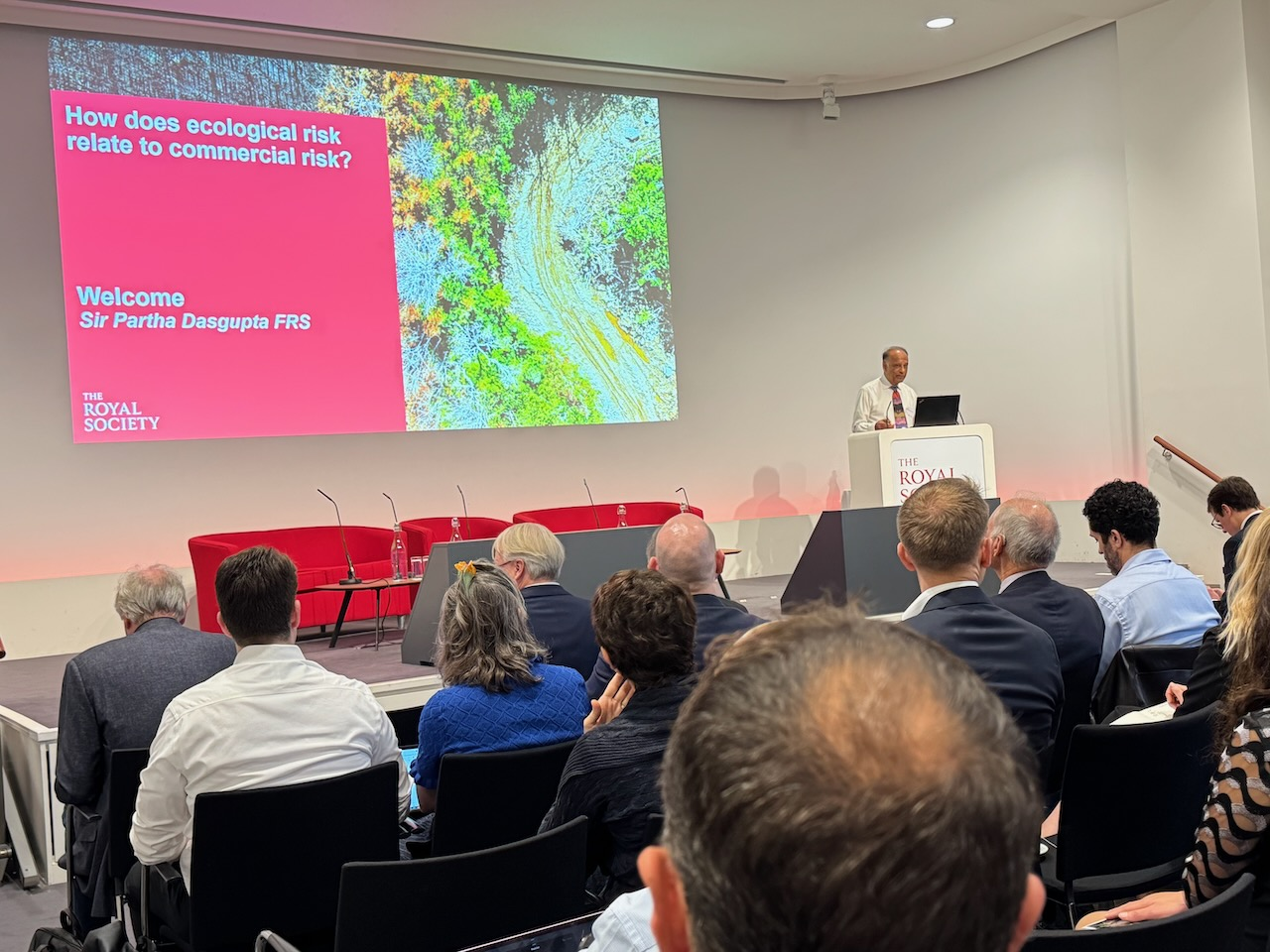
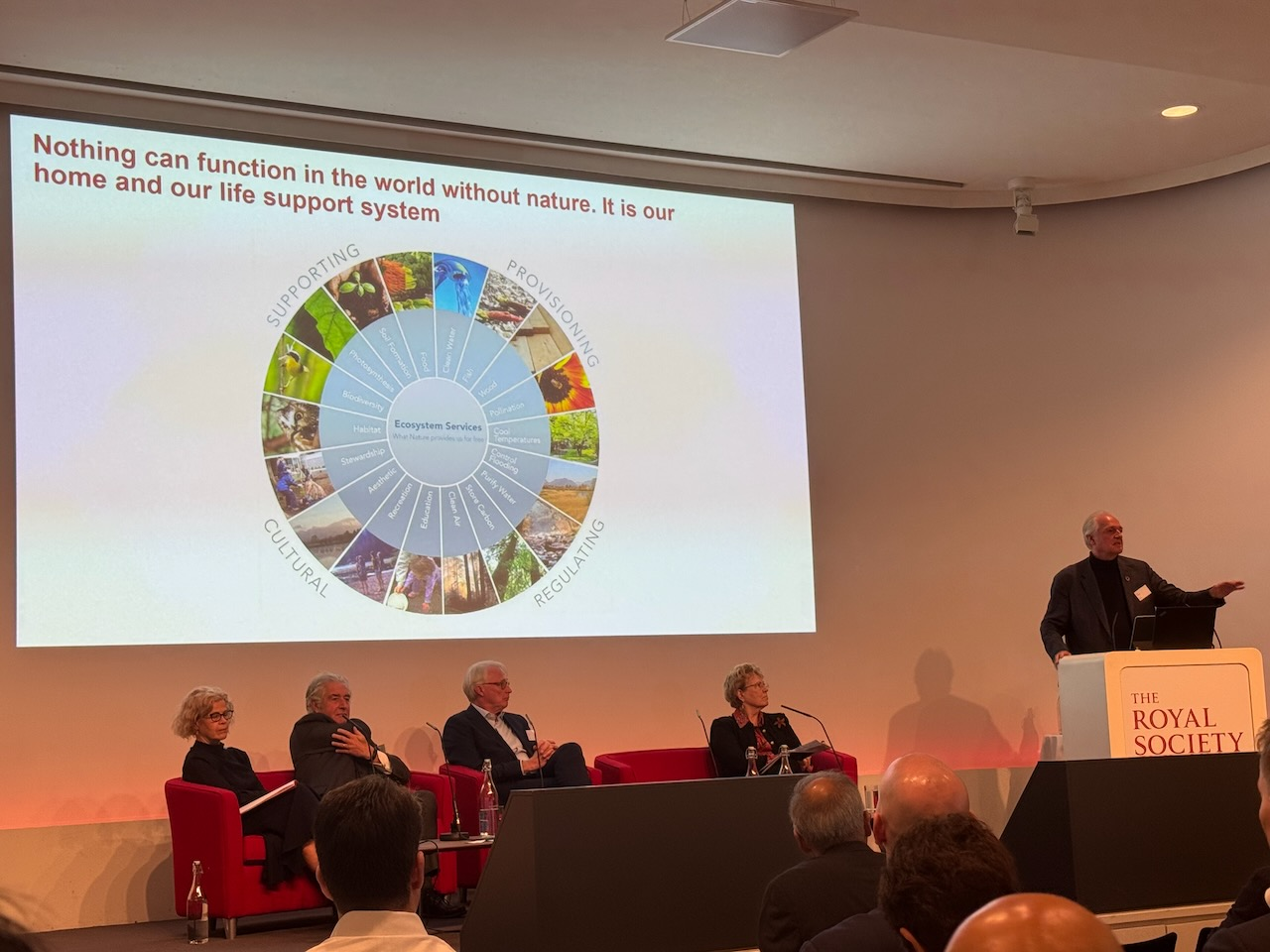
The summit kicked off with a keynote by economist [Sir Partha Dasgupta](https://en.wikipedia.org/wiki/Partha_Dasgupta). The focus was on the intersection of nature and economics, covering how markets fail to account for the ecosystems that sustain them. His [landmark report](https://www.gov.uk/government/publications/final-report-the-economics-of-biodiversity-the-dasgupta-review) covered ecosystem services, freshwater, tipping points, and physical risk, bringing to light the urgent need to reframe economic activities around the services provided by nature.
Sir Partha Dasgupta opening the morning session.
He began by distinguishing between two types of market activities:
- **Provisioning goods**. Commodities like food, water, timber, fibres and so forth are the primary products which, when aggregated and valued at market prices, form the GDP (the visible outputs) of human endeavour.
- **Processes** are the background work of maintaining and regulating services which produce these goods are problematic from a commercial perspective. The services aren't extractive in the same way as provisioning goods, but they express themselves via the goods.
In the language of economics, there is a missing link here for the markets of
processes, which makes for inefficiency, but more alarmingly a crisis in the
management of natural resources. The action is on the activities we undertake
which affect our landscape -- and the huge number of species affected therein.
Our knowledge is extremely limited, but keeping them intact is in our interest.
There is a good deal of work on option values which economists have tried to
uncover, but research has somewhat stalled in recent years. The risks that
companies face as a consequence of this inefficiency are correlated, which is
extremely dangerous for market stability.
He tried to address this in the review of the [Economics of Biodiversity
report](https://www.gov.uk/government/publications/final-report-the-economics-of-biodiversity-the-dasgupta-review),
but it needs a lot more thinking. A feature of the human condition is that
fragmented ecosystems lose their productivity. The sum of the productivity of
an ecosystem vs the sum of the individual parts has a big difference. The
[late](https://www.theguardian.com/environment/2021/dec/27/thomas-lovejoy-conservation-biologist-dies-80)
Tom Lovejoy did a lot of work on this in the context of the Amazon rainforest
ecosystem. Similarly, we are looking at a fragmented nature ecosystem today in
a global context as more and more habitats get truncated.
The background extinction rates of organisms are hugely growing - the option
value of organisms suggests we are losing enormous amounts of value in the form
of unknown lifeforms. The correlation risk here is something that whole
governments need to take on board -- it's too vast for any single organisation
to take on board\!
## Ecosystem Services and Physical Risk
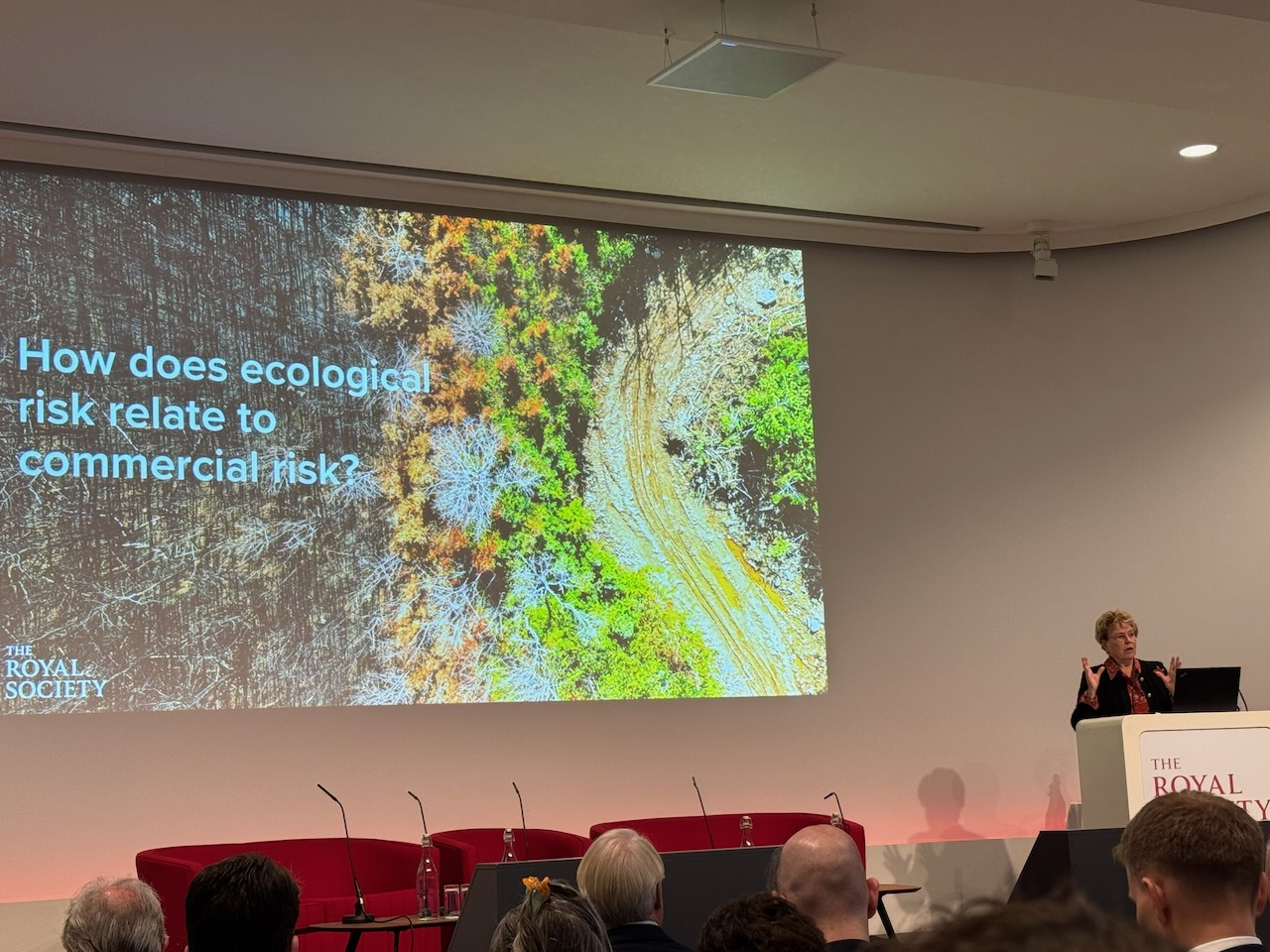
[Jane Lutchenko](https://en.wikipedia.org/wiki/Jane_Lubchenco) chaired the panel session. She is the administrator of the NOAA, "on loan" to the White House to work on nature and technology policy.
Jane Lutchenko chairing the morning session.
### Dr Tony Juniper CBE
We have not always been looking at nature through a financial perspective. The
journey of Natural England in the 1940 began more an ethical and moral
perspective, and the scientific and beauty value of landscapes. It's only
recently been that practical impacts of nature and its benefit to humanity is
being considered.
The [Millenium Ecosystem
Assessment](https://en.wikipedia.org/wiki/Millennium_Ecosystem_Assessment)
commissioned in 2001 by Kofi Annan was a stocktake of the earth's natural
capital assets, and remarkable for how it made it clear how if we didn't
reverse the decline of nature then we would be unable to meet humanity's needs
such as ending poverty. A few years later in 2007 the G8 commissioned
["Economics of Ecosystems and
Biodiversity"](https://en.wikipedia.org/wiki/The_Economics_of_Ecosystems_and_Biodiversity)
that worked until 2011 and helped reset the understanding of the human world
and is fundamental to how we conduct our ecosystem. Later on the
"Intergovernmental Science-Policy Platform on Biodiversity and Ecosystem
Services" ([IPBES](https://www.ipbes.net)) commissioned by the UN general
assembly to consider the contribution of nature to people.
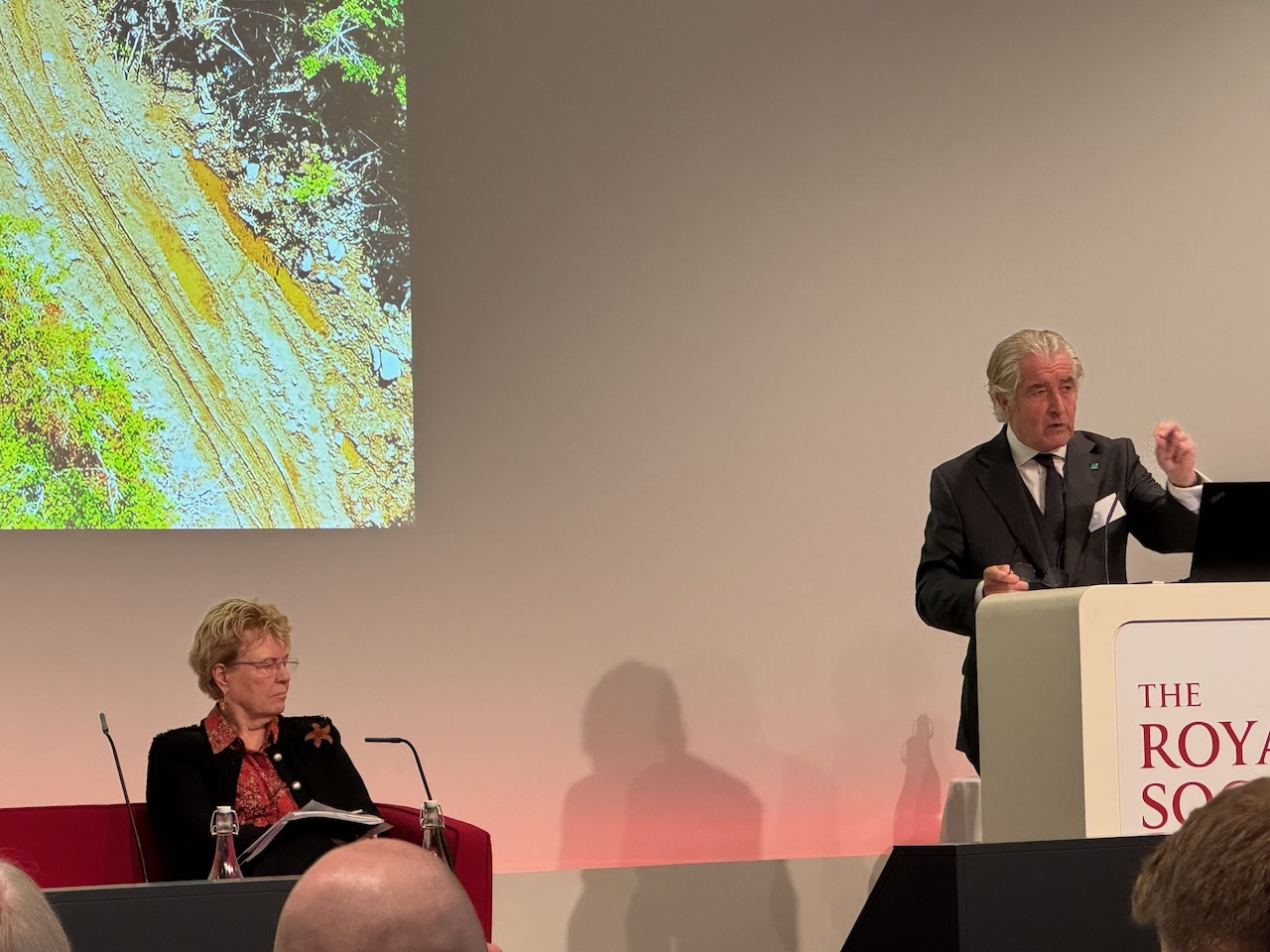
Tony Juniper speaking.
So as nature rises in the political eye, there are multiple national programs
all trying to assess the state of natural assets. In 2020 there was a Treasury
organisation to bring natural capital into national accounting in the UK.
Dasgputa's landmark report established that nature and the economy are
intertwined, which was a huge change in thinking. We no longer need to assume
that degradation of nature is the price of progress, and the new reality are
that the range of ecosystem services are critical to how we need to conduct our
ecosystem services into the future. Pollination, carbon capture, biomimicry,
nutrient capture, when all added up are worth more than the UK's GDP, but we
still struggle to how to measure this as part of our conventional economies\!
After 20 years of expert studies and carefully constructed datasets, we
still struggle to do the right thing, but why? No one company is quite able to
fully embrace the scope of the problem. There are 1000s of medium to large
companies that depend on agriculture, but they are all dependent on 25 billion
tons of water moving around intercontinental distances for the global water
cycle. Any particular one company might make a small difference to reduce their
deforestation footprint but without collective action they will be unable to
make a global change. There must be a collective force to bring things
together, and also better understanding of the connectivity across these
factors.
However, there still isn't a prominent intellectual place for the connections
between ecology and economy and still isn't being taught in undergraduate
courses and so not making it through to high political decision making. There
is still a lot of emphasis on financial growth, but not much discussion of
nature: we should be factoring in that nature is the mechanism by which we can
achieve financial growth. It's quite hard to meaure biodiversity vs "tons of
carbon". Environment regulation must move from stopping harm, but also plot
pathways to nature recovery. So the link between ecological and commercial
risk is very real and must be measured and actioned.
### Freshwater (Professor Louise Heathwaite CBE FRS)
Her first ever "proper job" was working at the Nature Conservancy as their first hydrologist. Freshwater is at the centre of the triple planetary crisis today. As a result of these challenges, what we see is an intensification of the water cycle:
- increasing temperatures increase atmospheric water holding capacity
- increases preciptation, increases evaporation, so the cycle intensifies
- evaporative demand increases and so extreme drough events increase
Our lack of investment in proper waste recycling infrastructures is now coming
back to haunt us. They impact hugely on freshwater availability and quality. It
disrupts commercial supply chains, and the quality of the supply for both water
and ecosystem services for which we heavily depend.
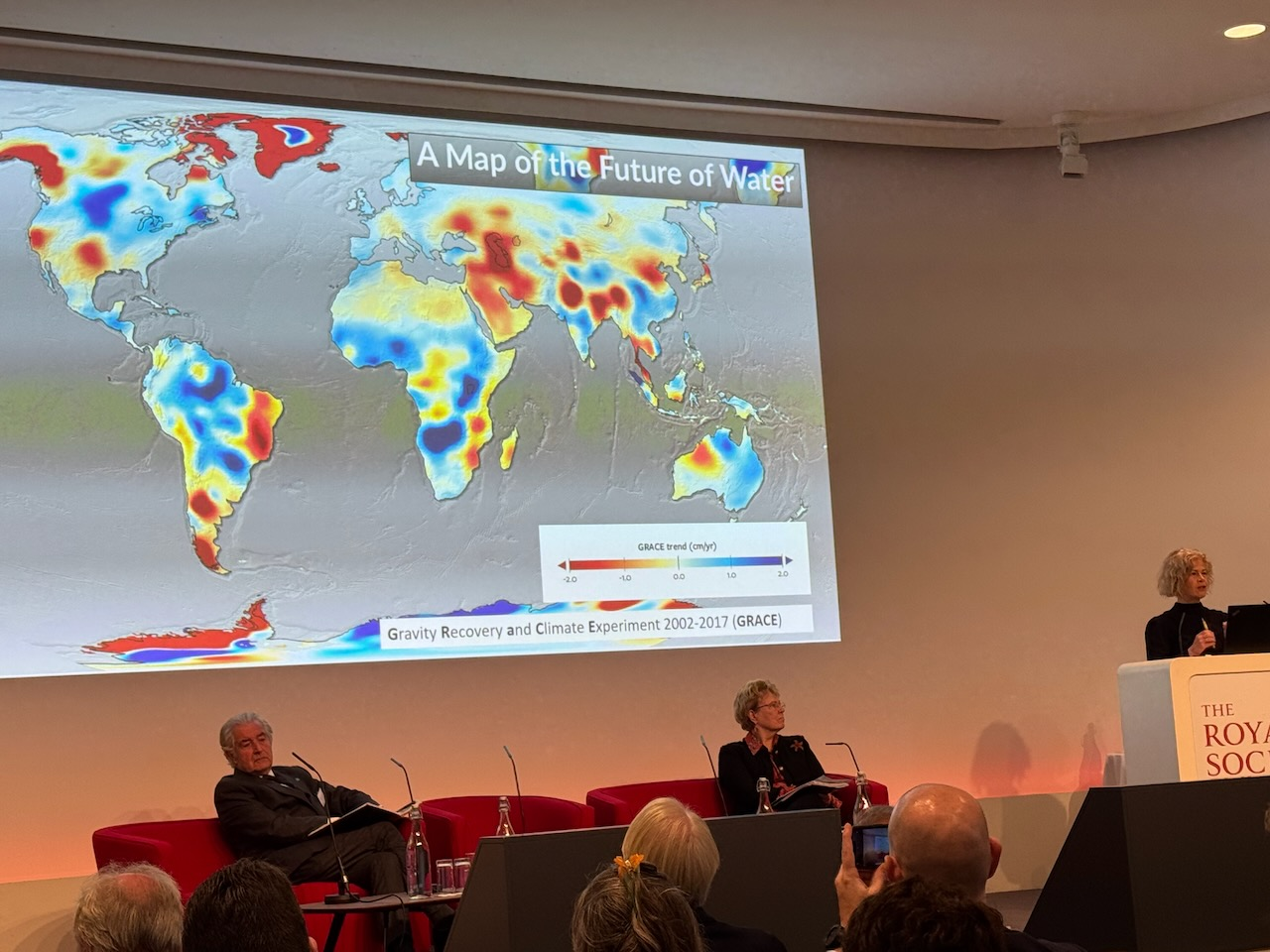
Louise Heathwaite shows the GRACE water map.
Two satellites (GRACE) spinning around earth from 2002-2017 that can detect
changes at a centimetre scale of changes in water mass. The image shows how
connected the world is, and the scale of the changes at the poles and greenland
is incredible. Some research just finished up in Greenland, and the rate of
warming in the arctic is roughly 2x the global warming rate. Greenland is
losing almost 260 gigatons of ice per year, which is a million Olympic-sized
swimming pools a year -- an awful lot of water to move around into the ocean
systems. The ocean cycles aren't on the slide, but they will impact.
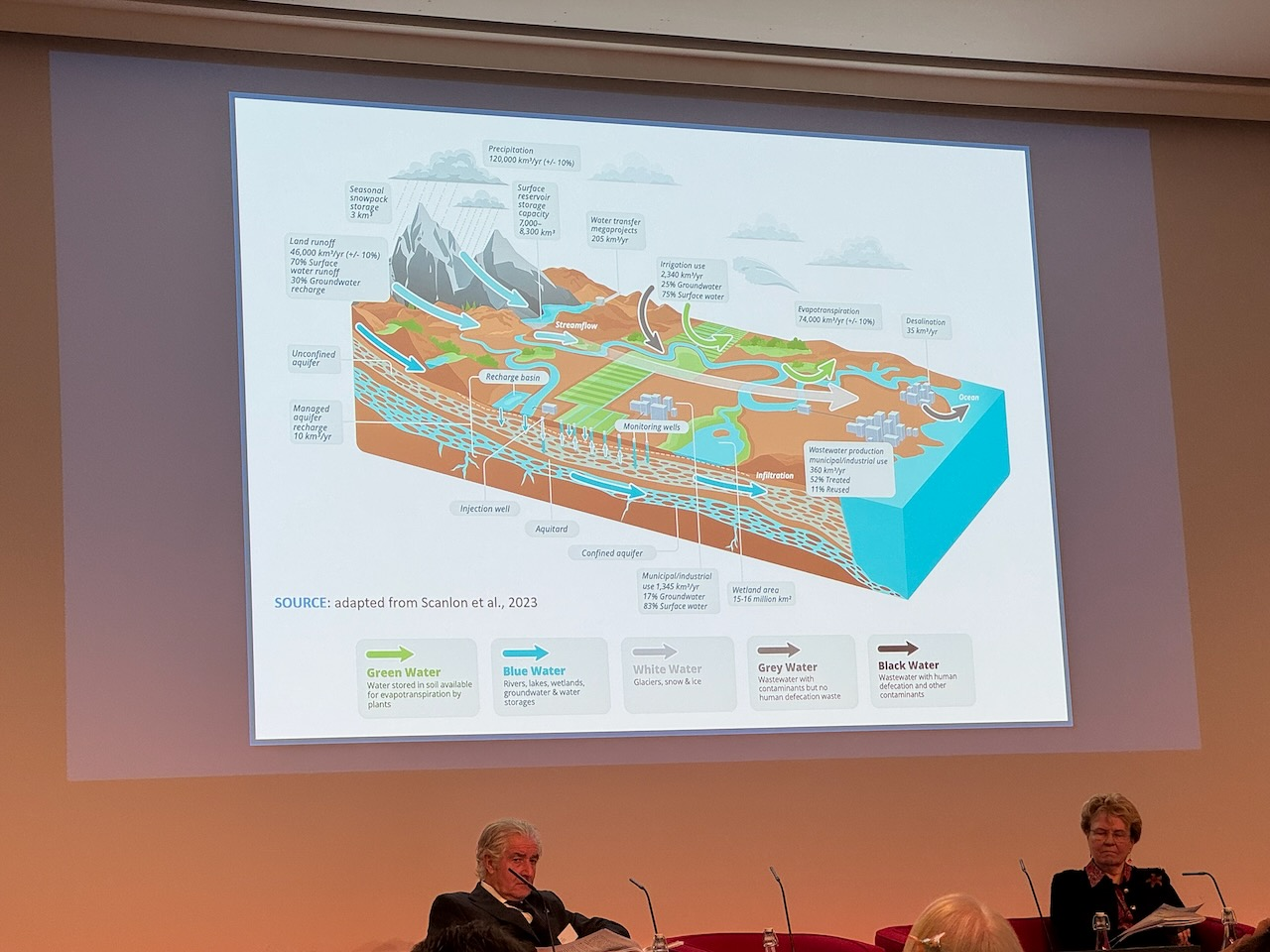
Only 1% of the total water supply is freshwater, and its appropriation among human
activities is quite unalanced. We have green water to blue water to white water
to grey water to black water. We have messed up the blue and black water
management. We are producing 360 billions of cubic metres of waste water a year
and only 3% is recycled. A significant percentage of the world population (2
billion people) are dependent on black water, and a lot only have access to
grey or black water.
Water flows in the ecosystem.
We need to treat management of surface and groundwater systems holistically.
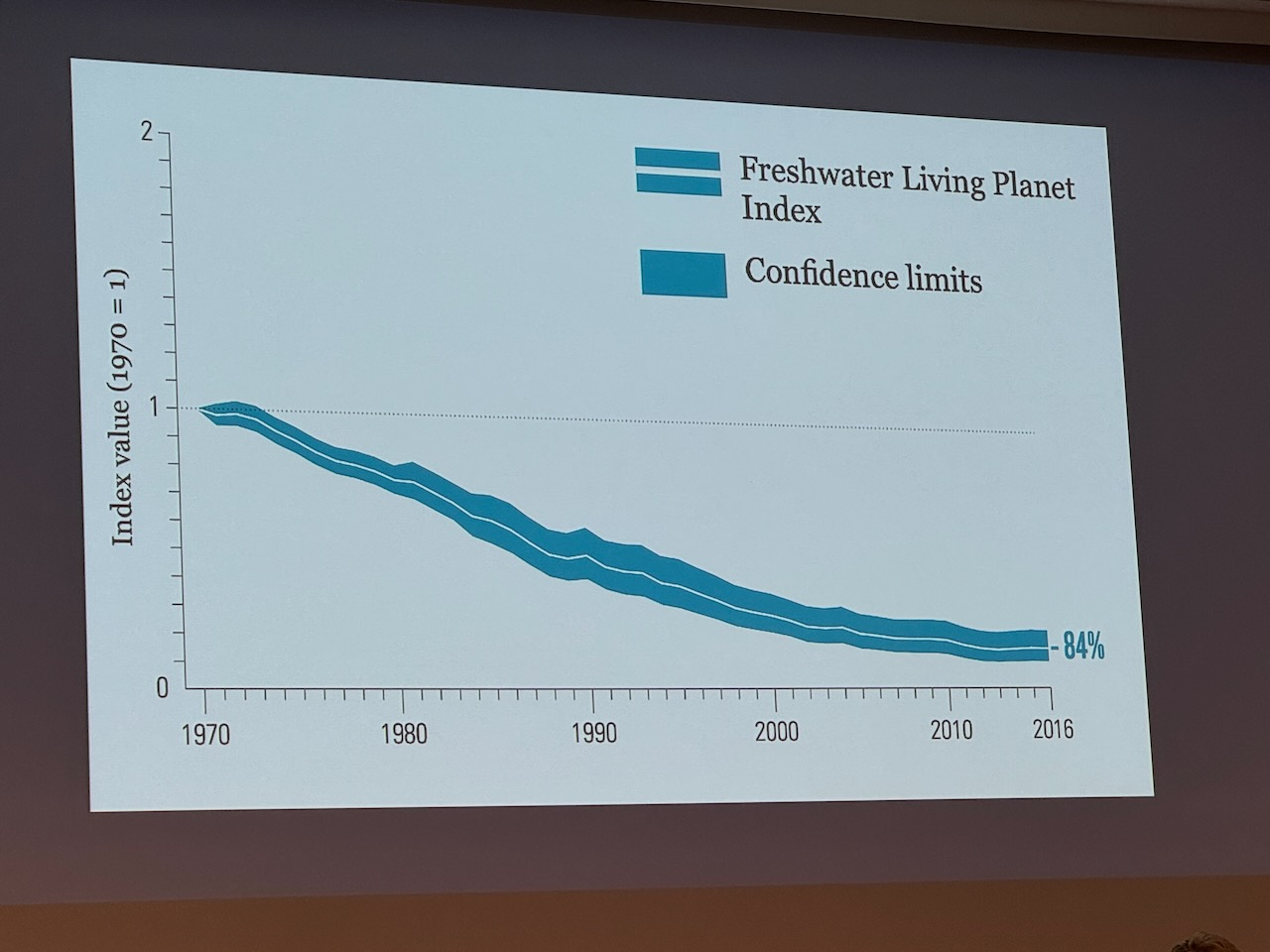
The freshwater living planet index is dropping precipitously: some causes are flow
reduction, introduction of invasive species and nitrogen/acidification peaks in the
1970s/80s/90s which all causes major changes in freshwater biodiversity. We
also introduced laws on long range transport regulation about acidification. In
1991 we had the EU urban wastewater directive and in 2000 the EU water
framework directive, but none of this seems to have made much of a difference (see graph above).
Freshwater confidence index not measurably changed by legislation.
Are we looking a tipping point in terms of waste water systems? We dont have
clear metrics about freshwater biodiversity, and without the metrics we dont
have a way of valuing them as part of commercial systems. We have new emerging
pollutants (microplastics etc) which we have to deal with multi-sectoral
changes to make a difference, which is lacking despite the legislation in
place.
However, the growth in urbanisation (56% of UK population lives in cities, increasing to
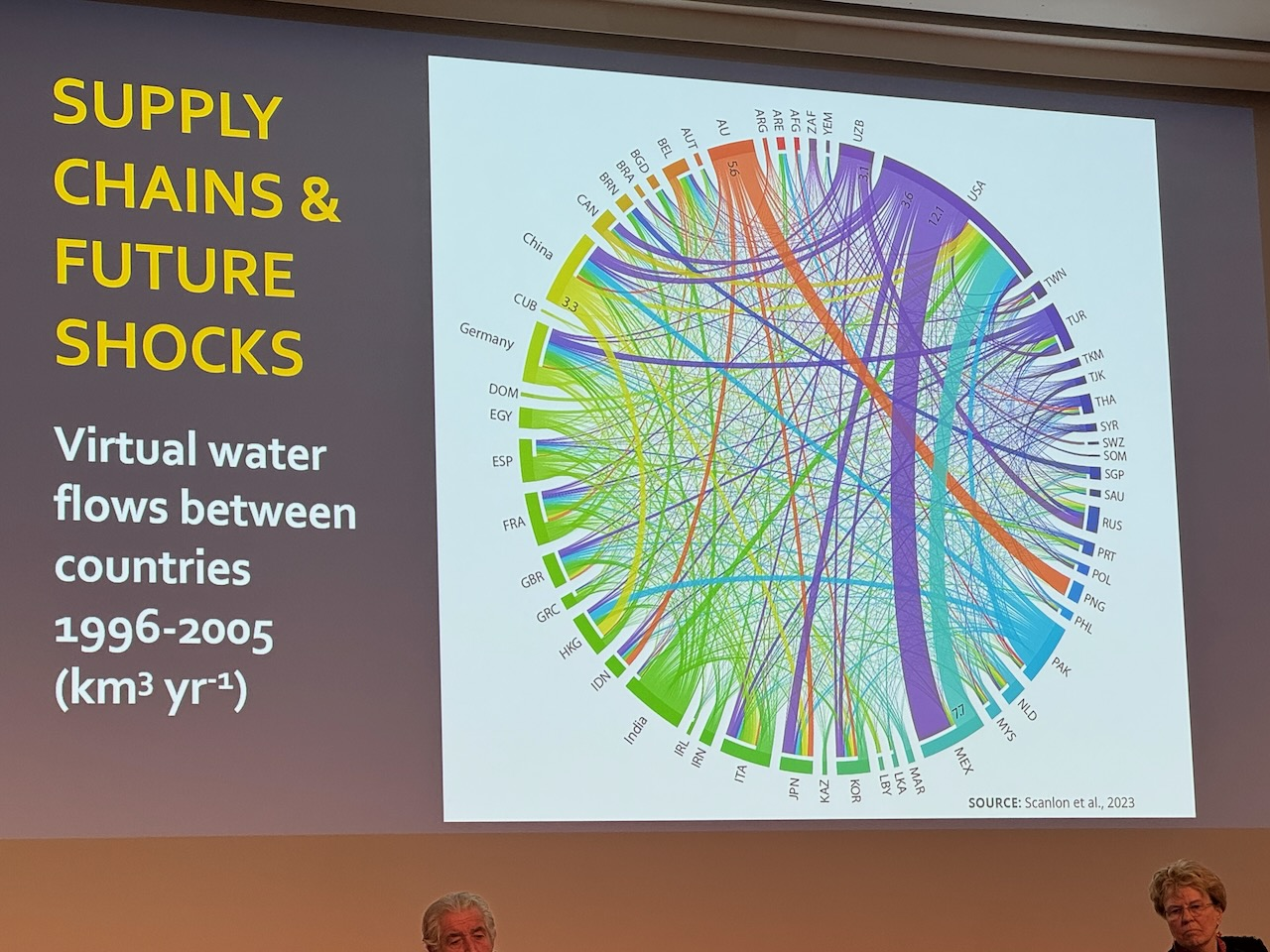
70% by 2050) which makes a huge difference to where waste comes from. When we
move food around the word, there is a water cost which is passed onto other
countries. *(Note: see also our preprint on [Food impacts on species extinction risks can vary by three orders of magnitude](https://anil.recoil.org/papers/2024-food-life))*
When we move to decarbonisation, the last 20% of action (the really difficult bit) is
related to land use in particular. But if we join up the practises around good
water use and decarbonisation then we have a bunch of innovative interventions,
for example natural flood management. There are also cobenefits around
infrastructure and there is a real challenge with our UK underinvestment. The
last report in 2022 there are some excellent propositions for how to deal with
water and atmospheric pollution and biodiversity. We need to act on this
report, but progress is slow: e.g. Thames Water is a long way away from
actioning this.
Water flows between countries worldwide.
In the 1980s, [ADAS](https://adas.co.uk) was the wing of farming and food ministry worked on how to
recycle waste better. Metals were the big problem back then, but now there are
loads of extra contaminants such as plastics and forever chemicals, We must
move towards reusing waste we produce towards reusable end products for farming
and dramatically drop our water use.
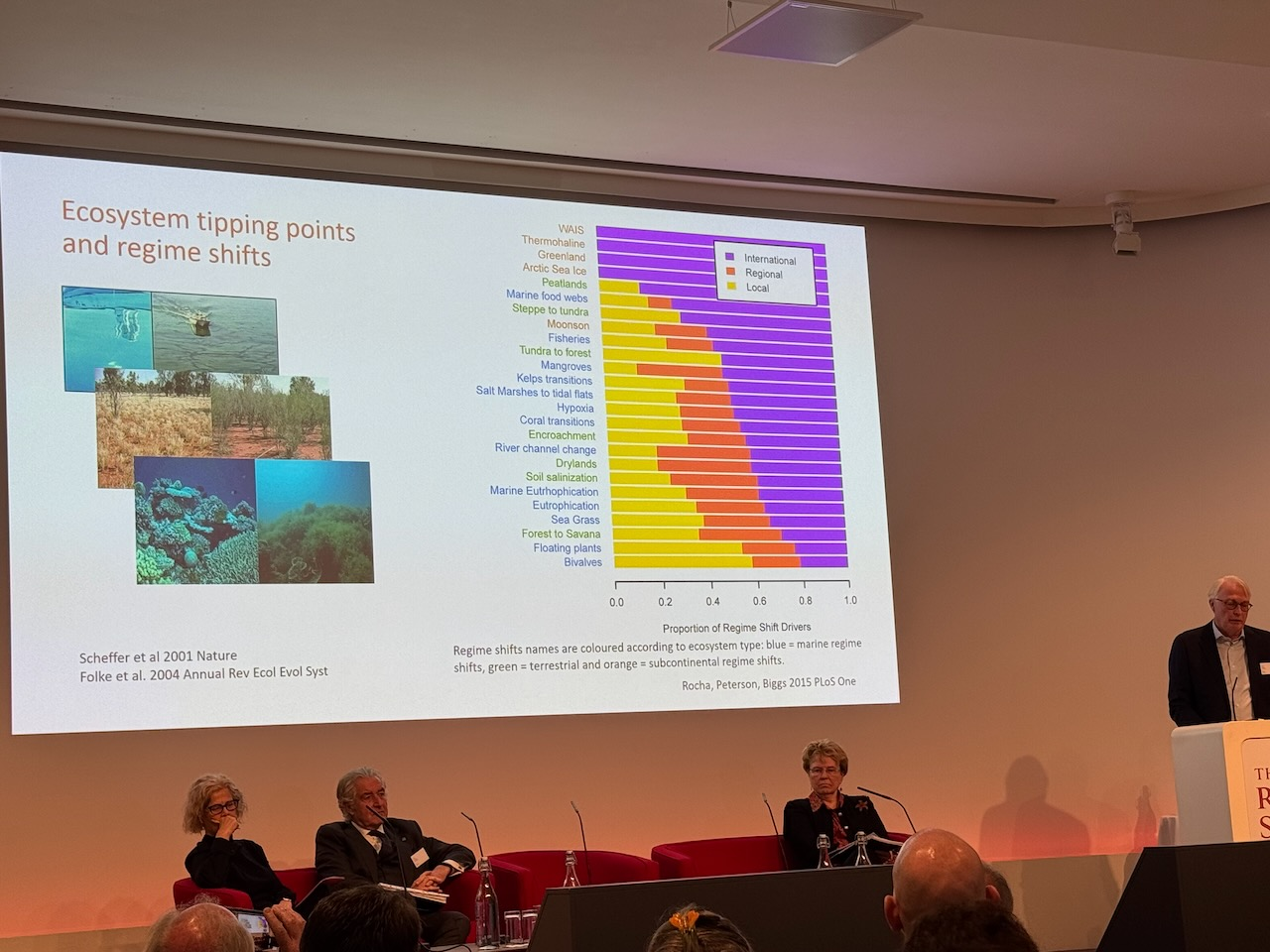
### Tipping points and biosphere stewardship (Professor Carl Folke)
We have polycrises with climate change, biosphere pressure, intertwined
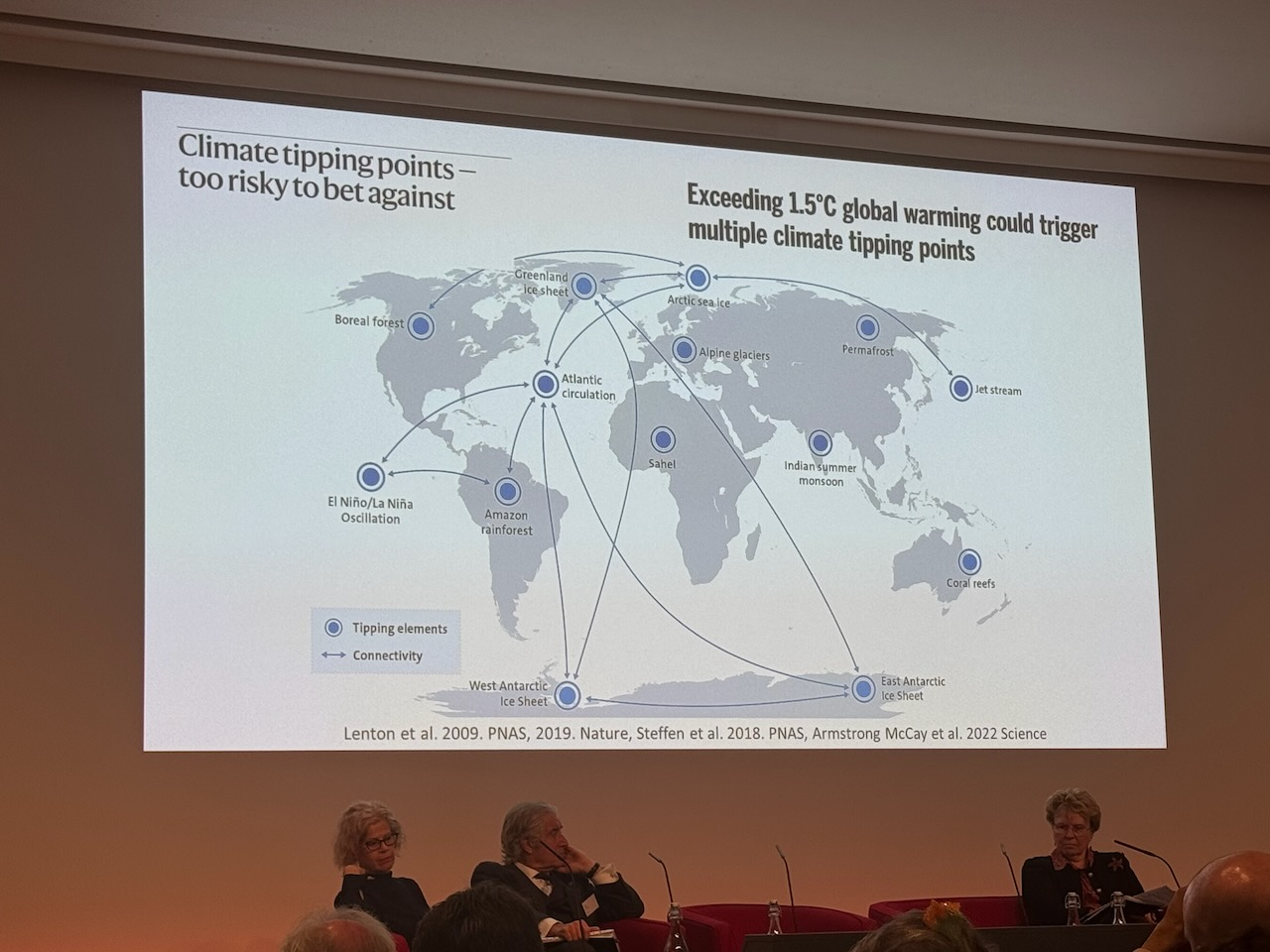
systems, interacting shocks, and many tipping points. Tipping points are a
shock that can move a system from a local maxima into a new stable state, but also
the gradual loss resilience can cause a system to shift suddenly. There are a
number of drives that cause these tipping points, and they are not just a
random aside: they should be a key part of any investment strategy.
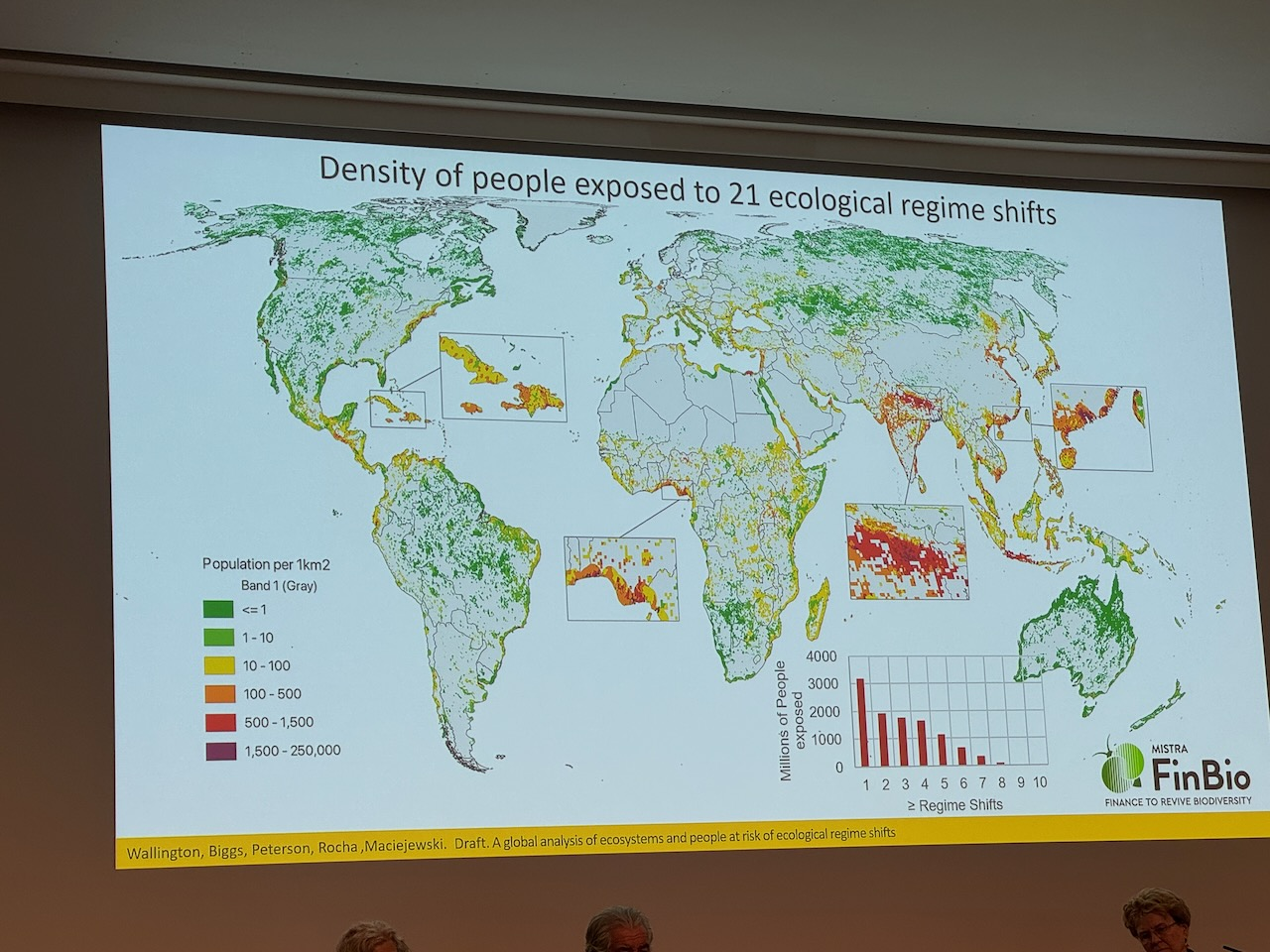
A lot of people live in areas that are at risk of ecological tipping points,
and the map seems very correlated to the earlier water change map shown by
Louise! 56% of human CO2e have been taken up by the biosphere so far (1430
GtCO2 from 1850-2019) which has been happening for "free" thanks to nature, and
this might come to an abrupt end soon which is a big source of worry in the
scientific community.
Prof Folke discussing tipping points.
The connectivity of various tipping points is becoming clearer. There are just
a few major actors that shape some of these (such as the Amazon rainforest) and
they are often quite far away geographically by virtual of their influence over
markets.
The current idea is that social tipping ("social norms as solutions") is the
way to alter our value systems. See "[Operationalising positive tipping points
towards global
sustainability](https://www.cambridge.org/core/journals/global-sustainability/article/operationalising-positive-tipping-points-towards-global-sustainability/8E318C85A8E462AEC26913EC43FE60B1)"
by Tim Lenton et al. *(Note: Simon Sharpe also authored this, see our CSaP
[reading
group](https://www.csap.cam.ac.uk/news/article-reading-group-five-times-faster-4-rethinking-unive/?preview=1)
on his excellent ["Five Times Faster"](https://fivetimesfaster.org) book.)*
Exposure of people to tipping points.Interconnected climate tipping points worldwide.
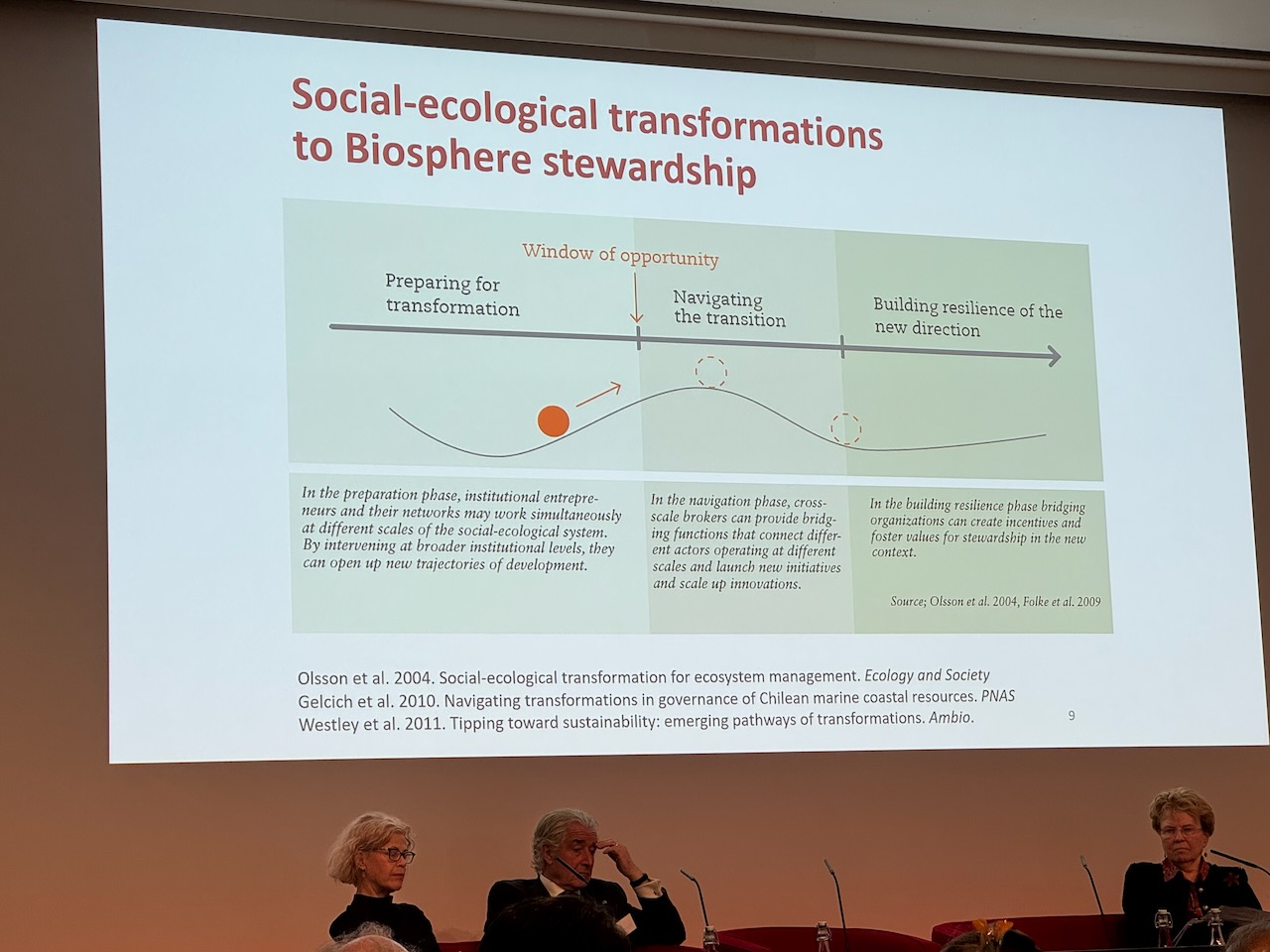
So we need to prepare for tranformation, navigate the sudden transition and
then build resilience in the new norm after the tipping point. But our window
of opportinty is happening right now so action must happen urgently or we miss
the window and enter the tipping point unprepared. So "corporate biosphere
stewardship" is a new business logic with the purpose of shepherding and
safeguarding the resilience of the biosphere for human well-being, and
fostering the sustainability of a rapidly changing planet. Rather than viewing
nature as a compliance question, we should view it as humanity's greatest
business opportunnity! For example, Seafood Business for Ocean Stewardship
(\[seabos.org\](Seafood Business for Ocean Stweardship)) is codifying this
approach for marine foodstocks. There is an increasing focus on how to report
this stuff. There are three good books to read more on this:
- ["Nature's Frontiers"](https://openknowledge.worldbank.org/entities/publication/855c2e15-c88b-4c04-a2e5-2d98c25b8eca), 2023 from the World Bank group.
- ["Economy and Finance for a Just Future on a Thriving Planet"](https://www.stockholmresilience.org/publications/publications/2022-09-29-economy-and-finance-for-a-just-future-on-a-thriving-planet.html), 2022 from the SRC.
- ["The Green Scorpion"](https://www.ngfs.net/en/the-green-scorpion-macro-criticality-nature-for-finance), the macro-criticality of nature for finance.
The window to tackle tipping points.
### Ecosystem services and physical risk (Paul Polman KBE)
[Paul Polman](https://en.wikipedia.org/wiki/Paul_Polman) is the former CEO of
Unilever. He started by noting that we have to make sure that we dont just
spend our time talking to each other, but we have to get the message out in the
form of action to the wider world! When they developed the SDGs, Ban Ki Moon
requested Paul to represent the private sector. He was described as *"the
problem walking into the room"* when the politicans first met him, but luckily
they ended up in a happier place! We must find a balance into a sustainable
economy into the future. Most businesses, although they dont behave entirely
sustainabiltly now, they do understand the need for a planet. When he ran
Unilever for a decade, they encoutered hundreds of millions of dollars worth of
nature-related interruptions tot heir business.
4 billion people in the world depend on natural medicine, and nature governs
huge amounts of the human ecosystem. Nature supports peace and national
security - many of the world geopolitical events train back to inequality in
access to natural resources and this is the foundation for many economics. The
WEF report recently calculated thaat \$44tn of the world economy depends on
nature -- but this is a huge understatement given that our entire life depends
on it! Changes in one ecosystem affects others, and so our conversation must
address the interrelationship of all this that makes it so complex.
Paul Polman discussing global business and nature.
We must not see ourselves at the top of the pyramid -- biomimicry and
geoengineering is an arrogant approach as our survival relies on cooperation
with the biosphere -- when we destroy nature we destroy ourselves. (paraphrased quote) *"Man is the
most insane species - he worships an invisible god and destroys the visible
nature, not realising that the invisible god he worships is the visible nature
he destroys"* (original: [Hubert Reeves](https://www.goodreads.com/quotes/1171374-man-is-the-most-insane-species-he-worships-an-invisible)). Extinctions are 10-100x the average of the previous
centuries.
Food and land use is about 30% of our global emissions, and yet we have the
audacity to keep our famers in poverty. Every \$1 invested in changing nature
and regenerative farming approaches give us \$16 return. The food companies are
really exposed if they don't act, much as we criticiise fossil fuel companies
right now.
We are making withdrawals much faster than we are depositing in the bank of
planetary boundaries, and there are millions of people losing their lives and
billions being displaced because of these choices. The Carribean has lowered
its tourism by a significant percentage due to beach erosion. The Amazon this
year has had unprecedented wildfires (around the size of Italy) as an example.
We name our tropical storms (we name them as if they are our friends); would it
be different if we named them Exxon Chevron etc? We must absolutely link the
commercial sector to nature as companies like Unilever must become
border-positive and nature positive as they are hugely global.
Leadership is increasingly centred in europe with many business regulations
that are nature positive. There is a bunch of business interaction happening,
but the estimation is that loss of biodiversity has cost us over \$10tn. In
agriculture we are destroying \$12tn of value, but if we turn that around its a
\$4tn opportunity. This just doesn't make business sense to not act. Covid
showed us that infinite growth on a finite planet is unsustainable.
What can business do next then?
- *Invest in nature.* It drives innovation and nature has probably been the best R\&D lab (1/3rd of medicines come directly from nature)
- *Water utility improvement.* If the 500 largest cities looked into restoring local forests and water tables, it would make a huge difference in quality of life.
- *A mindset change for business.* See his [book on the topic](https://netpositive.world/book/). The only way to think in business to be successful now is to think regeneratively and restoratively -- every action needs to contribute to restoration and not cause to us to fail slightly more slowly.
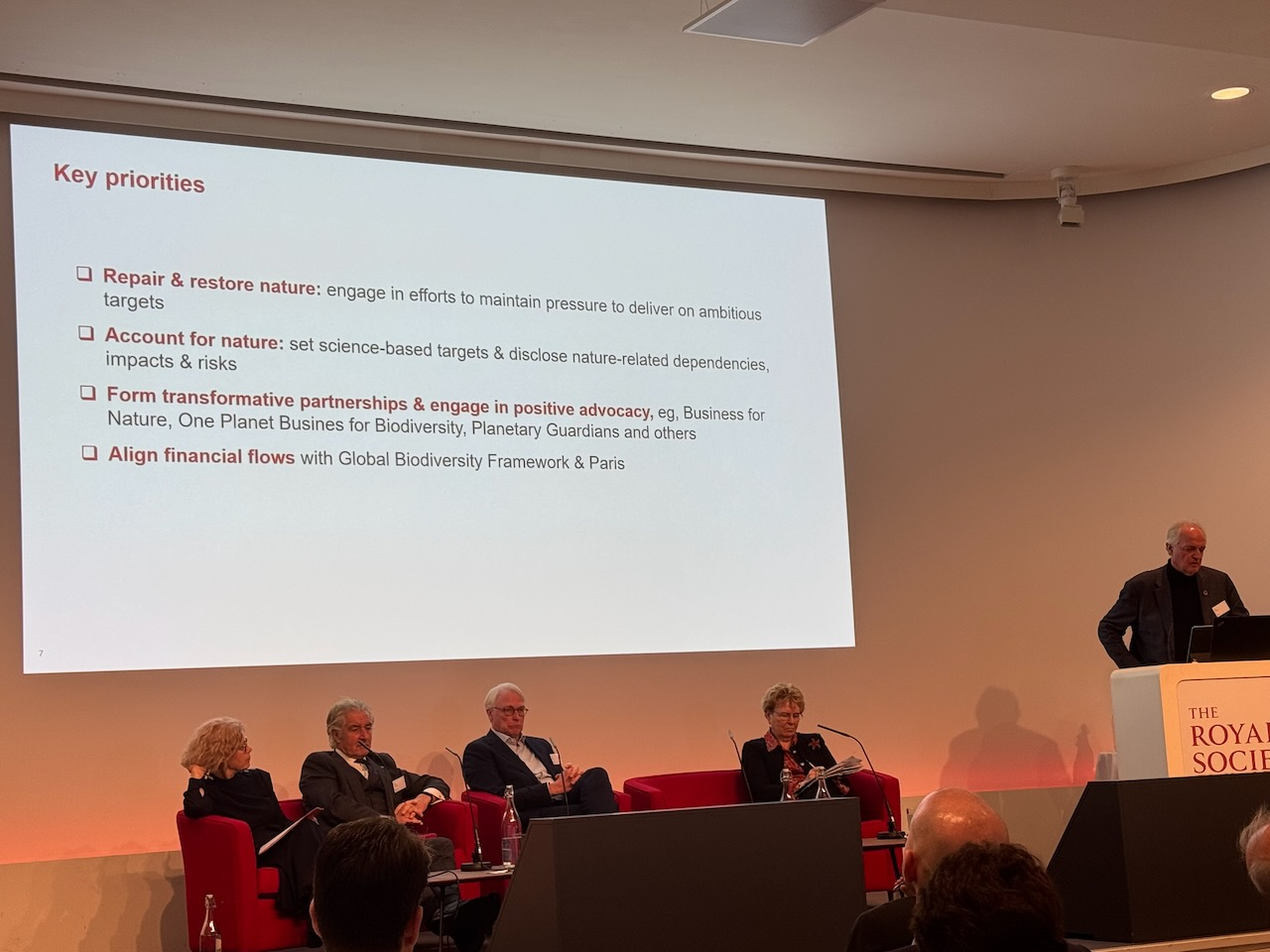
Priorities for business action:
- Repair and restore nature. e.g. 30x30 the global biodiversity framework
- Account for the value of nature, the point of this event. less than 5% of companies today account for nature, and this needs to vastly increase.
- Form partnerships for advocacy and change. most of the big issues cannot be tackled by one company; even at Unilever Paul could only solve about 20% of the problem with one of the biggest companies in the world. So for global change (like "planetary guardians" launched at the UN last week) is another example of partnership.
- Align financial flows using the political moves around GBF and the Paris agreement. We need to put money behind this.
Nature needs business, and nature needs business, and the time to act is now\!
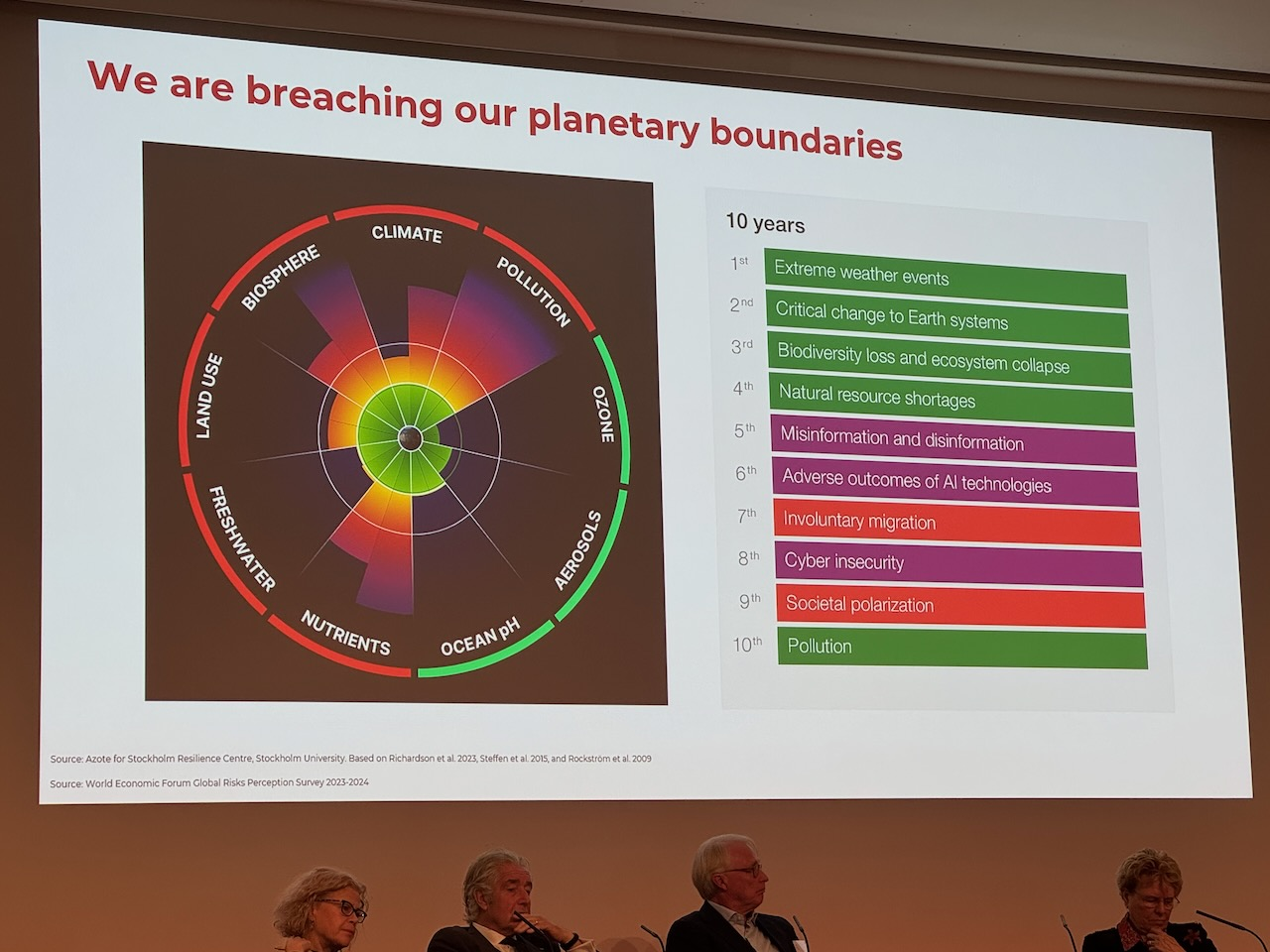
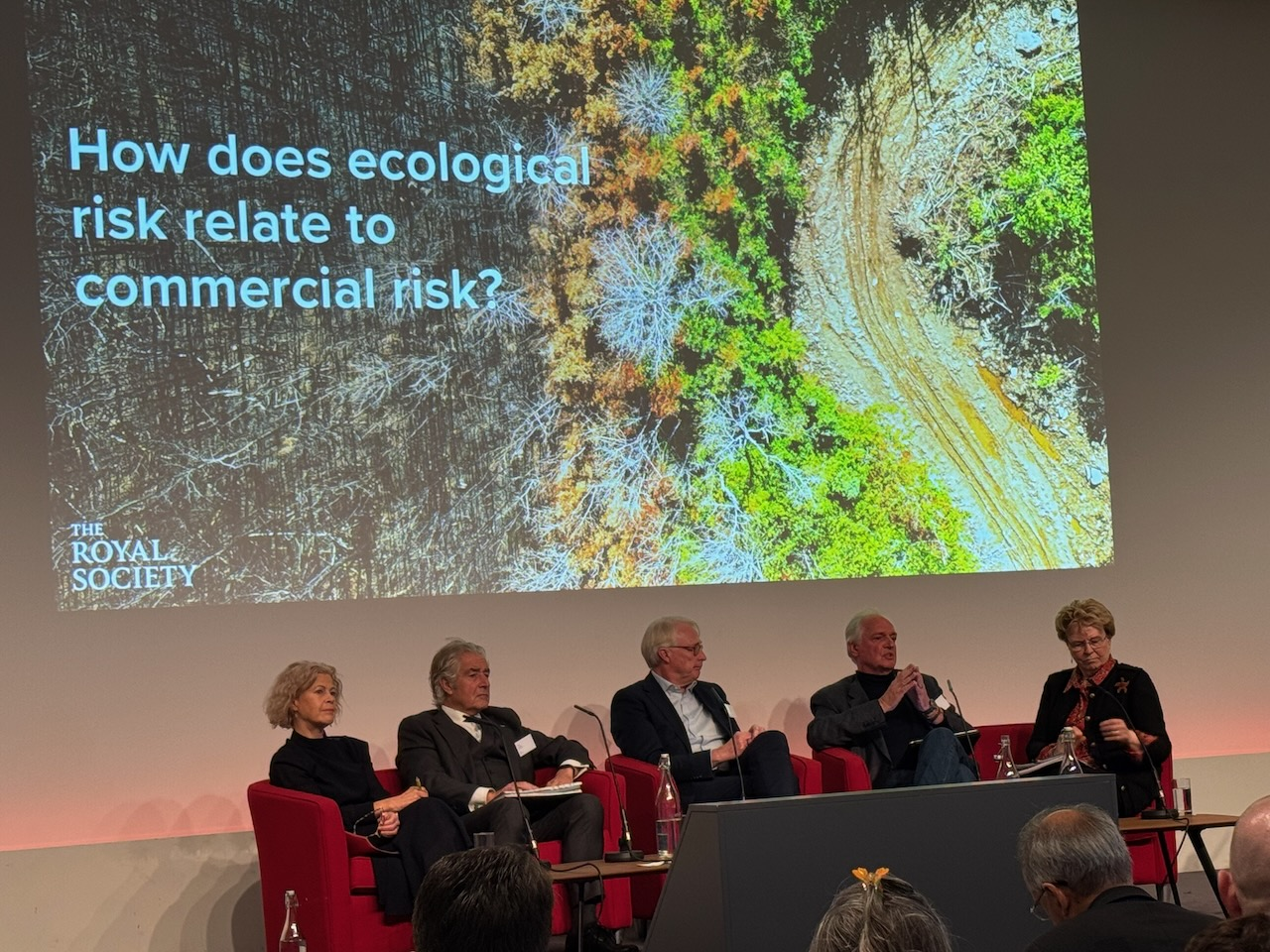
Breaching planetary boundaries.Key priorities next for nature and business.The full panel discussing these topics.
## Discussion
Partial notes from the audience Q\&A follow.
Q: To what extent have we made progress in the transition towards a nature positive future -- is the awakening fast enough?
Tony: what we have discussed here is not very well known in the majority of the
world's population. Most people get in their car and go to work, and their food
is processed and disconnected from nature. So the insight that most people have
into their dependencies on nature isnt very well known. David Attenborough has
made it clear that if we take steps towards repairing the natural world then
people will need to be exposed to nature so that they understand what they're
trying to save. This was disconnected in the beginning of the industrial
revolution, and we need to urgently reconnect it, or people will simply not
appreciate what we're about to lose.
Louise: is quite optimistic because the younger generation is very engaged in
this, and we need to ensure they have the levers for action. It's the older
generations challenge to bring the right levers to them.
Paul: the science is still evolving at a fast pace, and will continue to, and
if we dont convert it to fast practical steps we'll be trouble. Everything
starts and ends with educaiton, but we are also out of time. The urgency isnt
well understood -- a survey of 4000 people about this skewed to about 30% of
people where they left a company because it wasnt aligned with their values.
60% were considering leaving but didnt. We must get businesses to move out of
the current gridlock where multilateral institutions cannot change easily, and
we must cooperate across boundaries. The EU has a nature restoration law which
wouldnt have happened without businesses getting involved to push it over the
line for example -- without that it wouldnt have moved. And tipping points mean
that only 4-5% change is required to get us to a new stable state, so this is
both an opportunity and a risk. The biggest risk right now is the US election,
as its a global vote but decided by a tiny minority.
Q: What examples have you seen about nature flows in the real world?
Paul: the economic forces must be made to work; people arent skeptical but the
economic realities must work. But there are pressures; the average tenure of a
CEO has dropped to 4-5 years and so their actions are aligned with reelection
cycles just like poliitics! So we have to make capital and money flow work much
more transparently. With a relatively small investment, we can get to 50%
regenerative agriculture; this is happening in the USA (thanks to IRA). Many
of the major food companies (from Pepsi to Unilever) are committed to \$15bn
towards soil health and regenerative agriculture. And there is nothing better
than healthy soil towards preserving yields in the face of climate change. The
average age of farmers is ~50 now and so they only have 10 seasons left before
they retire, so they need to be paid to shift proactively for ecosystem
services. It needs a proper farmer rewards to do the shift quickly and hedge
the risk. Luckily, the speed of nature restoration is faster than we predicted.
Carl: it has become a strategic issues in companies, as opposed to a
greenwashing protection. They run an executive course for companies and they
are factoring in risks proactively now in a way they didnt before. They are
demanding satellite data and other risk management data products to quantify
the uncertainties in nature. Earth SYstem Indicators is their system to combine
multoiple planetary boundaries into one actionable indicator. It is a bit like
an avalanche now where the reaction is awakening, but we are probably in a
tipping point right now so we must act in the right direction.
Jane: social systems are highly non linear and also characterised by social
system tipping points. Water seems to be an obvious one that underpins the
operation of many companies.
Louise: Universities and research must turn into businesses (of innovation).
One thing we failed to do is to find the problems but dont find the solutions,
and research must come up with solutions. "Ecologists turn over stones looking
for problems". We must take a position on coming up with solutions and
communicating them clearly, and the only way to do this is to work together
across disciplines. We are looking to social scientists to combine civic change
with environmental scientists to propose interventions.
Jane: there has been a huge transformation in the US towards finding solutions,
and that means partnering with government agencies and NGOs in a way we haven't
seen before. *(Note: this describes the [Cambridge Conservation Initiative](https://www.cambridgeconservation.org) model perfectly!).*
Tony: even when the solutions exist, a number of entities want to keep the
status quo: e.g. Exxon and Shell spent more than two decades pretending it
wasnt a problem to protect their interests, and they're not alone. And so we
have to establish a social tipping point (just 3-4%) was just the idea of
Exctinction Rebellion to overload the court system and get to the point where
we could shift the discussion, But it didnt work, so what will work? We need to
try, try and try again on this. Otherwise we're rather just talking to
ourselves.
Q: Water related financial risks: TCFD galvanised focus on climate,
speciifcally carbon, and one of the barriers is this focus on regulations that
focus on the cause (carbon) but not the impacts. We mainly feel these impacts
through the water cycle, so how can we make the focus on the phsyical risks of
climate change being on the impacts and not the cause?
Louise: we need a systems approach to this; tipping points sort of get there,
but how do we get the evidence to get over the top?
Q: Why is it that the business and finance community isn't moving faster? The
suspicion is that not all businesses are part of the solution, and do we need
to be clearer on that? If we combine some of the social aspects and linking of
people to nature, does that supply chain need to be shorter?
Paul: we are slightly bending the curve linearly, but the gap is getting bigger
exponentially. If we dont solve the problems for the world, we can be great as
a company but it doesnt save the planet for the next generation. Business alone
cannot do it, but what we can do is to make it more transparent. The more
transparent we are the more we change behaviours and social norms. Companies
using AI across supply chains are doing surprisingly well at bringing this
transparency around. In every transition in the history of mankind, there will
be people resisting change, but now the noise globally is becoming louder is a
big deal and is a sign that the process is unstoppable and has begun. The noise
will only increase in the next five years. In the food chain there are
herbicide, pesticide producers that are doing really well on food speculation,
but at the expense of many lives. We need a leader to change them, and if they
dont change they will obsolete their business models.
Q: What is the single most important action businesses can take today to address the crisis?
Q: Why not spin this around to look at this at a very local level (e.g. flooding for business crisis)?
Q: Unless we can localise analysis with improved precision, can we improve decision making?
Tony: Localisation of issues is critical. The founding slogan of Friends of the Earth was to "think globally act lcoally" which was a very good slogan. Natural England is working with local authorities on spatial planning exercises on where the good remaining nature exists and where it might usefully be repaired (cleaning up peatlands etc). The targeting of the resources like this might help us bend the curve. This must be linked with our need to build 100k new houses and balance natural and business.
Paul: COP30 is likely to involve businesses heavily (COP29 is a writeoff due to location). But businesses are getting behind it all as countries cant implement their policies without business help. A large percentage of indigenous populations are planetary guardians and so we must support their efforts to protect existing natural capital against tipping points. Science without impact is useless when we have a crisis at this level.
## Day 1 Reflections by Sir Partha Dasgupta
Ecosystems are capital assets; we now use the term natural capital to include
the biosphere in the full stock. This raises the question of asset management,
and the questions discussed today represent shortcomings in asset management.
With natural capital, property rights are hard to enforce -- nature is always
on the move and "mobile" and the commodity changes when it moves. This leads to
an underpricing of many forms of natural capital (not all, but many) which
leads to the overuse of it, which in turns leads to deterioration of the asset,
which implies a runaway tipping point of decline. This all leads to a circular
decline in the value of natural capital; if there is a heightened risk of an
asset collapsing, the accounting value is naturally reduced. So this is a
vicious cycle at work that leads to the inevitable decline.
Global GDP has increased hugely as opposed to natural capital, which increases
the pressure to overspend on natural capital. What are the arbitrage conditions
(e.g. risk adjusted rate of return) on the portfolio assets that comprise
natural assets? Because of imperfect pricing, there is a big misalignment of
any portfolios. For example, the Ganges is the most polluted river in the world
and under the Ganges action plan to remedy this there was a [social cost benefit
analysis](https://archive.org/details/cleaningupganges0000mark) -- there was a 15% rate of return calculated. The rate of return on
government bonds was roughly 5%. There was a gap of 10% between these two assets,
and so if the structure was efficiently organised then the Ganges value as a stock
should be decreasing by 10%. But this is perverse since the reverse should hold
since the river quality has been decreasing not increasing\!
So from the firm's point of view we are looking at their balance sheets (from
the natural capital POV). But GDP was not constructed for this purpose -- instead
it was constructed in the post war period to calculate progress towards getting
out of economic depression resulting from lack of economic activity. But somehow
after WWII it became a long-term goal but it has no social benefit justification.
GDP is a flow and so not a future predictor like stocks. You can have GDP growth
and the national package of accounts, but it just won't take natural capital
into account. There is a gap between portfolio management and GDP therefore.
But countries are moving towards wealth accounting bit by bit, including for natural
capital aspects of wealth. Most of the attention has been towards human capital,
including the attention of investors. This now needs to shift quickly towards
natural capital. There have been studies attempting to assess the market demand
for natural capital. Think of the biosphere as a massive fishery -- the natural
analogy is how much we take out of it, and what the regeneration rate is. The question
is what the overreach is and there are [projects working on this](https://naturalcapitalproject.stanford.edu/about).
We need to take the outputs of these projects and treat them as underestimates due
to the huge extinction pressure on organisms.
Even if firms are competing in the market, they still need to cooperate on the
underlying natural capital accounting to avoid a "market crash". In academia,
there is both cooperation and competition. There is a race for paper publication,
but also a huge amount of sharing towards global scientific co-creation. There is a
good deal that companies could learn from this to cooperate and communicate towards
natural capital accounting. More on day 2 tomorrow about how we can get there\!
## Day 2: Metrics and Actions
Kat Bruce (founder of [NatureMetrics](https://www.naturemetrics.com/)) opened the session by noting just how quickly
the biodiversity space is moving, and how encouraging it is to see so many businesses
engaging with environmental scientists.
### Metrics for business use (Prof Neil Burgess)
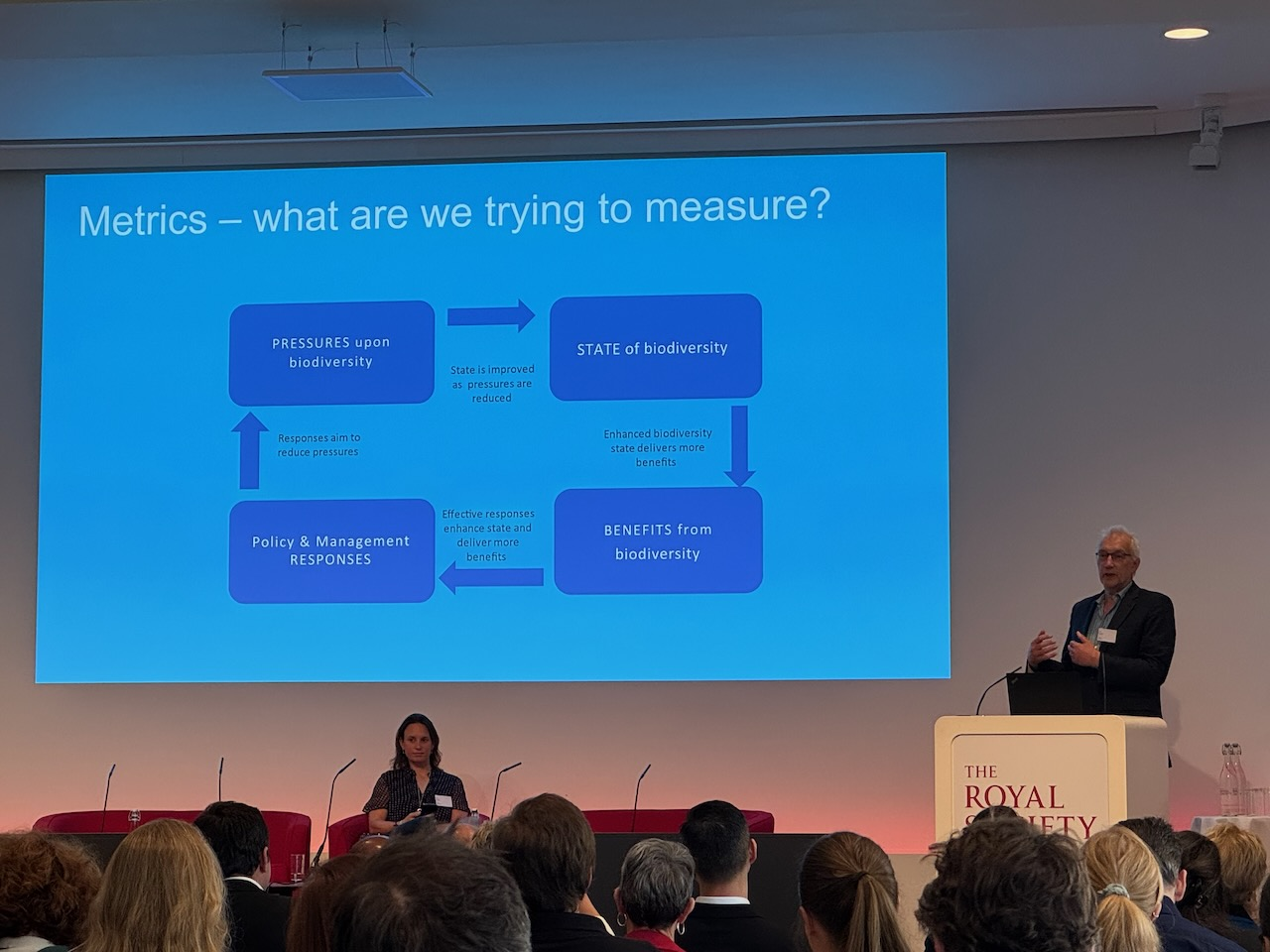
Is going to cover terrestrial metrics only. There are several sorts of metrics we could measure:
- pressures on biodiversity
- steady state metrics for biodiversity
- measuring benefits from biodiversity
- response metrics on the effectiveness of biodiversity interventions
We do need to understand biodiversity risk in regional detail so that
businesses can use this to influence their actions. There is also the need for
clear target setting to know how much opportunity cost to "spend" on
biodiversity vs other actions.
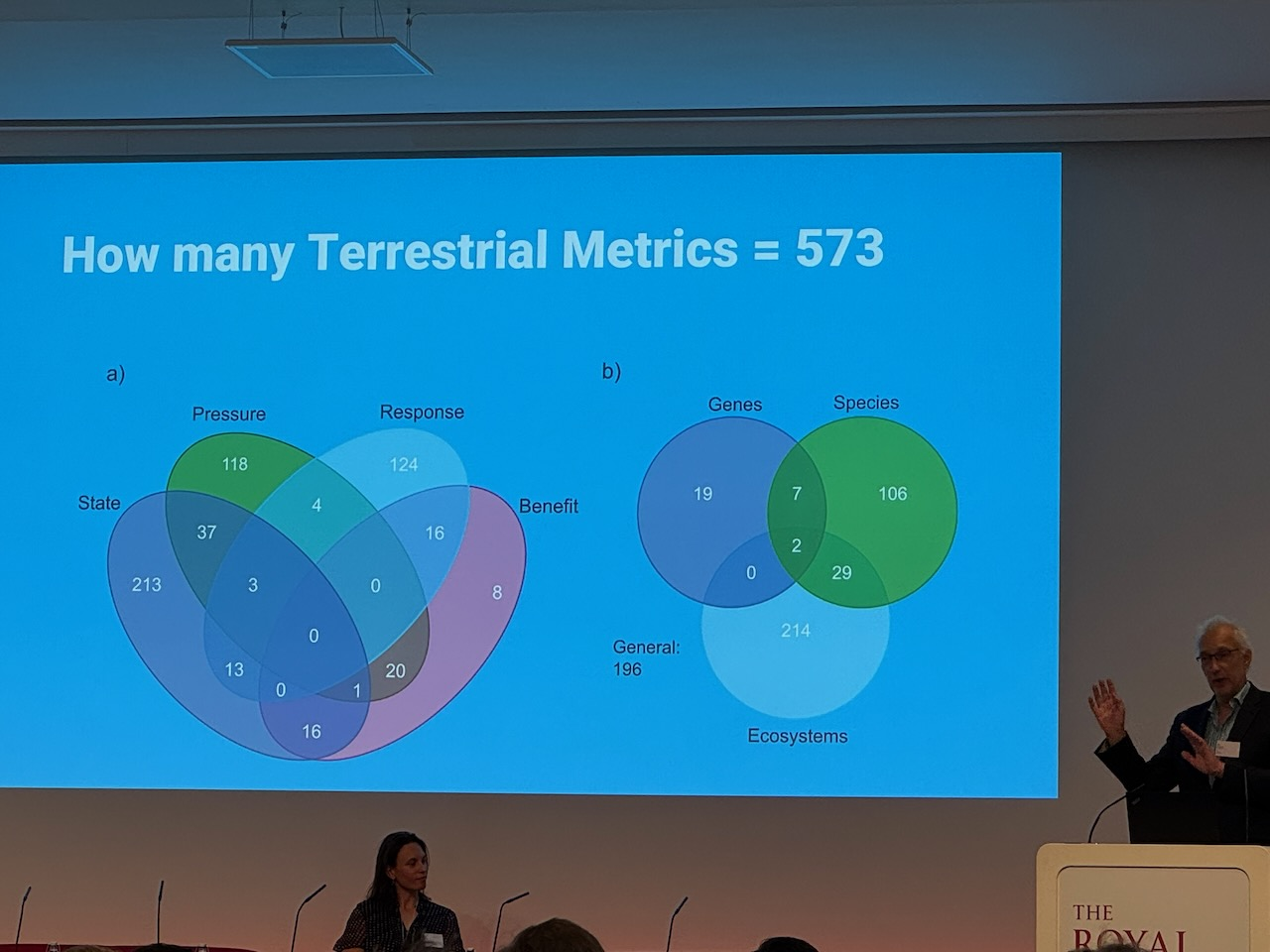
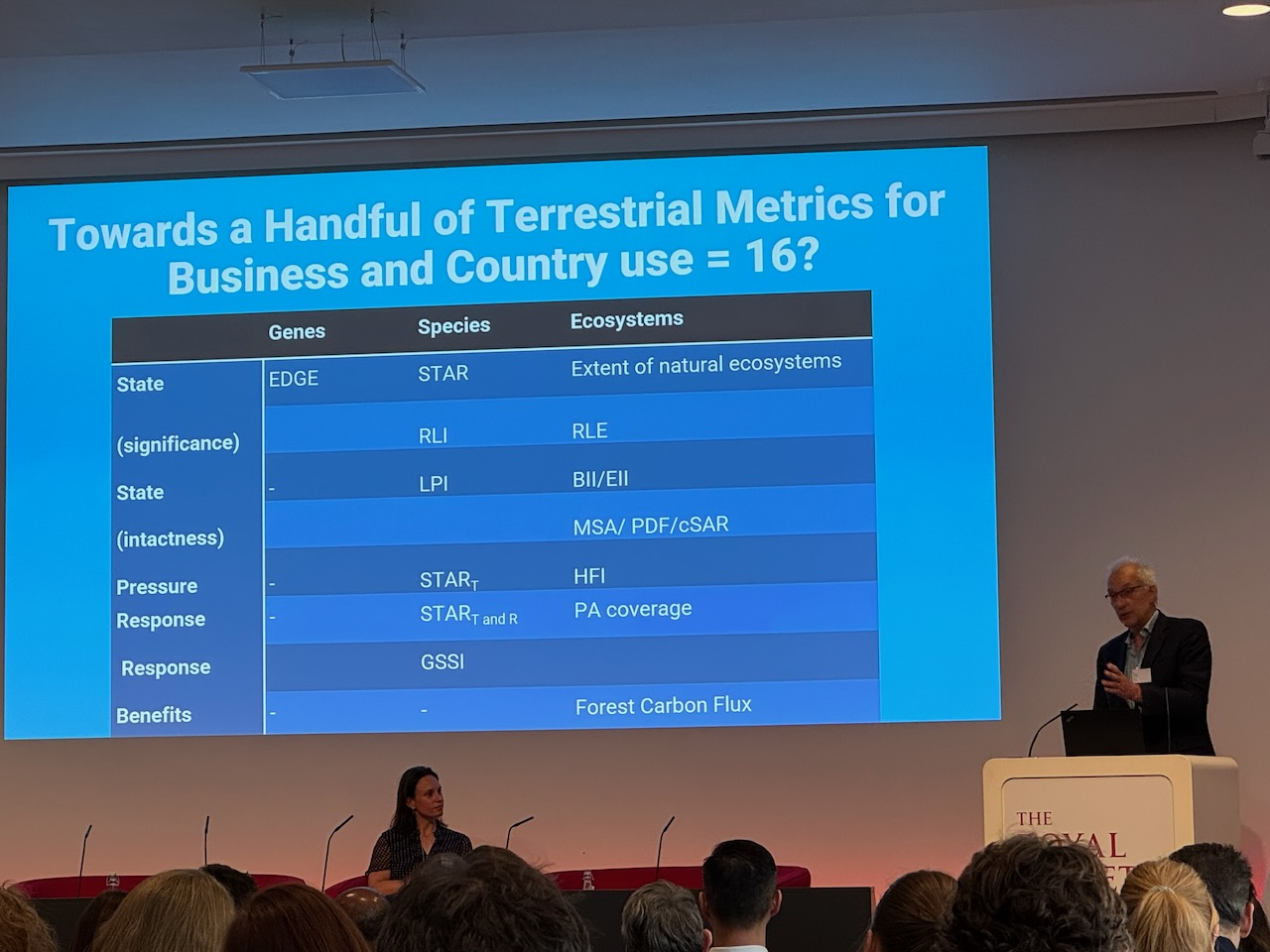
Neil describes how to classify biodiversity metricsCategorising 573 (!) biodiversity metricsMetrics usable for businesses currently
UNEP-WCMC have a huge database about all the various metrics (~573!) that
cover biodiversity. If you even add other things like marine, the number
breaks 600 (see picture). There are around 23 useful ones for business use;
there are few in this list that check benefits to people or discuss genetic
changes, but there are lots of on diversity, habitat area and so on.
(Neil noted that our [LIFE: A metric for mapping the impact of land-cover change on global extinctions](https://anil.recoil.org/papers/2024-life) paper isnt listed as its not published yet
till the end of the year, but it will be!)
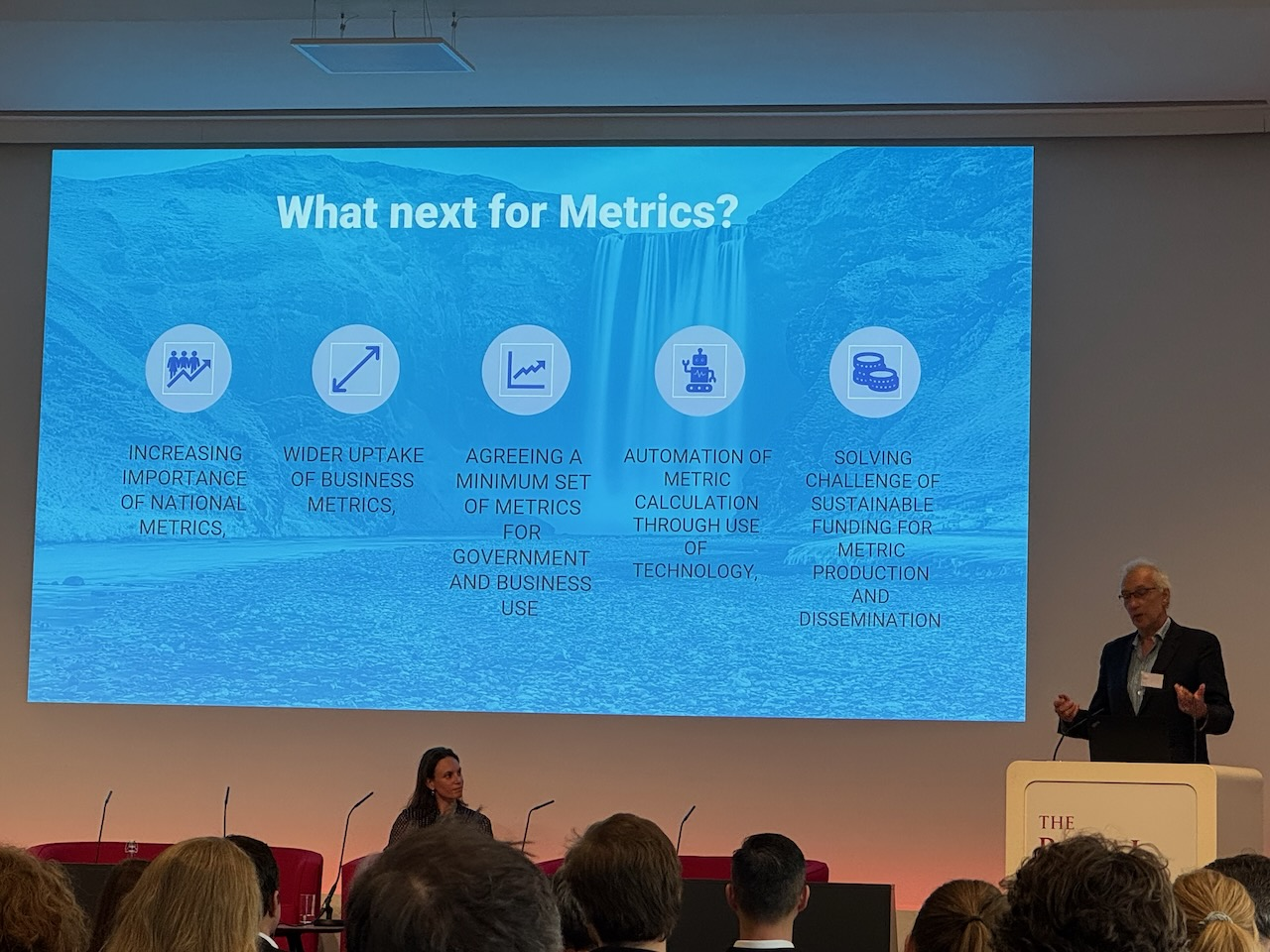
What next for biodiversity metrics?
There is quite a lot of work needed to make the metrics usable, and a pipeline.
He also noted the importance of incremental pipelines and mentioned the
incremental pipelines that [Michael Dales](https://mynameismwd.org) and [Patrick Ferris](https://patrick.sirref.org) are working on for these.
And this is something I'd like to advance with [Planetary Computing](https://anil.recoil.org/projects/plancomp)...
The main tool that pulls this together is [IBAT](https://www.ibat-alliance.org)
which is a paid-for model to support its continued developed. There is also
the free [ENCORE nature](https://encorenature.org/en) platform. For supply chains,
there is also tools to help check the country to country. There is a big emphasis
on the need for open sharing between platforms as well due to the sheer
complexity of biodiversity worldwide, which is a key thing to keep the platforms
sustainable both financially and equitably.
### Data availability and use (Prof Andy Purvis)
Andy's career as a scientist started 35 years, and he is now at the Natural
History Museum as a senior researcher. The mission there is not just to track
the decline of the planet, but also to advocate towards a healthier nature
positive society as well.
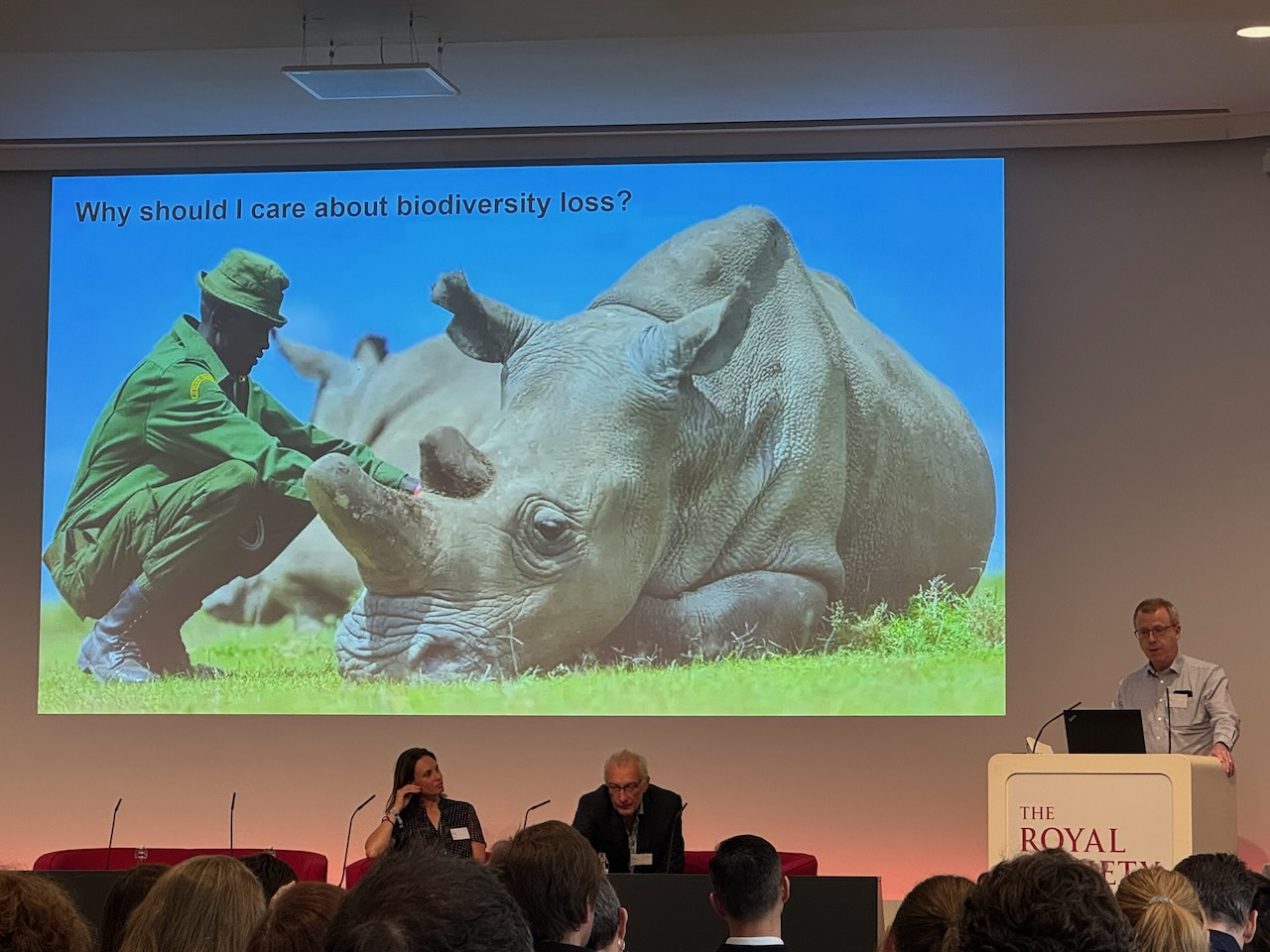
Why care about biodiversity?
We have a million or so species of animal and plants threatened by species
extinction. Our job as scientists is to come up with defensible statistics,
but they also don't convince anyone. So stories about individual species
(like the white rhino) are vital to build public awareness about the real
impact.
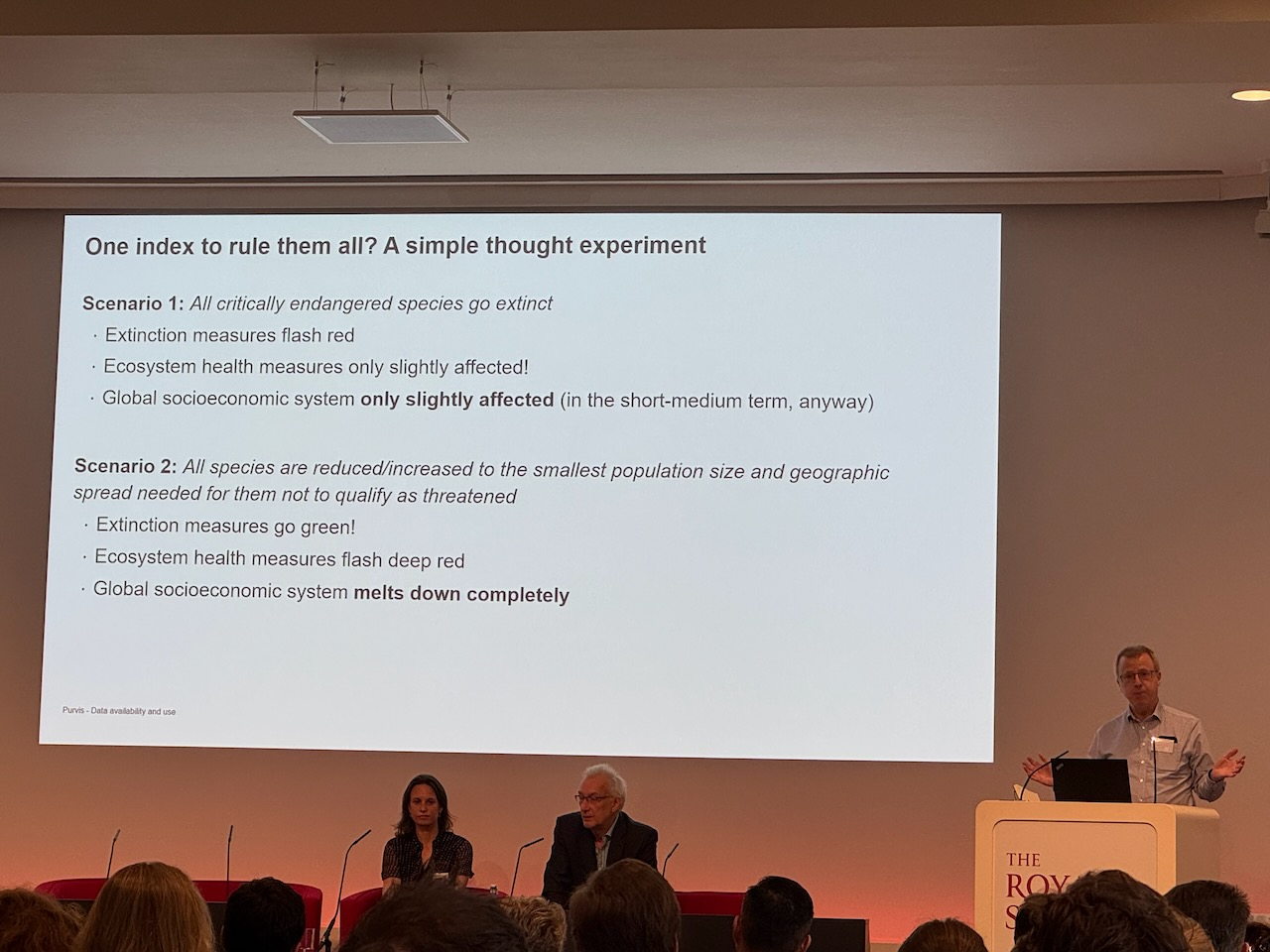
Is there one index to rule them all? Andy is against that idea of a single
metric to describe the world's biodiversity. Any indicator combining some of
the metrics has an "exchange rate" between extinctions and human wellbeing. In
other words, it creates an "extinction market".
Decision grade data are derived very carefully from very biased raw data. And
the data collection requires a huge amount of expertise, and is painstaking
to conduct. This has to be funded, and not even the collection of the raw data
is very well funded right now. To illustrate the data bias, there are a huge
amount of birds...and mallards...in there, which is clearly not representative
of global species spread.
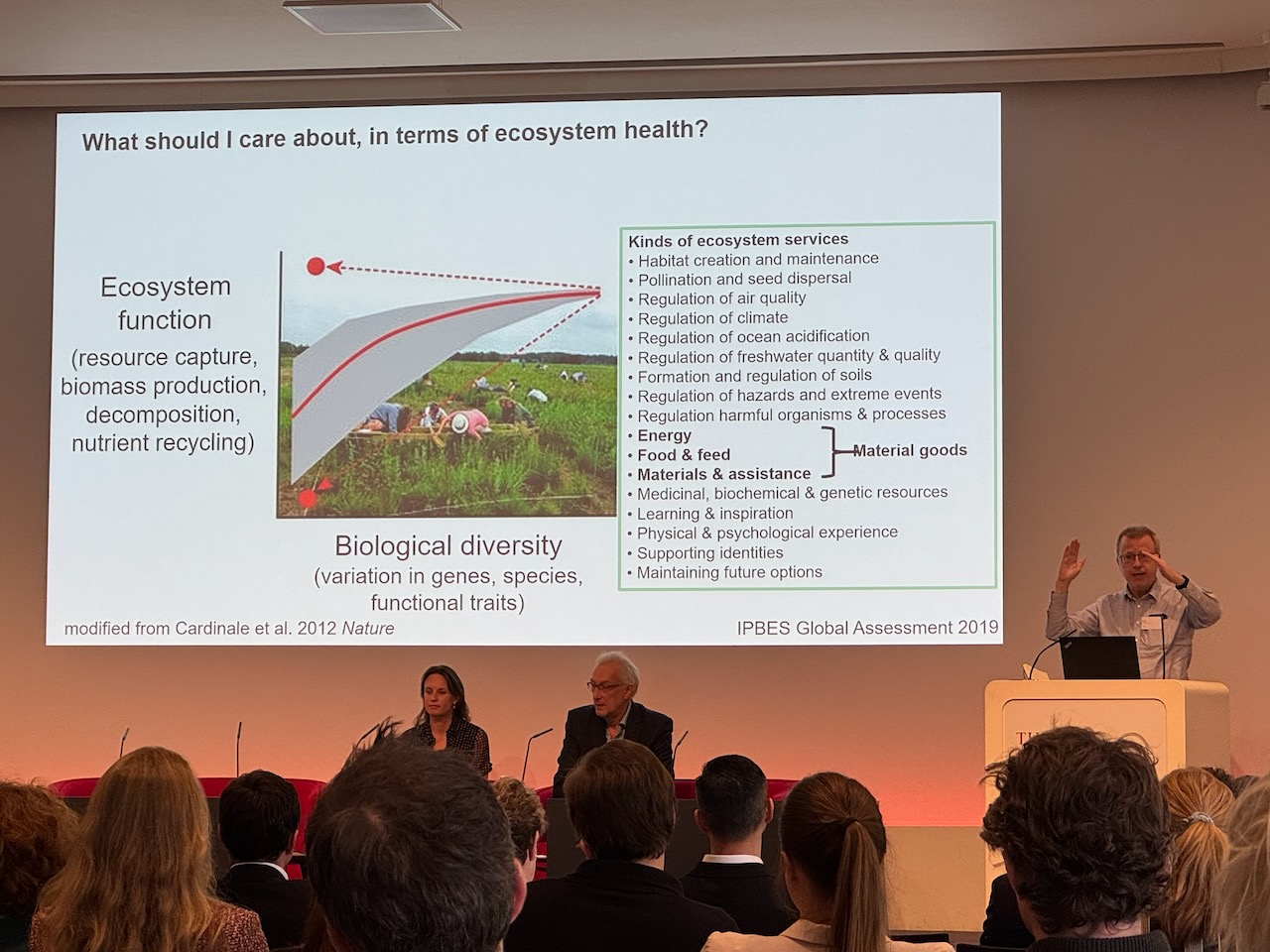
We can plot ecosystem function (resource capture, biomass production, decomposition
and nutrient recycling) on the axis of biological diversity (variation in genes
and species and functional traits). Across this, there is a huge spectrum
of ecosystem services that this supports, of which a few are really useful to humans.
And the [BII index](https://www.nhm.ac.uk/our-science/services/data/biodiversity-intactness-index.html)
is a statistical model relating nature to human pressures that produces both
high resolution temporal and spatial models.
What should we do in terms of ecosystem health?
- Deintensify activities in unhealthy systems where people depend on local ecosystem services
- Divest from businesses that are poor stewards of ecosystem health
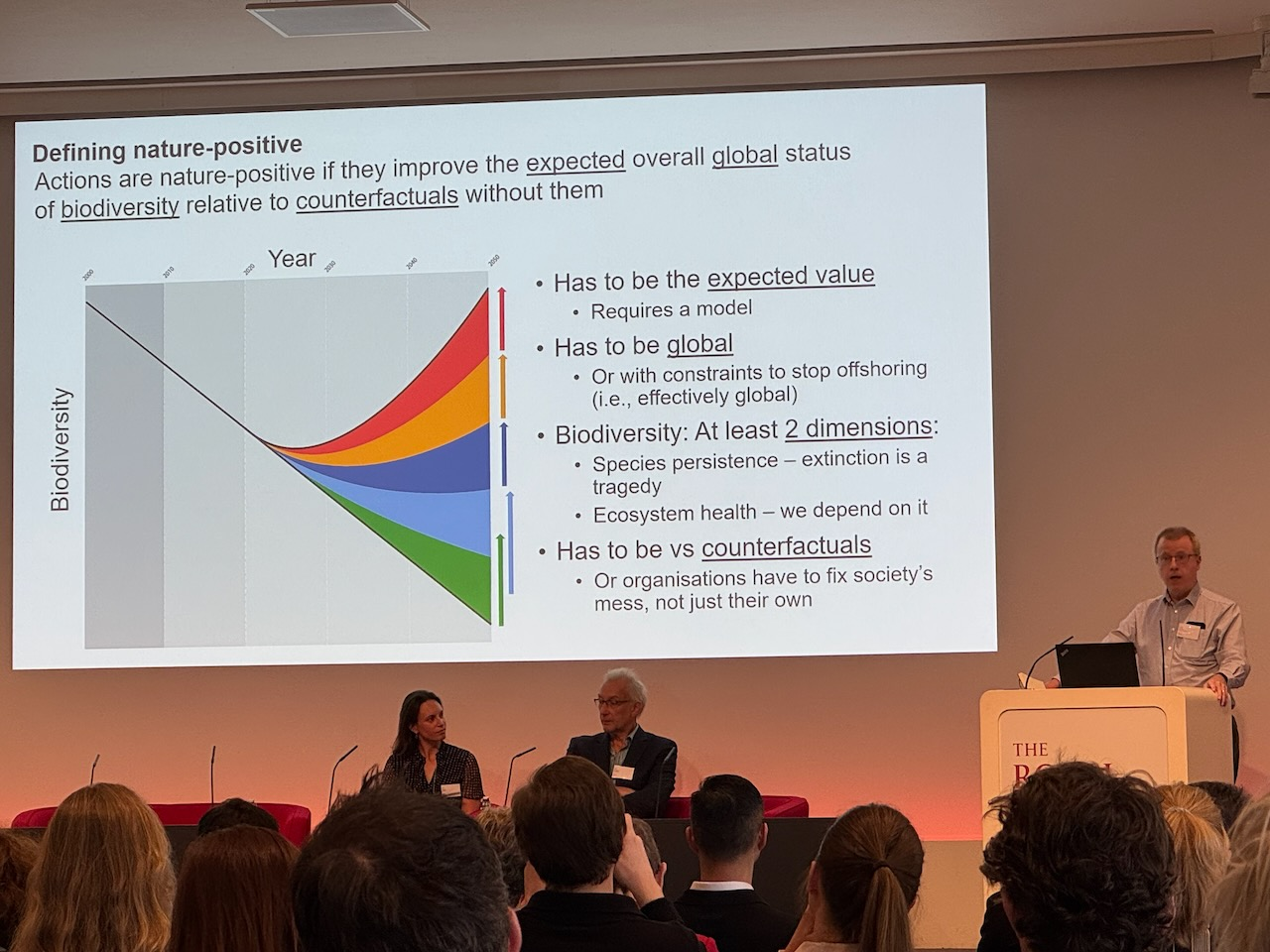
- Invest in actions that are "nature positive", which is an action that improves the expected global status of biodiversity relative to counterfactuals.
It requires a model, has to be global, and measure both species persistence and
ecosystem health. It has to be vs counterfactuals otherwise the cost is too
high for any individual organisation _vs_ society taking action collectively.
Why not have one biodiversity index?Ecosystem function vs healthDefining nature positivity as a counterfactual
We need to combine models with monitoring to give us a "sat nav" for nature.
There is a need to monitor drivers as well biodiversity, which
relies on data being available to improve the models. And if the platforms are
open then this is possible. There are platforms in the form of Geo BON, IBAT, BII ha a data license with
Bloomberg, and some TNFD tools.
Take home messages:
- Use data whose methodologies are transparent
- Remember the pitfall of hybrid indicators or indices
- Reduce extinctions and mitigate existing activities in important areas and dont do new human activities there
- Divest from poor stewards and invest in nature positive actions
- Monitor closely to verify gains and contribute to data repositories
- Accept that decision grade data does cost money and needs funding\!
### Q\&A
- Is the restoration of an ecosystem the reverse of destruction curve?
- Is there consensus about BII outside of the NHM team?
- Are we moving towards biodiversity standardisation?
- How can we make these metrics to be more understandable to businesses?
Andy: if we go back to a system with the original biodiversity, but the actions to get it there don't have an immediate effect (there is a timelag). There's no standardisation effort yet across many metrics, but we are moving towards ensembles of models with alternative sets of inputs for the environmental rasters in order to normalise the uncertainty in both the environmental and geographic space.
Neil: UNEP-WCMC uses BII a lot! In terms of metrics, a species and ecosystem metric and something on genes would cover the three dimensions of biodiversity, but others also need to be factored in. There is an effort to use AI/geospatial to get higher resolution landuse data (is this a forest?) and also probabilistic SDMs, but no standardisation.
Kat: being able to reverse degradation is a secret weapon for nature as it has an incredible ability to bounce back if pressures are reduced due to its innate resilience. The aspect of the data we often forget about is its ability to tell these stories and drive uptake, and this is powerful.
- What are the greenwashing risks of nature-positive counterfactuals?
- When we boil down the metrics that are ready for both country and business use, what are the qualities that make a metric useful? There were only 16 or so outside of ~600\!
Neil: There are criteria (peer reviewed, published, etc) with lots of feedback from the co-authors of the paper (to appear later this year). There are strongly held opinions in the biodiversity metric space. But it's actually not a huge and manageable list of metrics.
Andy: trying to avoid false claims of nature positive requires verification. We're going to get better at this by estimating the net gain and how certain its positive. The models will improve when there is a connecting pipeline to monitoring data and needs verification. So any payment for nature-positive claims needs to be staged and ex-ante.
## Other talks
I failed to capture notes for the middle sessions as I was engrossed in conversations, but here's a gallery of some of the fantastic speakers! They're on the livestream video if you want to catch the details.
# Partha's Day 2 roundup
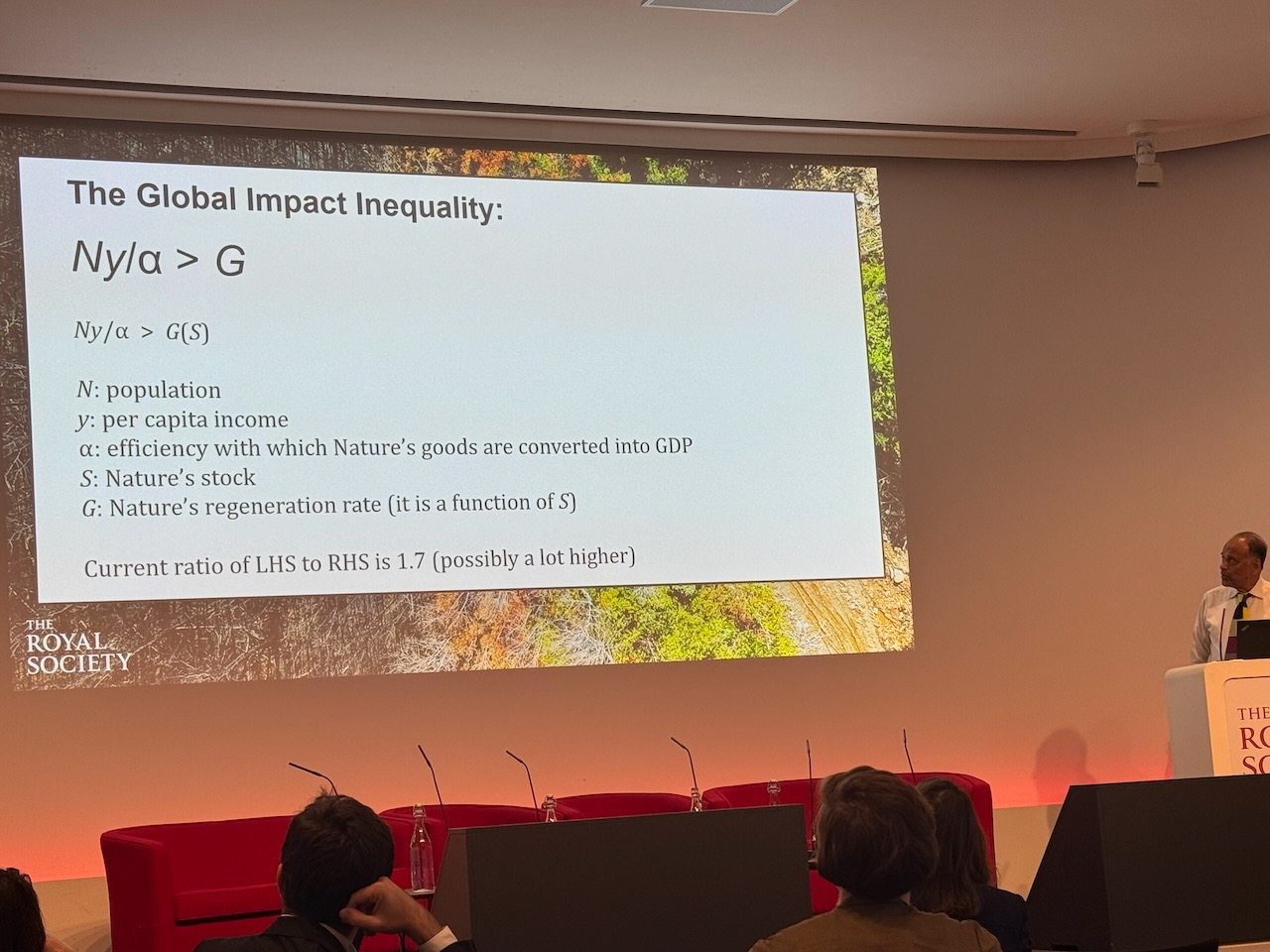
See the equation below. The right hand side is `G` (nature's regeneration rates) and is a function of the state of the biosphere (the `S`).
The left hand side is the human demand (human activity) which is a per-capita adjusted population and the efficiency of provisioning goods (recall what those are from the start of day 1 notes).
Most of the discussion in these two days have been on the right hand side. A huge amount of the literature is on the alpha, and how technological progress can raise alpha (e.g. via cleaner energy) and help rebalance the inequality. How fast can alpha change, as the faster it grows, the faster GDP and natural capital grows.
Sir Partha's equation to sum up the two days!
How might we advocate for change? The total we pay ourselves is 2-3% of global GDP for subsidising our assault on nature. Removing those subsidies is the equivalent of raising alpha. Adam Smith's classic book in the 18th century was the "Wealth of Nations" and not the "GDP of Nations". For us, wealth includes natural capital. Even as early as 60 years ago, human capital didn't appear in the economic literature. Most national accountants include statements about the increase in human capital, and for our purposes we must include natural capital in the notion of wealth. We must shift accounting away from GDP into calculations of stock and inequalities, as shown in the equation.
What the discussions missed didn't discuss invasive species and the "transfer of natural capital" through the fact that goods and services are traded. This is represented in the capital `N` in the equation. So that's future work\!
## Follow more
This concludes my rapid note taking. Do join the [livestream](https://royalsociety.org/science-events-and-lectures/2024/10/ecological-and-commercial-risk/) and follow for the remaining day and a half if you have a spare moment\!
*Edit: upon being prodded by [Alec Christie](https://profiles.imperial.ac.uk/a.christie), I've uploaded a [NotebookLM](https://notebooklm.google) generated podcast summary of the morning. It's surprisingly entertaining, but I'm sure I'm going to regret this for some reason...*
Synopsis: The discussion centered around the relationship between ecological and commercial risk, highlighting the need for a more comprehensive understanding of natural capital and its role in the economy. The equation presented by Sir Partha Dasgupta summarizes the two days of discussion, emphasizing the importance of balancing human demand with nature's regeneration rates. The talks touched on various topics, including greenwashing risks, standardization of biodiversity metrics, and the need for verification of nature-positive claims. The conversation also stressed the importance of shifting accounting away from GDP and towards calculations of stock and inequalities, incorporating natural capital into the notion of wealth. Overall, the event aimed to raise awareness about the interconnectedness of ecological and commercial risk and the need for a more sustainable approach to economic development.
Words: 6736
DOI: 10.59350/0qmn2-rwh65
## Related
- [Food impacts on species extinction risks can vary by three orders of magnitude](https://anil.recoil.org/papers/2024-food-life) (paper, 2025-09-01)
- [The Cambridge "Green Blue" competition to reduce emissions](https://anil.recoil.org/notes/cambridge-green-blue) (note, 2025-05-06)
- [LIFE: A metric for mapping the impact of land-cover change on global extinctions](https://anil.recoil.org/papers/2024-life) (paper, 2025-01-01)
- [How does ecological risk related to commercial risk (NotebookLM AI summary)](https://anil.recoil.org/videos/09d626ed-d090-4016-a812-ca90e382b441) (video, 2024-10-03)
- [Planetary Computing](https://anil.recoil.org/projects/plancomp) (project, 2022-01-01)
---
Canonical: https://anil.recoil.org/notes/rs-ecorisk-day1
Type: note
Tags: :rsn, :life, royalsociety, livenotes, conservation, ecology, economics