# Parsosaur: turning PDFs back into a structured academic paper metadata
*2026-11-15 — note*
I've just released [Parsosaur](https://tangled.org/anil.recoil.org/parsosaur), a
Python tool that converts academic PDF papers into machine-structured
formats such as JSON, [TEI XML](https://tei-c.org/) and also an interactive HTML bundle.
I [first mentioned this](https://anil.recoil.org/notes/2026w33) back in August as a machine learning
experiment I'm working on with [Sadiq Jaffer](https://toao.com) while developing
the [Evidence TAP](https://anil.recoil.org/projects/ce), and am just about ready to run it on our
[Taposaur](https://anil.recoil.org/notes/2026w31) crawler that now holds around [35 million fulltexts](https://anil.recoil.org/notes/2026w45).
None of the raw PDFs we have from the crawler are much use towards evidence
synthesis until we can reliably extract structured information such as semantic
sections, tables and refs for the domain experts to quickly verify that the
data is accurate from the sources.
This PDF extraction is surprisingly tricky to get right, since we are essentially
reversing a complex document compilation pipeline. And for [evidence synthesis](https://anil.recoil.org/papers/2025-evidence-tap), this
is often for papers that are decades old and sometimes just scanned\!
## Why PDFs are hard to parse
A [PDF](https://en.wikipedia.org/wiki/PDF) is a complex set of declarative instructions for laying out vectors on a
digital canvas. The format originated from [PostScript](https://en.wikipedia.org/wiki/PostScript) (which is [Turing
complete](https://en.wikipedia.org/wiki/Turing_completeness)) but is less powerful and only describes where shapes appear
on a canvas. There's no *required* [semantic markup](https://en.wikipedia.org/wiki/PDF#Tagged_PDF) (paragraphs, column,
captions etc) but some (e.g. [LaTeX](https://en.wikipedia.org/wiki/LaTeX)) pipelines do happen to embed extra
metadata.
Our [goal](https://anil.recoil.org/projects/ce) is to work on a large number of PDFs from a variety of sources, so we
have to assume that we'll need to infer the semantic knowledge from the raw
[glyph](https://en.wikipedia.org/wiki/Glyph) positions in the PDF.
I used a bunch of my own [papers](/papers) as a quick test corpus, as they
spanned 2002 to 2026 and so had a reasonable variety of PDF toolchains involved
in their production. I wanted Parsosaur to generate machine output with decent
section structures, with knowledge about tables and figures, and every
reference and citation cross-linked and checked against a DOI database.
### Browse the HTML results
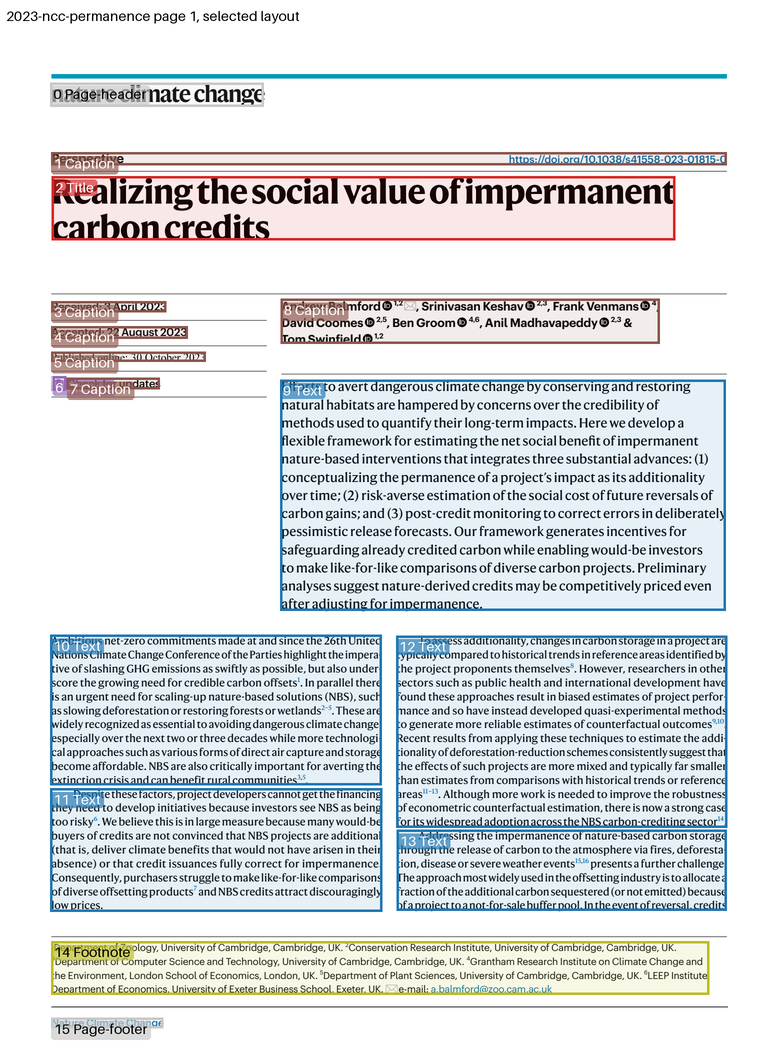
The image below shows the first page of our [Nature Climate Change paper on permanence](https://anil.recoil.org/papers/2023-ncc-permanence) after being parsed, with the masthead, dates,
authors, abstract, two-column body and affiliation footnote each separated into
their own labelled region.
I've also uploaded the [HTML output](https://www.cl.cam.ac.uk/~avsm2/parsosaur)
for six of my papers so you can try out the different outputs. It's a lot of
fun seeing the two models converge on a PDF layout for papers with a variety
of layouts\!
A successful Parsosaur run on a Nature layout paper
### Try it out
Parsosaur is an MIT-licensed Python package, now [available on
PyPI](https://pypi.org/project/parsosaur/), that you can run with
[uv](https://docs.astral.sh/uv/guides/tools/). It needs a Linux machine with
an NVIDIA GPU for the layout model, and a vision language model served over an
OpenAI-compatible API. Just stick each PDF in a directory and point
Parsosaur at it for it to populate the directory with metadata:
```sh
mkdir paper && cp mypaper.pdf paper/
uvx parsosaur paper/ --base-url http://localhost:8000
```
There will be an `index.html` in the output directory that's a reading
view, as well as a bunch of other reconstructions such as the JSON and
TEI XML.
The layout model is a download of several gigabytes on first use.
If you also have GROBID, then you can put the GROBID TEI file output beside the PDF
to have it used as yet another accuracy check.
## Technical details
Let's now look at how Parsosaur works under the hood, and why we need it.
The brilliant [GROBID](https://github.com/kermitt2/grobid) software stack,
which [we already run](https://anil.recoil.org/notes/2026w31), is designed to extract metadata from papers.
While it gets a long way on titles and authors, it is weaker on structured extraction
of body text and figures. On the other hand, while newer AI vision models
that convert a whole page as an image are better on average, they still make big
mistakes like (e.g.) dropping whole columns silently and so need to be double-checked.
Parsosaur therefore combines three sources of information:
- A small _layout model_, NVIDIA's
[Nemotron-3.5-Parse](https://huggingface.co/nvidia/Nemotron-3.5-Parse),
looks at each page as an image and draws a labelled box around every region,
such as a paragraph, a table or a footnote.
- A larger _vision language model_,
[Qwen 3.8 27B](https://huggingface.co/Qwen/Qwen3.8-27B-FP8), is shown each
box in turn and transcribes what is inside it. It is told what type of
region the box holds, so that a table can be parsed into a columnar format, or a formula as
LaTeX. For figures it uses the LLM to determine if structured JSON can be read from it.
- A _heuristic engine_, aka a set of deterministic rules, that
uses the PDF glyphs to repair things the models got wrong.
Since the PDF knows where every character is drawn, we use this
to cross-check if our fancy machine learning models have missed something\!
Both ML models are compact enough to run on local GPUs, which is important as a
lot of our paper corpus is closed source and not redistributable.
Parsosaur also does a final pass to figure out the title, authors and abstract,
and splits the bibliography into individual references that are cross-linked to the
in-text citations.
It also caches intermediate results in the paper output directory, to make it
easy to add heuristics without having to re-run the more expensive GPU inferences.
### Precision vs accuracy tradeoffs
NVIDIA published a [case study of Edison
Scientific](https://developer.nvidia.com/case-studies/scientific-literature-ai-nvidia-nemotron),
who use the same Nemotron model family to feed an [AI literature
agent](https://github.com/Future-House/paper-qa/tree/main/packages/paper-qa-nemotron).
In their deployment, Nemotron Parse supplies both the boxes and the text in a
single pass, and the vision model only examines figures, tables and
equations.
Their approach is fast, and well suited to answering questions over
thousands of papers. Our purpose is to obtain a faithful offline conversion of
each paper, such that a domain expert can navigate back to the paper and cross
check assertions from the primary sources. We therefore want high fidelity
tracking of source locations, and as much accuracy as we can reasonably afford.
### Using the PDF as a referee
Therefore for every page, Parsosaur counts the fraction of the PDF's characters
that fall inside one of the layout model's text boxes. Above 95% (a threshold
determined by experimentation), the layout is accepted. Below that, the layout
model is invoked in a more thorough mode that's cross-checked against the
first.
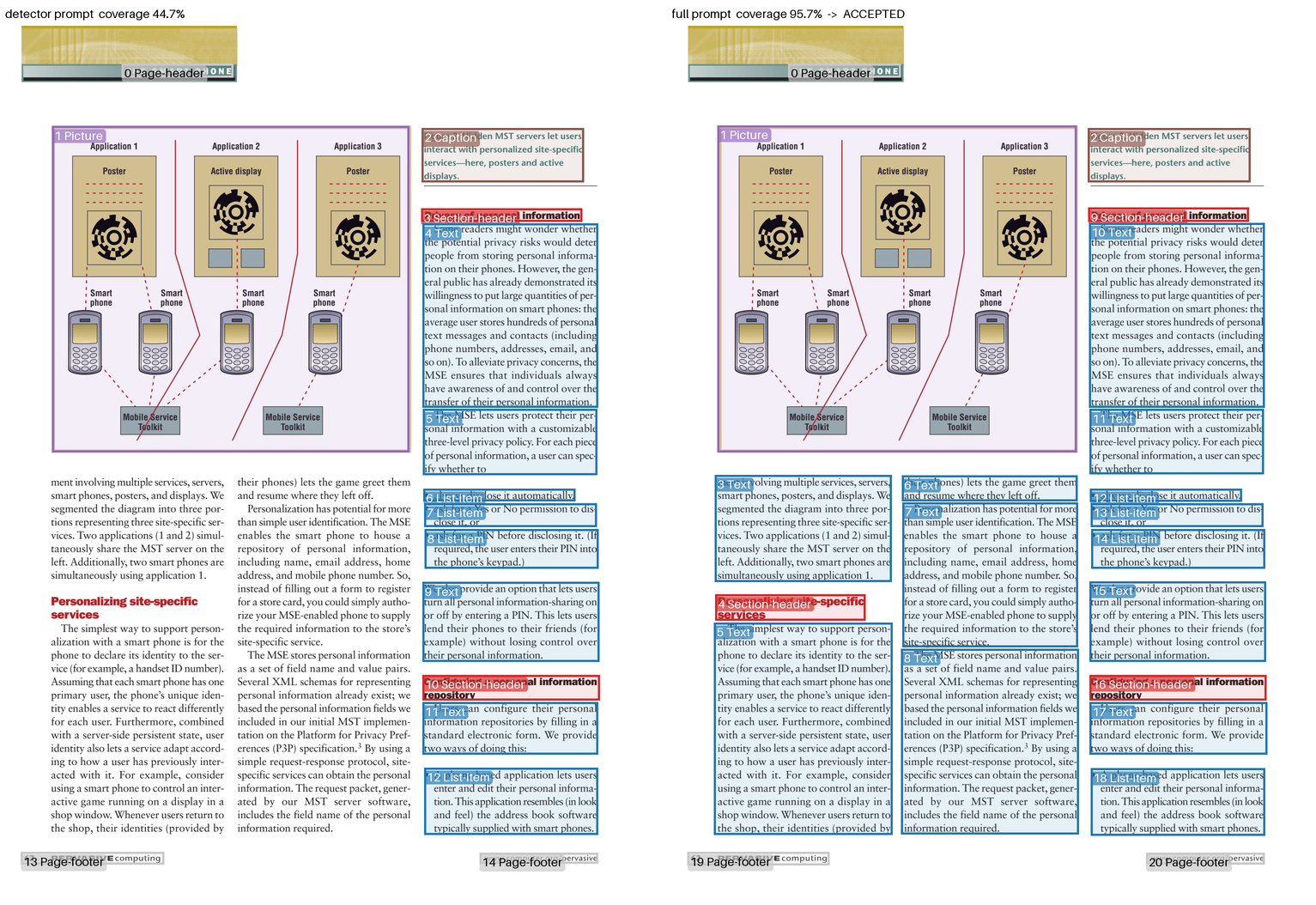
For example, page 4 of my [2005 IEEE Pervasive Computing article](https://anil.recoil.org/papers/2005-ieee-smartphones)
shows the two modes. The layout model boxes the figure and one column of text and then stops, whereas
the more thorough run takes longer but finds the unusual magazine layout text with
all the glyphs on the page accounted for.
The first Nemotron parse attempt (left) accounts for only 44.7% of the characters on the page, having missed two columns. The second attempt (right) finds all three columns, reaching 95.7% glyph coverage.
We don't use the "thorough" mode on every page since it is much slower.
Over our test set it generally took 3.5-4x as long, and also introduced
occasional large new losses on papers that the quick mode handled correctly.
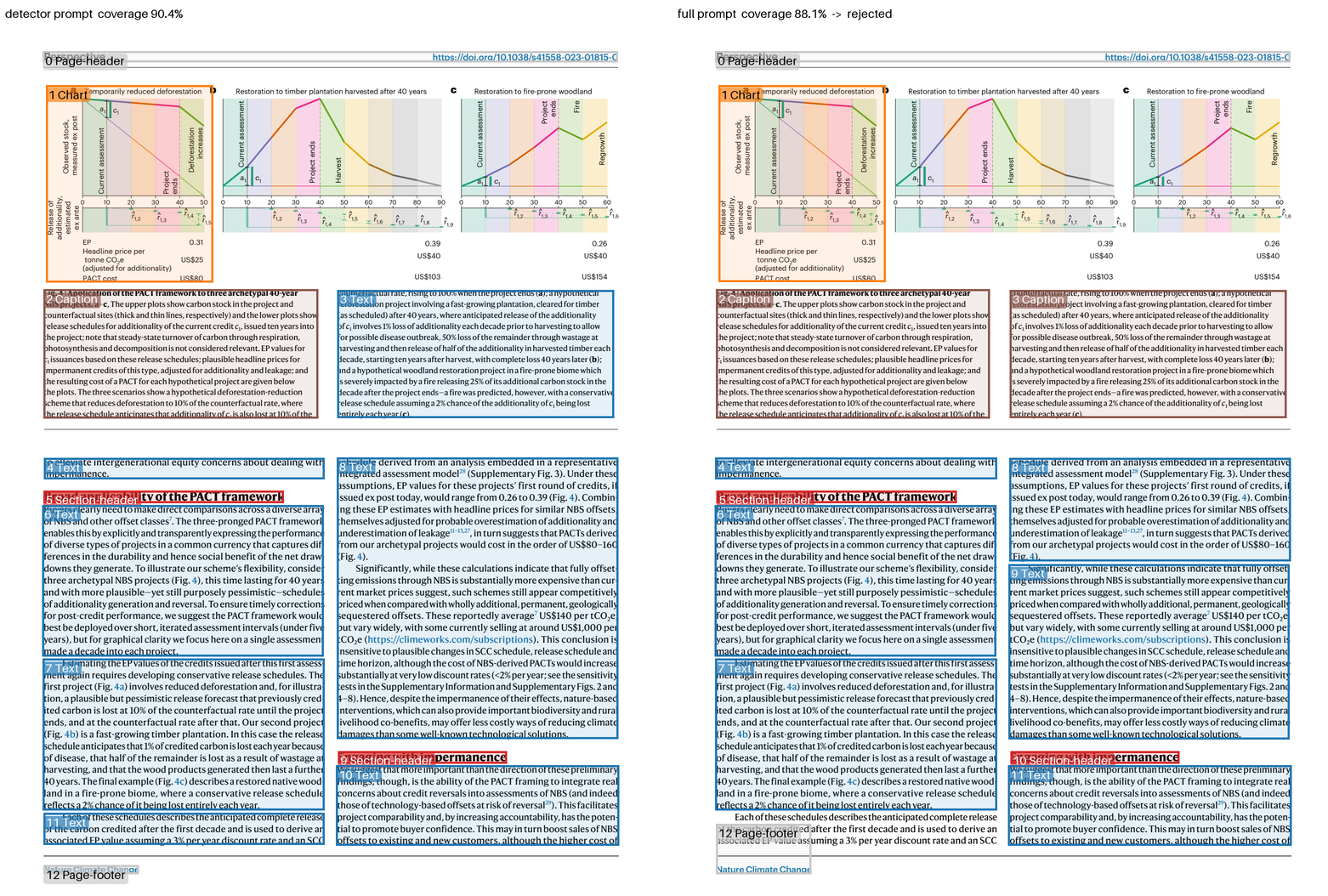
The thorough attempt is therefore only made on suspect pages, and only kept if
it accounts for more characters than the first.
The thorough mode accounts for 88.1% of characters against the quick mode's 90.4%, because it loses the final paragraph of the left column.
## The heuristic engine
Switching between the parsing and the vision models requires some heuristics
to bridge the data. We establish a few rules here (arrived at by experimentation)
that allow papers from a publisher to be sampled. Since most papers in a journal
share similar typesetting, this works pretty well towards getting good structured
output.
### Dealing with drop caps and glyphs
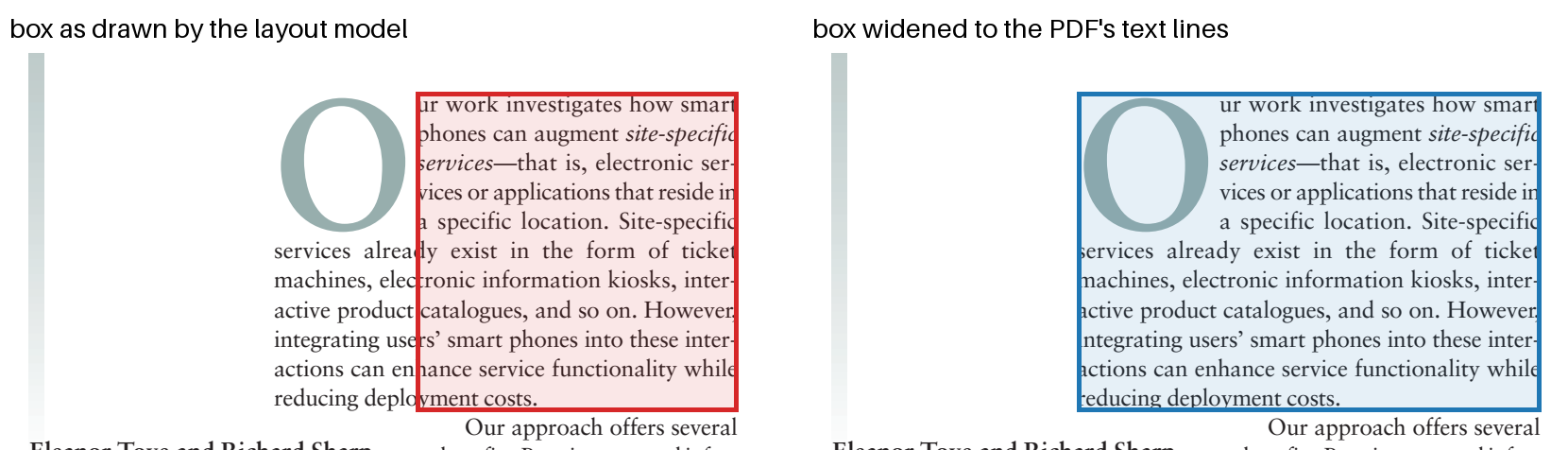
One example of a heuristic is widening boxes to the text. The layout model
sometimes draws a box that's too narrow, often when there's a drop cap in the layout.
This means the vision model misses text, as it can only read inside the crop. Our heuristic
checks whether the PDF has characters just outside a box that are spaced similarly to the rest of that line,
and if so widens the box to include them.
Left: the box drawn by the layout model cuts off the start of the lower six lines. Right: the same box after being widened to the lines of text recorded in the PDF.
Another is spelling names correctly from the PDF text, which is important for unusual glyphs
or foreign languages. For example, the vision model read the title of our [NPU paper](https://anil.recoil.org/papers/2026-benchmarking-npus)
as "Benchmarking Ultra-Low-Power μNPs", but the PDF file's properties had
"μNPUs". When the PDF agrees with a transcribed title, heading or author name
to within a letter or two, the PDF's spelling wins.
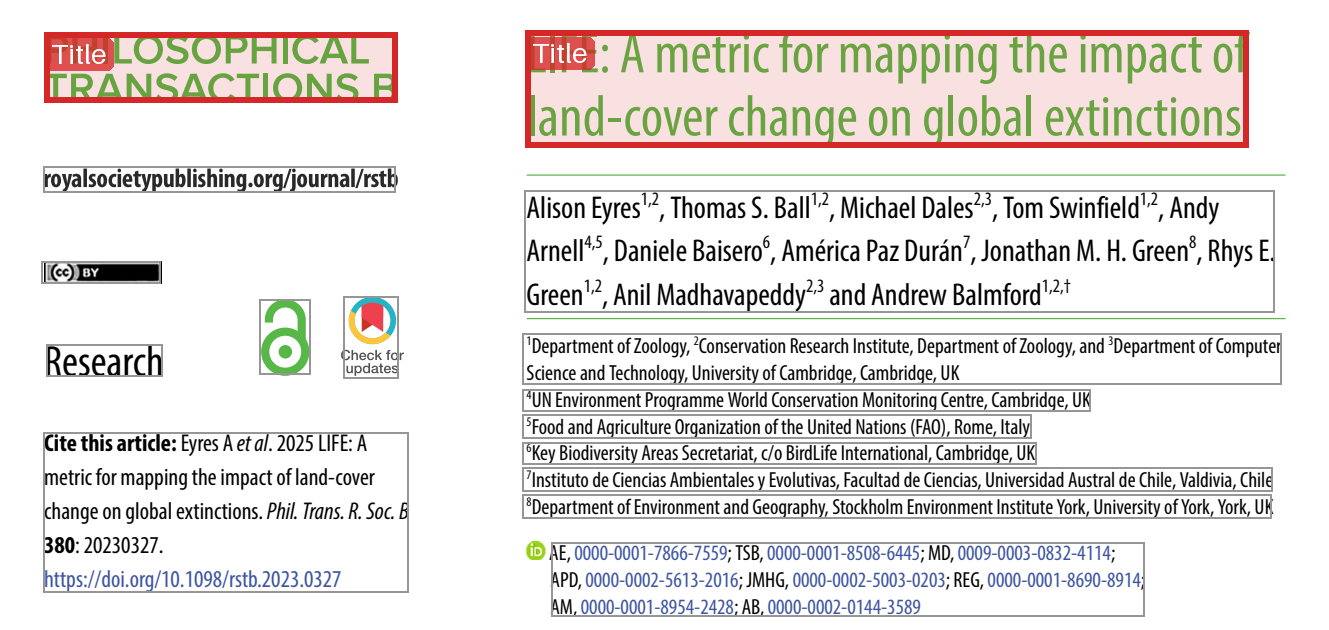
### Disambiguating multiple titles
Journals often print their own name as large as the article's title, and the
layout model labels both as titles, as it does for our [LIFE paper](https://anil.recoil.org/papers/2024-life)
below. The box whose words best match the extracted title is chosen.
The first page of our LIFE paper, where the layout model labels both the journal name and the article title as titles. The second one is chosen as it matches the title that was extracted.
### Cross-checking against PDF metadata fields
One obvious win is that we can read the metadata identifiers that the PDF
declares. Most journal papers self-identify their own DOI in their metadata,
and modern papers also link each author to their ORCID. These are taken
straight from the file. A DOI that _only_ appears as a link in the body is
ignored as it may belong to a cited paper.
### Double-checking Crossref lookups
GROBID can look papers up in [Crossref](https://www.crossref.org/) via
[biblio-glutton](https://github.com/kermitt2/biblio-glutton), and for 15 of my
141 papers it returned somebody else's! For example, the NPU paper came back as ["Approaches
to Improving Nursing Handover in Surgical Wards"](https://doi.org/10.70749/ijbr.v3i8.2063). This
was weird enough to dig into, and it turns out to be multiple chained mistakes:
1. First GROBID misread the magazine layout and took the column banner
"EXPERIMENTAL METHODS" as the title, and the stock image credit "Photo,
istockphoto.com" as a first author called Photo.
2. Then the nursing paper's own [Crossref record](https://api.crossref.org/works/10.70749/ijbr.v3i8.2063) is corrupt, and also lists a first
author whose family name is Photo.
3. The match score is the mean of the title similarity, the author similarity
and the search rank. A surname as rare as Photo matches exactly and ranks
first, so (0.21 + 1.0 + 1.0) / 3 = 0.74 was above the 0.7 threshold.
Parsosaur therefore refuses GROBID's record if its DOI differs from the one
the PDF declares, or if its title does not match the page. We need to be really
careful not to overly rely on any one metadata inferences, as the above chain
of results demonstrates\!
## Experiments
This was a very simple experimental setup, primarily just based on a 10,000-page
corpus sampled from my papers and Taposaur. The next step is to run
this on a much larger corpus to do systematic ablations and establish whether
per-publisher heuristics are definitely necessary.
There are some research questions we need to dig into further with a larger corpus.
### Does processing more pages at once change the result?
Each page should be processed independently, but there's a speed tradeoff involved.
Laying out 16 pages at a time was 23% faster than 2 at a time, but lost more regions, including bibliography entries.
Parsosaur therefore currently processes two pages at a time, but needs more experiments to establish the Pareto frontier (if any) here.
I suspect that as the context window of these later models increases, they'll get better at managing extra pages.
### Is the Nemotron 3.5 model more accurate than the 2.0 model?
When I [started this](https://anil.recoil.org/notes/2026w33) with [Sadiq Jaffer](https://toao.com), the SOTA model was Nemotron 2.0. I later upgraded to Nemotron 3.5 and compared against the 2.0 version.
|Measured over 146 pages|2.0|3.5|
|---|---:|---:|
|Time to lay out every page|236 s|142 s|
|Coverage|95.29%|96.69%|
|Characters counted twice|0.81%|0.03%|
|Word accuracy|93.62%|95.17%|
On average the 3.5 model is faster and better, but not always. Coverage did improve on 37 pages, was
unchanged on 75 and worsened on 34, but the regressions were surprisingly severe.
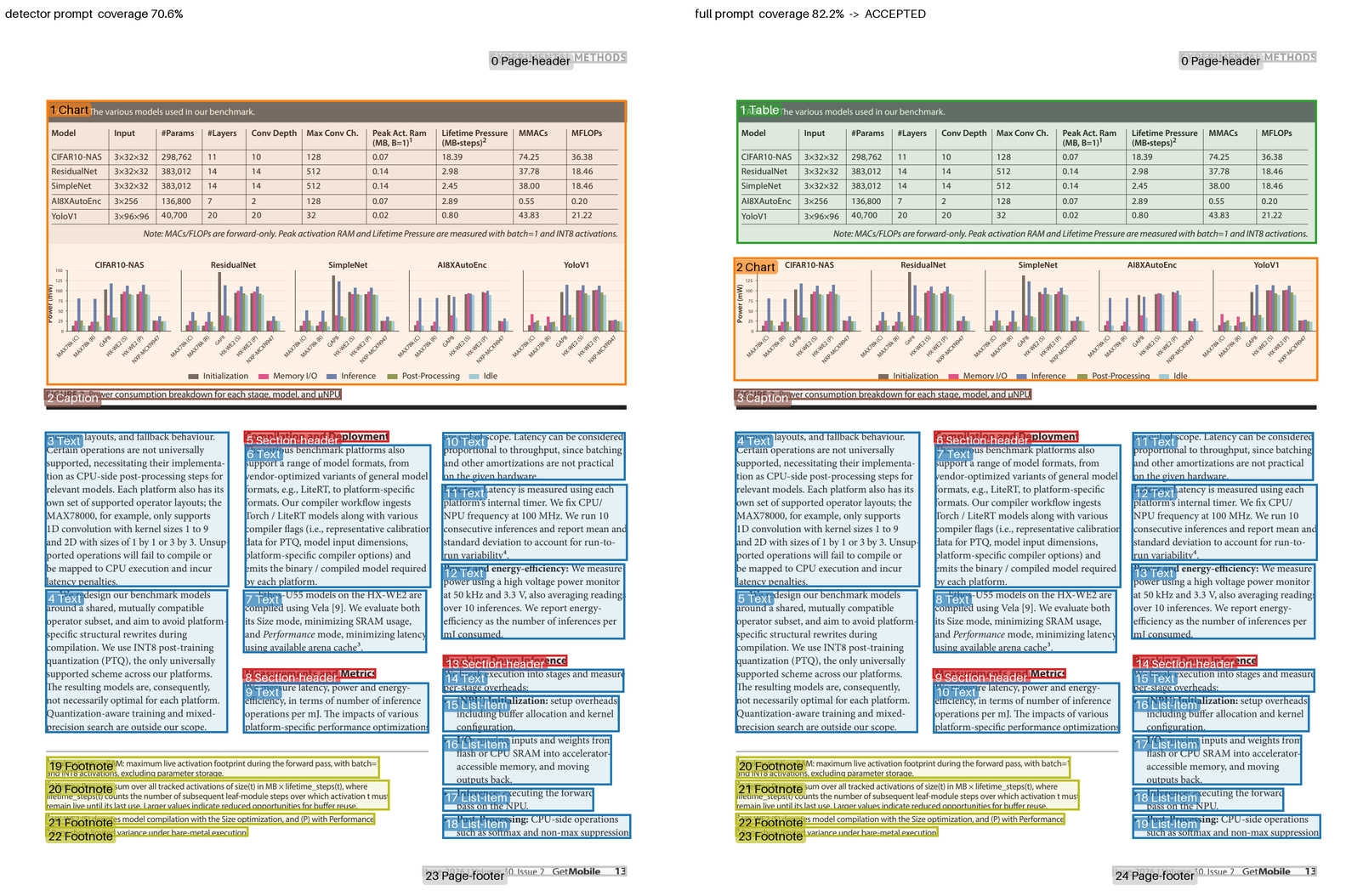
Version 3.5 lost columns, and merged a table in our [NPU benchmarking paper](https://anil.recoil.org/papers/2026-benchmarking-npus) into the chart beneath it.
The lost columns also reproduced on a CPU-only run, pointing to the model itself being at fault.
The strong performance results motivated adopting 3.5, but with the heuristic engine and the thorough/quick modes to vary the context window.
Left: the table and the chart below it are boxed together as one chart in Nemotron 3.5. Right: the second, more thorough attempt separates them.
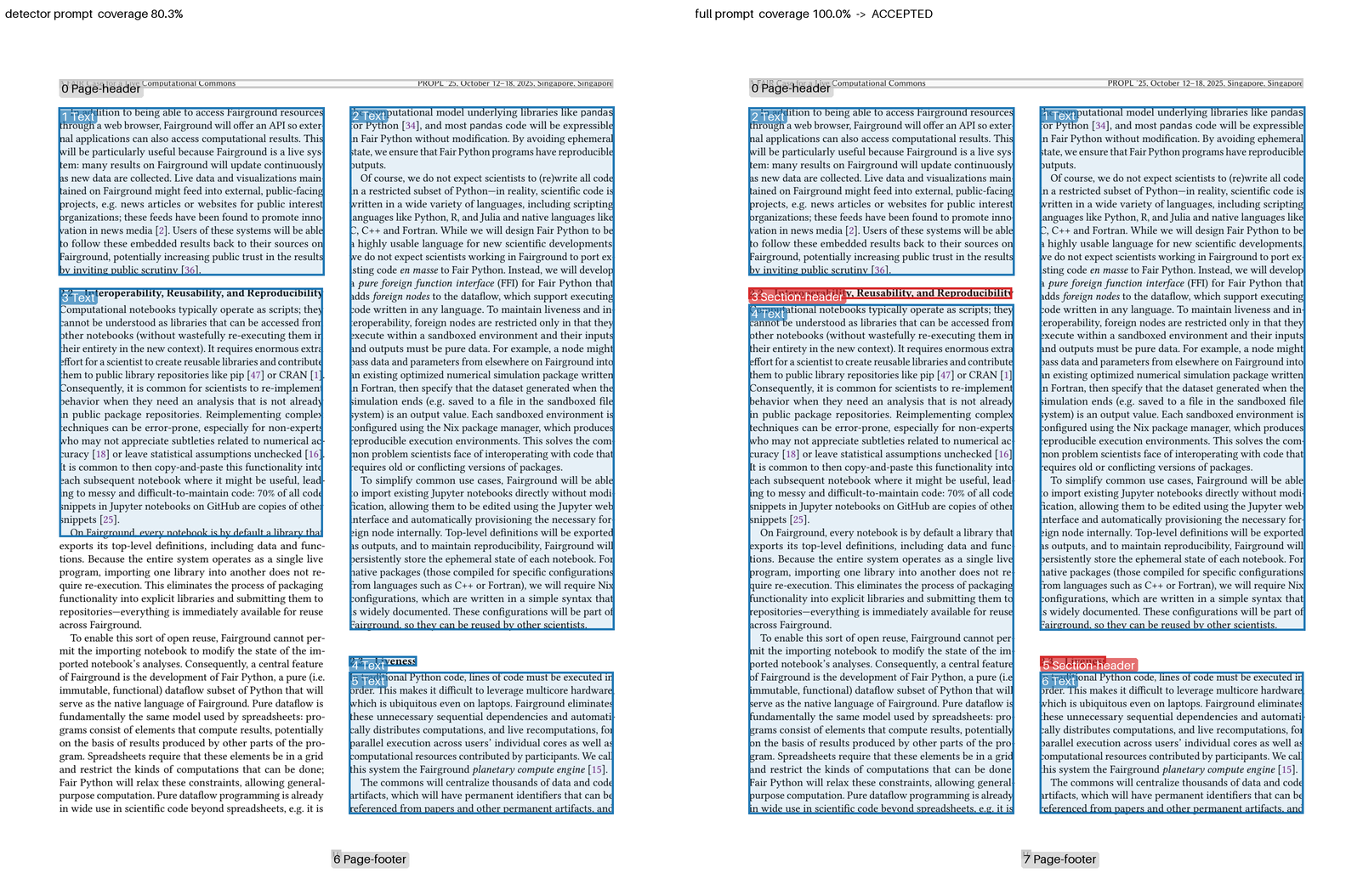
As a secondary question, does retrying only suspect pages keep the gains without the losses?
This does work well on Nemotron 3.5. Of the 146 pages, 31 fell below 95% coverage and were retried, and 4
retries were accepted. Coverage rose to 97.47%, no previously found character
was lost, the hand-checked table returned to 76 correct cells out of 77, and
layout was faster.
From our Fairground paper, the first attempt leaves the lower half of the left column unboxed. The second accounts for every character but numbers the right column first incorrectly.
### Does providing full text help the vision model interpret figures more accurately?
A little, but not as much as I expected! I think this needs more
data to give a convincing result.
I gave the vision model the paper's text alongside each figure, and measured how many of the labels printed inside the figure appeared in its
corresponding description.
While there was a gain of nine points on the paper test set, tables responded
badly since the model began to reconstruct them from the prose and dropped
whole columns. Parsosaur therefore supplies the text for figures and formulas
but not for tables.
A general purpose frontier LLM has no problem with these layouts, but the smaller
models do struggle and need these heuristics. This is also unsatisfying, but necessary
due to our need to run on local GPUs only\!
## Related work
There are broadly three ways to get the text out of a PDF paper. The classical
one, used by [GROBID](https://doi.org/10.1007/978-3-642-04346-8_62) and
Semantic Scholar's [PaperMage](https://aclanthology.org/2023.emnlp-demo.45/),
trusts the PDF's embedded text and trains models to label it semantically. Independent
comparisons of [extraction tools](https://arxiv.org/abs/2303.09957) and of
[PDF parsers](https://arxiv.org/abs/2410.09871) agree that this works well for
metadata and references, and poorly for anything that depends on layout.
Unfortunately, lots of journals have weird and wonderful layouts\!
The second way ignores the embedded text and reads the page as an image, as
[Nougat](https://arxiv.org/abs/2308.13418),
[olmOCR](https://arxiv.org/abs/2502.18443) and
[Nemotron Parse](https://arxiv.org/abs/2511.20478) do. This copes with any
layout, but a fluent model will also
[rewrite](https://arxiv.org/abs/2607.21617) things, which is how we ended up with "μNPs" and also works poorly for foreign languages.
The third finds the regions first and then reads each one separately, as in
[MinerU 2.5](https://arxiv.org/abs/2509.22186),
[PaddleOCR-VL](https://arxiv.org/abs/2510.14528) and
[Docling](https://arxiv.org/abs/2408.09869), and is the one we follow.
Where Parsosaur differs is in combining all the methods with heuristics, which
is quite agent-friendly. We use image models to do the reading, and the
embedded text serves to double check. Existing benchmarks such as
[OmniDocBench](https://arxiv.org/abs/2412.07626) and
[PureDocBench](https://arxiv.org/abs/2605.07492) rank PDF parsers by their
average score, but for for evidence synthesis we really need to avoid outlier
results that might be hidden by an averaging.
## Onwards to millions of fulltexts
This post just rounds up the results on a few hundred papers.
The next step is to run this on a much more significant corpus, and figure
out how to validate them at scale.
For the [Evidence TAP](https://anil.recoil.org/papers/2025-evidence-tap), every page therefore needs a cheap (and
as independent as possible) signal that encourages a human to douvle check it.
I'll next try running Parsosaur over the [Conservation Evidence](https://anil.recoil.org/projects/ce) butterflies and
moths corpus, which the team knows well enough now to eyeball things rapidly\!
Much of this would be unnecessary if publishers simply
[gave us the structured text](https://anil.recoil.org/notes/rs-future-of-publishing) they already hold, but
until then, we parse as best we can\!
Thanks very much to [Sadiq Jaffer](https://toao.com) for much help with all of this, and also to the
wider [CE](https://anil.recoil.org/projects/ce) team, especially [Sam Reynolds](https://samreynolds.org) and [Alec Christie](https://profiles.imperial.ac.uk/a.christie) for helpful discussions
about approaches to this parsing. While Parsosaur should strictly still be considered
a research prototype, I'm going to iterate on it more in the coming months. Please
do get in touch if you're working in a similar area and want to compare notes.
## References
1. Eyres et al (2025). LIFE: A metric for mapping the impact of land-cover change on global extinctions.
2. Scott et al (2005). Using smart phones to access site-specific services.
3. Madhavapeddy (2026). .plan-26-31: Sorting out Tessera and Evidence TAP infrastructure.
4. Madhavapeddy (2025). Royal Society's Future of Scientific Publishing meeting.
5. Jaffer et al (2025). AI-assisted Living Evidence Databases for Conservation Science. Cambridge Open Engage.
6. Balmford et al (2023). Realizing the social value of impermanent carbon credits.
7. Millar et al (2026). Benchmarking Ultra-Low-Power -NPUs.
8. Chandio et al (2025). Approaches to Improving Nursing Handover in Surgical Wards Liaquat University Hospital Hyderabad.
9. Agosti et al (2009). GROBID: Combining Automatic Bibliographic Data Recognition and Term Extraction for Scholarship Publications. Springer Berlin Heidelberg.
10. Meuschke et al (2023). A Benchmark of PDF Information Extraction Tools using a Multi-Task and Multi-Domain Evaluation Framework for Academic Documents.
11. Adhikari et al (2025). A Comparative Study of PDF Parsing Tools Across Diverse Document Categories. arXiv.
12. Blecher et al (2023). Nougat: Neural Optical Understanding for Academic Documents. arXiv.
13. Poznanski et al (2025). olmOCR: Unlocking Trillions of Tokens in PDFs with Vision Language Models. arXiv.
14. Chumachenko et al (2025). NVIDIA Nemotron Parse 1.1. arXiv.
15. Lee et al (2026). Do VLMs Read or Rewrite? On Transcription Faithfulness in Vision-Language Models. arXiv.
16. Niu et al (2025). MinerU2.5: A Decoupled Vision-Language Model for Efficient High-Resolution Document Parsing. arXiv.
17. Cui et al (2025). PaddleOCR-VL: Boosting Multilingual Document Parsing via a 0.9B Ultra-Compact Vision-Language Model. arXiv.
18. Auer et al (2024). Docling Technical Report. arXiv.
19. Ouyang et al (2025). OmniDocBench: Benchmarking Diverse PDF Document Parsing with Comprehensive Annotations. arXiv.
20. Li et al (2026). How Far Is Document Parsing from Solved? PureDocBench: A Source-Traceable Benchmark across Clean, Degraded, and Real-World Settings. arXiv.
Synopsis: Releasing Parsosaur, a PDF to TEI XML pipeline that pairs a local layout model with a vision language model to generate accurate structured data about academic papers.
Words: 2764
## Related
- [.plan-26-45: Welcome to the House of Fun](https://anil.recoil.org/notes/2026w45) (note, 2026-11-08)
Tessera wins the OpenUK software award, local AI agents pass the Red List exam, FoCS lecturing wraps up, and an OpenWrt router rebellion.
- [.plan-26-33: Zarro rides out and evidence papers pour in](https://anil.recoil.org/notes/2026w33) (note, 2026-08-16)
TESSERA 1.0 is now fully available as Zarr with global RGB previews, a weather downscaling preprint, and Evidence TAP gets a public website with progress on the downloader and parser.
- [.plan-26-31: Sorting out Tessera and Evidence TAP infrastructure](https://anil.recoil.org/notes/2026w31) (note, 2026-08-02)
A petabyte of TESSERA embeddings moves to Source Cooperative, and Taposaur's GROBID metadata index and capability-based downloader take shape for Evidence TAP, while Eio gets some native Windows support.
- [Benchmarking Ultra-Low-Power -NPUs](https://anil.recoil.org/papers/2026-benchmarking-npus) (paper, 2026-08-01)
Josh Millar, Yushan Huang et al. — GetMobile: Mobile Computing and Communications
- [AI-assisted Living Evidence Databases for Conservation Science](https://anil.recoil.org/papers/2025-evidence-tap) (paper, 2025-10-01)
Sadiq Jaffer, William Morgan et al.
- [Royal Society's Future of Scientific Publishing meeting](https://anil.recoil.org/notes/rs-future-of-publishing) (note, 2025-07-14)
Live notes from Royal Society conference on scientific publishing challenges including peer review crisis, AI poisoning threats and open access economics.
- [LIFE: A metric for mapping the impact of land-cover change on global extinctions](https://anil.recoil.org/papers/2024-life) (paper, 2025-01-01)
Alison Eyres, Thomas S. Ball et al. — Phil. Transactions of the Royal Society
- [Conservation Evidence Copilots](https://anil.recoil.org/projects/ce) (project, 2024-01-01)
- [Realizing the social value of impermanent carbon credits](https://anil.recoil.org/papers/2023-ncc-permanence) (paper, 2023-11-01)
Andrew Balmford, Srinivasan Keshav et al. — Nature Climate Change
- [Using smart phones to access site-specific services](https://anil.recoil.org/papers/2005-ieee-smartphones) (paper, 2005-01-01)
Eleanor Toye Scott, Richard Sharp et al. — IEEE Pervasive Computing
---
Canonical: https://anil.recoil.org/notes/parsosaur
Type: note
License: CC BY 4.0
Tags: ai, conservation, evidence, academia, publishing, llms