# Connecting the dots for biodiversity action from the NAS/Royal Society Forum
*2026-03-07 — note*
Last summer I spoke at the [US-UK Forum on Measuring Biodiversity](https://anil.recoil.org/notes/nas-rs-biodiversity) at the National Academy of Sciences, jointly organised with the Royal Society. Two companion papers from that forum have just been published in [PNAS](https://pnas.org) to turn the Washington meeting into an agenda for transforming how the world monitors global biodiversity.
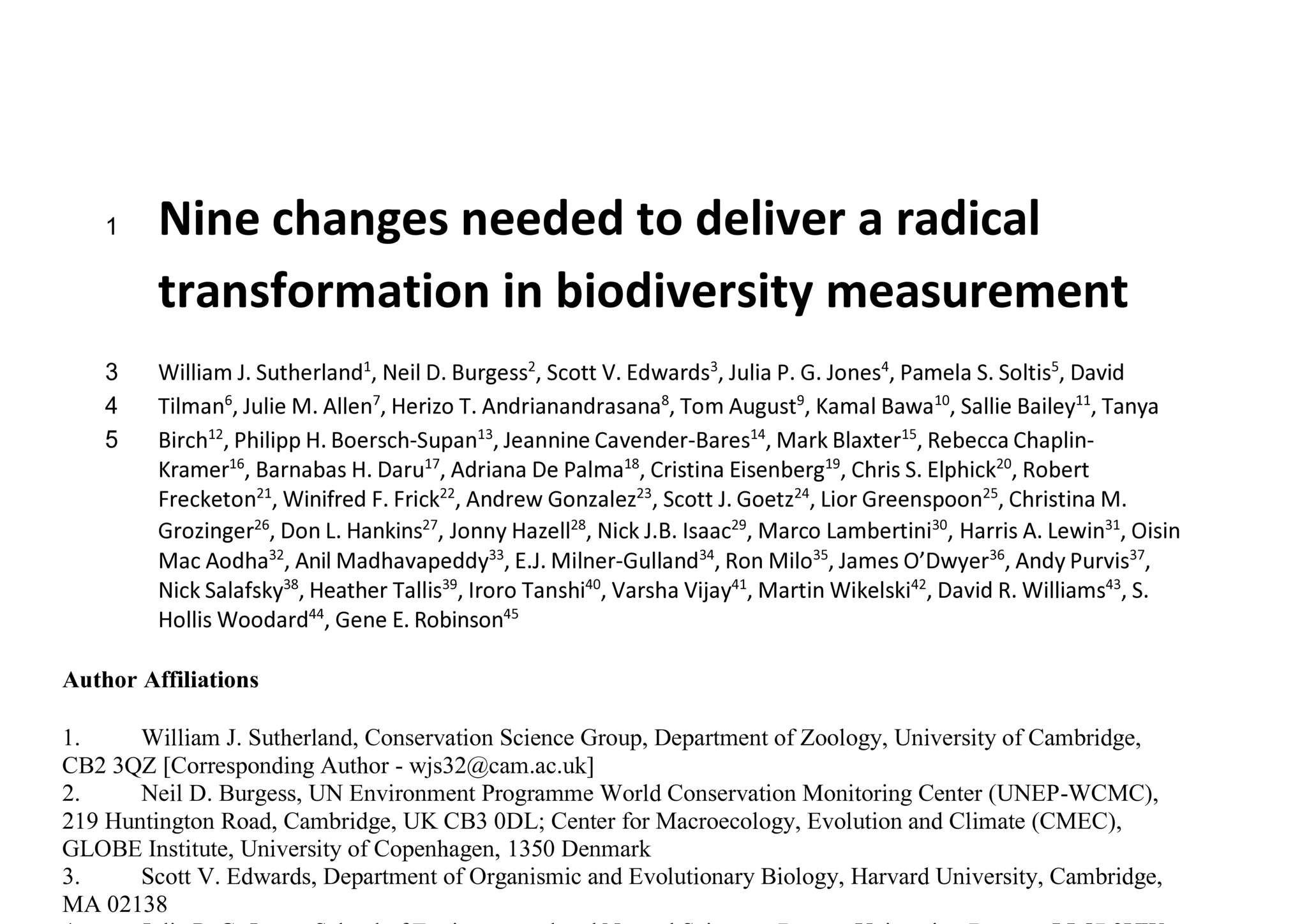
Throwback to last summer at the National Academy of Sciences in DC!Nine changes needed to deliver a radical transformation in biodiversity measurement
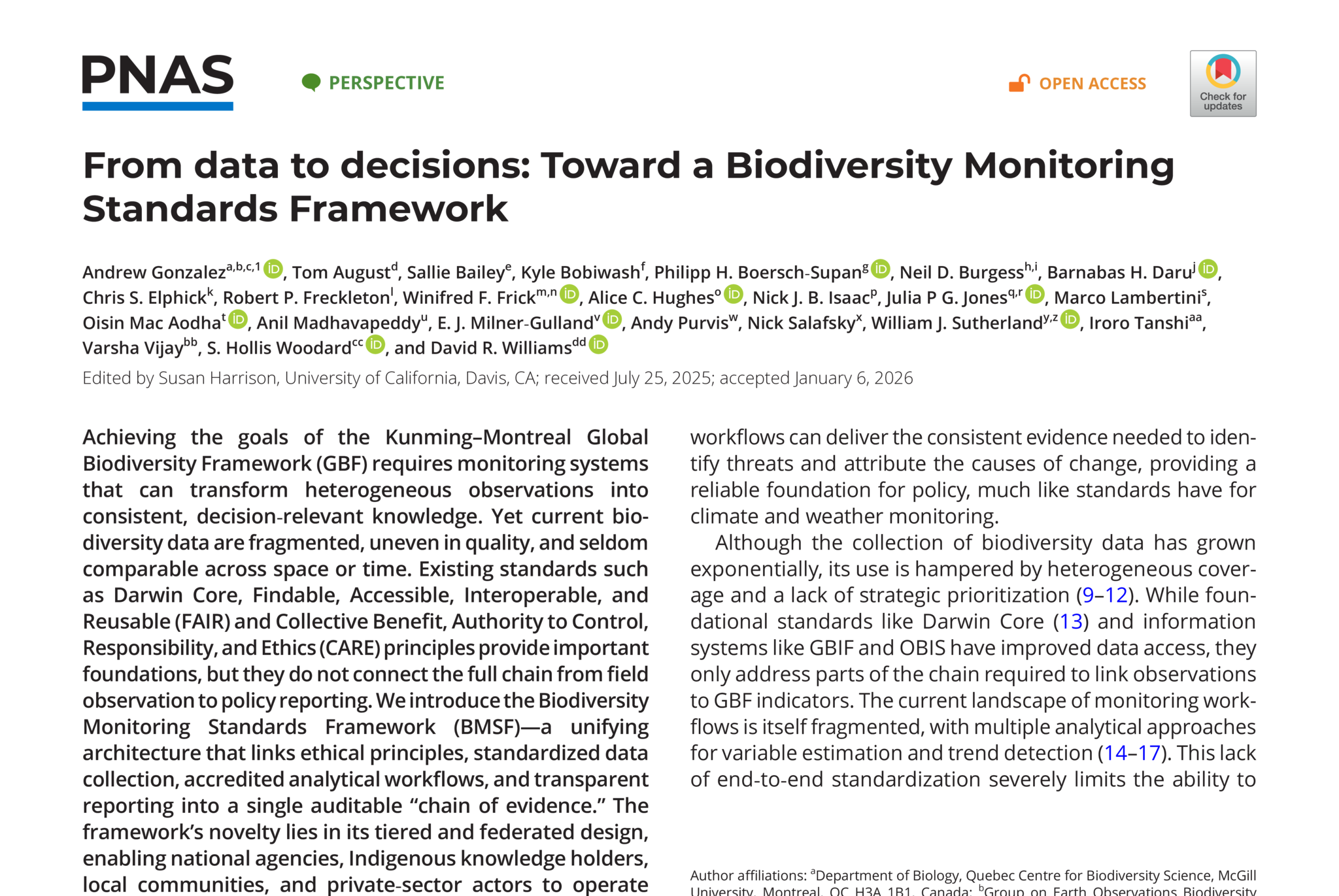
**"[Nine changes needed to deliver a radical transformation in biodiversity measurement](https://anil.recoil.org/papers/2025-biodiversity-9recs)"** ([pdf](/papers/2025-biodiversity-9recs.pdf)) lead by [Bill Sutherland](https://www.zoo.cam.ac.uk/directory/bill-sutherland) tackles the flood of new data from emerging technologies and makes concrete recommendations for ensuring biodiversity measurement can turn into effective action on the ground. Then **"[From data to decisions: Toward a Biodiversity Monitoring Standards Framework](https://anil.recoil.org/papers/2025-biodiversity-msf)** ([pdf](/papers/2025-biodiversity-msf.pdf)) lead by [Andrew Gonzalez](https://www.thegonzalezlab.org/) introduces the BMSF as a structured, auditable "chain of evidence" that connects ethical principles through to standardised data collection, curation, analysis and reporting into a single federated framework. The first paper identifies what needs to change, and the BMSF paper provides a blueprint for _how_ to implement those changes.
From data to decisions: Toward a Biodiversity Monitoring Standards Framework
The BMSF is particularly relevant to tying together my group's work on [planetary computing](https://anil.recoil.org/projects/plancomp), and so I've been thinking hard about what to organise this year to bring more computer scientists into the fold. Data processing might sound boring at first glance, but the scales and diversity of information involved in biodiversity is [mindbogglingly complex](https://doi.org/10.1146/annurev-environ-121522-045106). We are, after all, trying to describe all life on earth...
## The nine recommendations for biodiversity
The key numbers in global biodiversity are pretty stark: roughly [1 million species threatened with extinction](https://www.nationalgeographic.com/environment/article/ipbes-un-biodiversity-report-warns-one-million-species-at-risk), a [70% decline in monitored wildlife populations since 1970](https://www.worldwildlife.org/news/press-releases/catastrophic-73-decline-in-the-average-size-of-global-wildlife-populations-in-just-50-years-reveals-a-system-in-peril/),
and [insect populations declining at around 10% per decade](https://doi.org/10.1126/science.aax9931).
Against this backdrop, the paper makes nine recommendations towards accelerating action:
1. **Capitalise on novel technology to integrate data sources.** This is partly where my work comes in! Geospatial foundation models like [TESSERA](https://anil.recoil.org/projects/tessera), eDNA, [acoustic monitoring](https://anil.recoil.org/papers/2024-terracorder) and citizen science are generating data at scale. The challenge is combining these heterogeneous sources, which is where [TESSERA](https://anil.recoil.org/papers/2025-tessera) fits directly. What's missing is effective labeling infrastructure to combine the observational knowledge from space with human expert knowledge on the ground.
2. **Agree standard methods for data collection.** Inconsistency in methods hinders all major uses of biodiversity data, but it's not practitioners' that are at fault: there's just a lot of different levels of biodiversity that need to be monitored. Consider how different even a medium sized back garden is from one end to the other, and then scale this out to a tropical rainforest. The paper calls for a tiered and modular monitoring workflow, which is described in detail in the companion [BMSF paper](https://anil.recoil.org).
3. **Ensure new technologies are calibrated with existing data.** As we race to [upgrade technology](https://www.nightjar.tech/), monitoring results from traditional field surveys (that might date back decades) need to be migrated to newer AI-driven workflows. But we _must_ keep the primary observatios distinct from the statistical derivations or else we [poison our sources](https://anil.recoil.org/papers/2025-ai-poison) and confound long-term trends.
4. **Fill data gaps using emerging technologies, especially in the tropics.** Biodiversity data is [geographically biased toward charismatic species](https://doi.org/10.1126/science.adh8874) in wealthy countries. Invertebrates, soil biota and tropical ecosystems are massively underrepresented; just check out [Shane Weisz](https://shaneweisz.com) and his [living RED list dashboard](https://anil.recoil.org/ideas/living-iucn-redlist) to see how poorly some taxa are represented in the overall picture.
5. **Create living databases of trusted information to reduce AI poisoning.** Our [CE](https://anil.recoil.org/projects/ce) [evidence TAP](https://anil.recoil.org/papers/2025-evidence-tap) pipeline of the scientific literature shows how we need institutionally federated networks of living evidence with humans-in-the-loop who can continuously gather, screen and index literature. The alternatives of depending on [blackbox and unaccountable LLMs](https://anil.recoil.org/notes/red-pill-conservation) is rapidly descending on us, and so we are building out dynamic meta-analysis and active vetting of literature databases to spot [AI poisoning](https://anil.recoil.org/papers/2025-ai-poison) to not only reject fabricated papers but also to invalidate downstream damage in the citation networks.
6. **Ensure data generation is valued.** Last summer, [David Coomes](https://coomeslab.org) and I spoke at an IUCN meeting about how [vital field-based data collection](https://bsky.app/profile/anil.recoil.org/post/3mc7p23y3gs2y) is for ground truth, especially as self-supervised AI advances. Incentives for data sharing need reform in the majority world where data is currently scarces, for example via governance for wholesale sharing, academic credit through coauthorship, recognition of data production as a research output, and sufficient resourcing for archival. My [principles for collective knowledge](https://anil.recoil.org/notes/principles-for-collective-knowledge) capture much of this from a technical perspective, but of course regulatory and financial reform is also necessary to push incentives in the right direction..
7. **Ensure respectful incorporation of Indigenous Knowledge.** When I spoke at the [CE conference](https://anil.recoil.org/notes/red-pill-conservation) recently, I carelessly use the term 'indigenous knowledge' to refer generically to grey literature, and [E. J. Milner-Gulland](https://www.biology.ox.ac.uk/people/ej-milner-gulland) quite rightly told me off afterwards! Indigenous knowledge systems hold _generations_ of environmental insight accumulated through direct interaction with ecosystems, and I need to learn more about how this aspect works (something that came up at the [Indian AI summit](https://anil.recoil.org/notes/india-ai-summit) as well). The paper stresses [Free, Prior and Informed Consent](https://en.wikipedia.org/wiki/Free,_prior_and_informed_consent) and the [CARE principles](https://www.gida-global.org/care) for Indigenous data governance. What I plan to do more work on this year is to understand how to weave in these data sources (without losing their distinctive timbre) into conventional technological monitoring capabilities, and think through the economic incentives.
8. **Ensure measurements enable quantification of effectiveness of actions.** Monitoring outcomes without a focus on evaluating the impact of interventions is like redecorating while the house burns. High spatial and temporal resolution data (for instance, dynamic [ground truth combined with geospatial models](https://about.conservationevidence.com/2026/01/16/geospatial-foundation-models/)) could estimate credible counterfactuals (what would have happened without the intervention). This in turn enables evidence-based policy at much larger scale than we currently do. Most ecological mitigation recommendations in the UK [are not evidence based](https://doi.org/10.1002/2688-8319.12089), which means there's a lot of paperwork without much point\!
9. **Increase the resilience of global datasets to technical and societal change.** This is a problem across society with the pace of AI, but it's particularly urgent for nature where business as usual results in [mass extinctions if we take action in the wrong place](https://anil.recoil.org). There are short term measures such as federation that will help, but I'm fascinated by the potential of [our work on building an ecology for the internet](https://anil.recoil.org/papers/2025-internet-ecology) that draws on ecological theory to make digital infrastructure more resilient. This is a pretty far-out prospect right now, but coding models have advanced _massively_ in just one year since I wrote that paper, and there's a growing connection between biodiversity science and computer science. There will be a [workshop on "Rewilding the Web"](https://avsm.leaflet.pub/3mgampzfq6k27) in Edinburgh (28th-29 May 2026) exploring exactly these ideas of applying ecological insights to digital infrastructure resilience, so I hope to see you there if you are into this\!
## The Biodiversity Monitoring Standards Framework
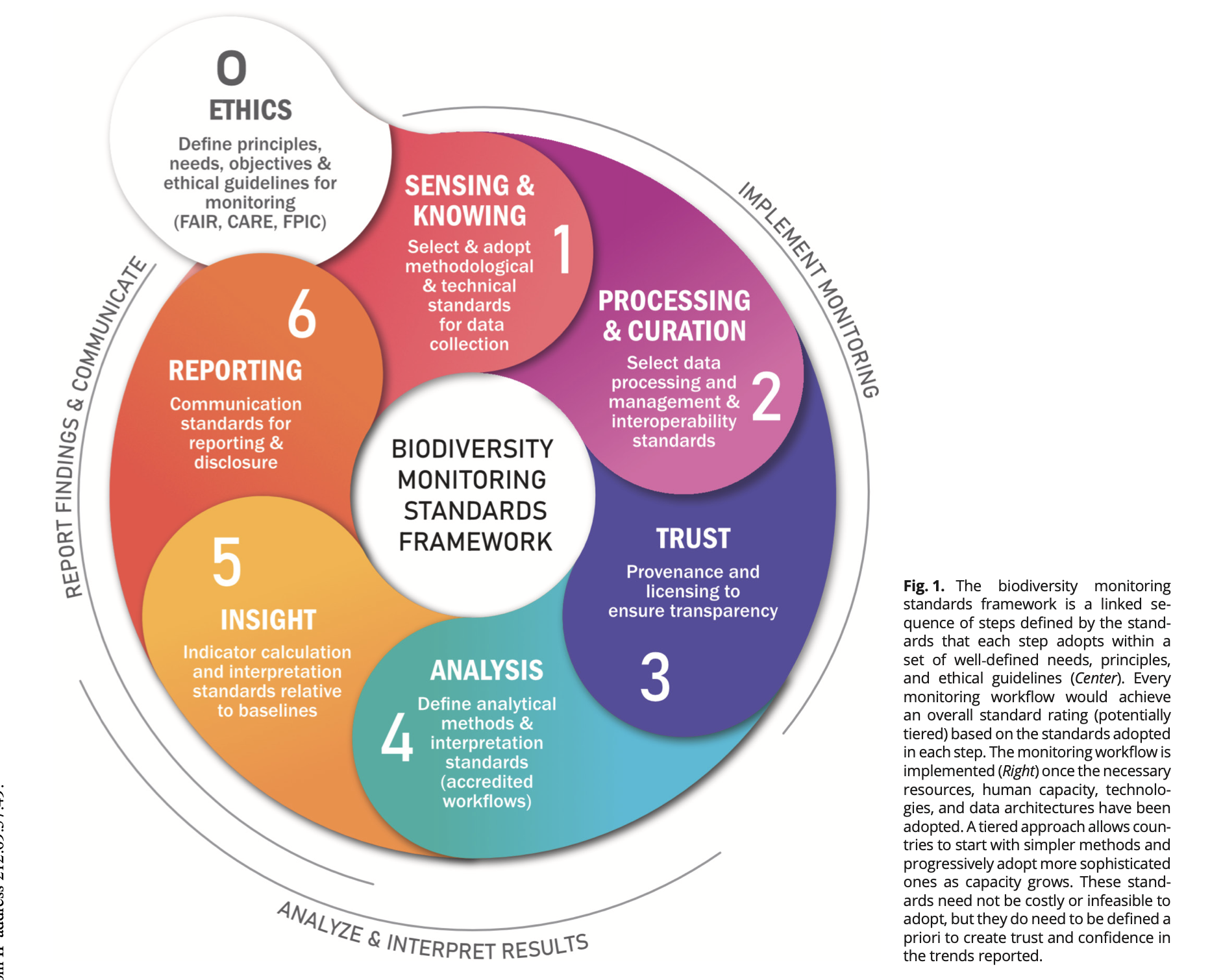
The [BMSF paper](https://anil.recoil.org) then provides a more concrete implementation to follow the flow of data. It defines an iterative cycle:
1. **Ethics:** Foundational principles including FAIR, CARE, FPIC ethical guidelines covering respect for life, indigenous data sovereignty, data security, transparency of purpose, the precautionary principle, and equitable benefit-sharing.
2. **Sensing & Knowing:** Standardised data collection from multiple evidence streams including fixed sensing, scientific methods, indigenous knowledge systems, and citizen science.
3. **Processing & Curation:** Data validation, quality assurance, interoperability via standards like [Darwin Core](https://dwc.tdwg.org/) and multimodal integration where needed.
4. **Trust**: Provenance and licensing towards trusting inputs (see earlier comments about AI poisoning), metadata, data lineage tracking, clear licensing and attribution, security protocols, and data sovereignty.
5. **Analysis:** Standardised analytical approaches, uncertainty quantification based on groups of data and their sources, documented models and software that's reproducible (including training data for models, so bitwise not necessary)
6. **Insight:** Indicator calculation and interpretation relative to baselines to generate counterfactuals, including long-term trend interpretation.
7. **Reporting:** Consistent reporting formats, publishing for long-term accessibility, [peer review mechanisms](https://doi.org/10.1093/biosci/biaf189), and communication.
The framework is federated by design, in a manner quite compatible with [Ostrom's guidelines](https://anil.recoil.org/notes/cambridge-green-blue) as locally generated data flows into regional and national hubs which apply consistent analytical workflows, producing GBF-compatible indicators for international reporting. Countries or organisations can start with simple methods and progressively adopt more sophisticated approaches as their capacity grows.
> For monitoring frameworks like REDD+ MRV, a centralized, top–down body like
> FAO makes sense given the direct link to the UNFCCC and IPCC and the coupling
> of climate observing systems to carbon stock and emissions models and
> assessments.
>
> However, the multifaceted nature of biodiversity and the existing landscape
> of key organizations make a federated governance model, with national
> ownership at its heart, more appropriate and likely to succeed for the BMSF.
> \-- Sec 2.4, [From data to decisions: Toward a BMSF](https://www.pnas.org/doi/10.1073/pnas.2519347123)
The paper also provides a handy worked example for forest connectivity
indicators under the maximum GBF Target 3, showing how each step produces a
certified evidence chain for a full provenance chain from [remote sensing](https://anil.recoil.org/projects/rsn) to the final reported indicator value.
## Connecting to collective knowledge systems
The BMSF maps on pretty well to the general [principles for collective knowledge systems](https://anil.recoil.org/notes/principles-for-collective-knowledge) that I recently articulated:
**"Permanence"** maps to the BMSF's recommandation to use DOIs for datasets, version-controlled code pipelines, and long-term archiving. Rec 9 from the first paper makes the case that biodiversity data must survive [political shocks](https://www.npr.org/2025/08/08/nx-s1-5495338/climate-change-environment-websites-trump), [institutional closures](https://www.motherjones.com/politics/2025/02/us-fish-wildlife-service-conservation-funding-freeze-pause-endangered-species-animals/) and [format obsolescence](https://doi.org/10.7717/peerj.2743). The BMSF's requirement for persistent identifiers at every step of the chain fits well with the "DOIs for all" that [Rogue Scholar](https://rogue-scholar.org) and [Zenodo](https://zenodo.com) have been pioneering for blogs and datasets.
**"Provenance"** is at the centre of the BMSF as it is designed as an auditable chain of evidence where every indicator can be traced back through analytical methods, data processing, licensing and raw observations. The 9-recs paper (Rec 5) calls out urgently for hallucination-free AI systems for evidence synthesis, and the BMSF's Trust+Analysis phases provide the architecture to make provenance tracking systematic. The same provenance protocols we [need for the broader Internet](https://anil.recoil.org/papers/2025-internet-ecology) -- tracking where knowledge came from and whether to trust it -- apply even mor to biodiversity data that informs actions affecting the abundances of millions of species.
**"Permission"** connects to the BMSF's Ethics step and its emphasis on FAIR and CARE principles, indigenous data sovereignty, and tiered access. As I noted in my [collective knowledge principles](https://anil.recoil.org/notes/principles-for-collective-knowledge), biodiversity data is a prime example of where everything _cannot_ be open: location data for endangered species could be exploited by poachers, and indigenous communities have sovereign rights over their own traditional knowledge. The BMSF's federated model explicitly supports this as not all collected data needs to be shared openly, and the principle of "guardianship" enables tiered access levels. This is the kind of [spatial permissioning](https://anil.recoil.org) that current Internet protocols handle poorly.
**"Placement"** maps to the BMSF's federated, nationally- and regionally-owned architecture. The tiered design allows countries to operate at their own level of capacity while still contributing to global assessments. We're feeling this with TESSERA's multi-petabyte embeddings as well; they physically can't move casually between continents and networks, and so the processing must be distributed and federated rather than centralised. [Aadi Seth](https://www.cse.iitd.ac.in/~aseth/) has suggested a mirror in India though\!
## How this maps to my immediate research efforts
Several strands of the research in the EEG connect directly to what these papers are calling for\!
### TESSERA and labelling frameworks
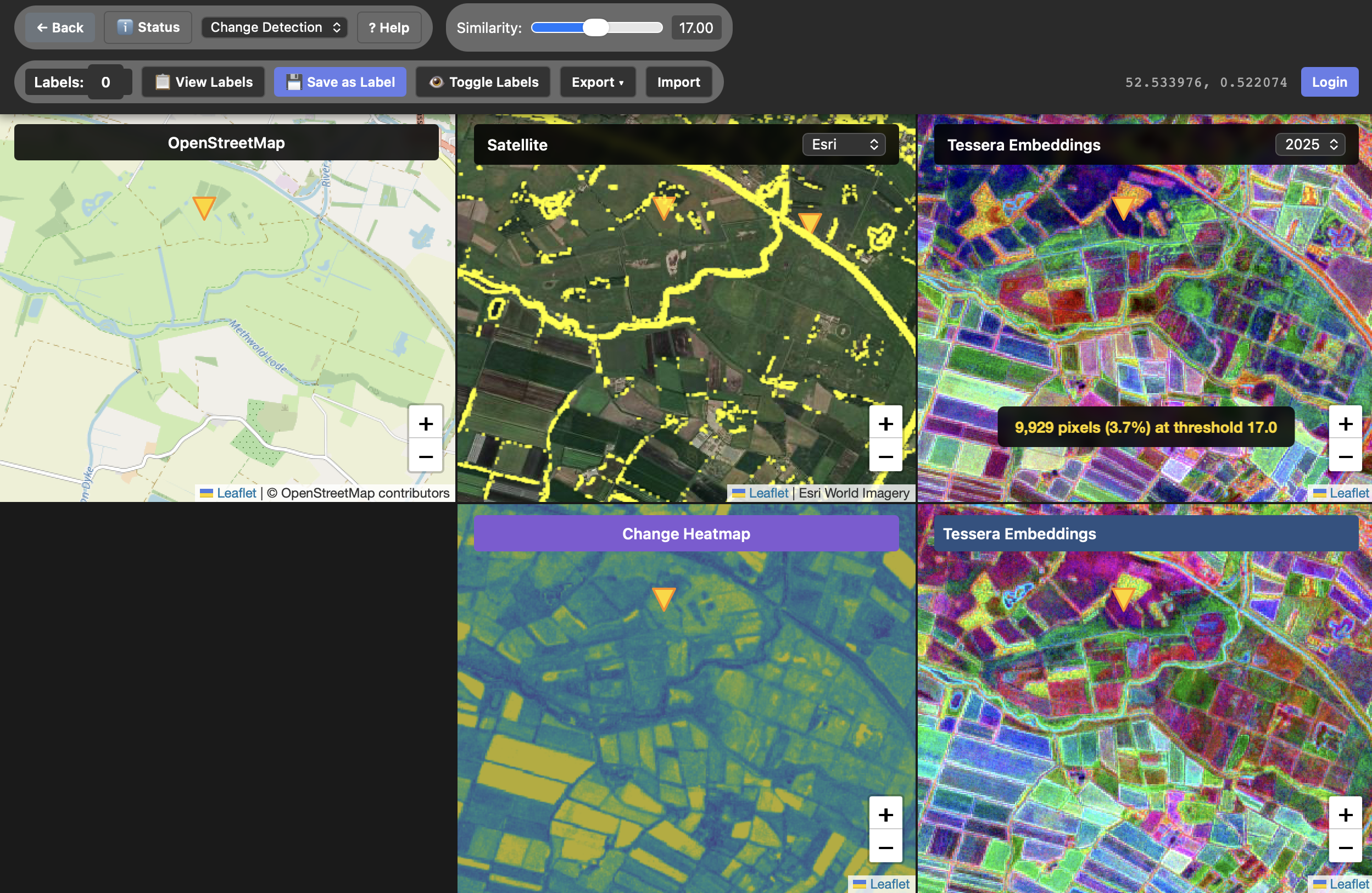
The TESSERA Embeddings Explorer, browsable at https://tee.cl.cam.ac.uk
[TESSERA](https://anil.recoil.org/projects/tessera) provides an open and robust geospatial foundation model to satisfy the first recommendation and support diverse downstream tasks from crop classification to canopy height estimation.
[Srinivasan Keshav](https://svr-sk818-web.cl.cam.ac.uk/keshav/wiki/index.php/Main_Page) and I are just starting work on a labelling framework that fits within the BMSF architecture, so that the ground-truth data used to finetune TESSERA for biodiversity applications can map to the standardised collection, curation and provenance requirements laid out in the framework. Since TESSERA itself is fully open and reproducible, this is a big step toward making AI-driven biodiversity assessments auditable end-to-end. There is also the intriguing possibility of using the [ATProto](https://anil.recoil.org/notes/atproto-for-fun-and-blogging) to anchor the federation while re-using identity infrastructure across social networks, but we need to carefully consider issues of privacy. More on this as it develops\!
### Evidence synthesis and living databases
Our paper pipeline for analysing the academic literature at scale for
[Conservation Evidence](https://anil.recoil.org/projects/ce) is a working prototype of the "living databases"
that the fifth recommandation calls for.
Dynamic meta-analysis, hallucination-free screening with humans in the loop,
and continuous evidence ingestion are all on the table here, and the BMSF
provides the architecture within which these tools can interoperate. We're just
beginning a [new project](https://anil.recoil.org/notes/2026w7) on this that also includes Education as well
as conservation, which I'm very excited about\!
### Internet resilience meets biodiversity
The most fun and somewhat far out thing is our [ecology of the internet](https://anil.recoil.org/papers/2025-internet-ecology) work, which tries to draw a connection
between ecological resilience principles and the digital infrastructure that
biodiversity data depends on. This is a [deliberately circular](https://anil.recoil.org/notes/ecology-at-aarhus) argument to see
where the thoughts go: we need resilient digital infrastructure to monitor
biodiversity, and ecological theory can teach us how to build that
infrastructure. The upcoming [Rewilding the Web workshop](https://avsm.leaflet.pub/3mgampzfq6k27) in Edinburgh will bring
together ecologists, philosophers and technologists to push this further.
These two perspective papers represent the published output of the conversations we had at the NAS last summer, and my own agenda is now a bit clearer. I want to connect models like TESSERA and our Cambridge TAP to federated, auditable monitoring systems that can transform the flood of biodiversity data into credible evidence that's urgently needed to halt and reverse nature loss. Stay tuned for some ideas I have about venues where we can do this together\!
Synopsis: Summary of the "Nine Recommendations" and Biodiversity Monitoring Standards Framework papers from the US-UK Forum I attended in the summer of 2025, connecting them to my thoughts on collective knowledge systems and TESSERA.
Words: 2276
## Related
- [At the AI Impact Summit in Delhi: people, planet, progress](https://anil.recoil.org/notes/india-ai-summit) (note, 2026-02-21)
- [.plan-26-07: Storage, Lego, Echo, and the IUCN](https://anil.recoil.org/notes/2026w7) (note, 2026-02-15)
- [Discussing effective conservation with all the UK Chief Scientists](https://anil.recoil.org/notes/red-pill-conservation) (note, 2026-02-03)
- [Nine changes needed to deliver a radical transformation in biodiversity measurement](https://anil.recoil.org/papers/2025-biodiversity-9recs) (paper, 2026-01-01)
- [From data to decisions: Toward a Biodiversity Monitoring Standards Framework](https://anil.recoil.org/papers/2025-biodiversity-msf) (paper, 2026-01-01)
- [Four Ps for Building Massive Collective Knowledge Systems](https://anil.recoil.org/notes/principles-for-collective-knowledge) (note, 2025-11-23)
- [TESSERA: Temporal Embeddings of Surface Spectra for Earth Representation and Analysis](https://anil.recoil.org/papers/2025-tessera) (paper, 2025-11-01)
- [AI-assisted Living Evidence Databases for Conservation Science](https://anil.recoil.org/papers/2025-evidence-tap) (paper, 2025-10-01)
- [A Living IUCN Red List of the World's Species](https://anil.recoil.org/ideas/living-iucn-redlist) (idea, 2025-09-01)
- [Presenting our Ecology of the Internet ideas at Aarhus 2025](https://anil.recoil.org/notes/ecology-at-aarhus) (note, 2025-08-22)
- [Steps towards an Ecology for the Internet](https://anil.recoil.org/papers/2025-internet-ecology) (paper, 2025-08-01)
- [Will AI speed up literature reviews or derail them entirely?](https://anil.recoil.org/papers/2025-ai-poison) (paper, 2025-07-01)
- [What I learnt at the National Academy of Sciences US-UK Forum on Biodiversity](https://anil.recoil.org/notes/nas-rs-biodiversity) (note, 2025-06-06)
- [The Cambridge "Green Blue" competition to reduce emissions](https://anil.recoil.org/notes/cambridge-green-blue) (note, 2025-05-06)
- [Using AT Proto for more than just Bluesky posts](https://anil.recoil.org/notes/atproto-for-fun-and-blogging) (note, 2025-02-11)
- [TESSERA, a pixelwise geospatial foundation model](https://anil.recoil.org/projects/tessera) (project, 2025-01-01)
- [Terracorder: Sense Long and Prosper](https://anil.recoil.org/papers/2024-terracorder) (paper, 2024-08-01)
- [Conservation Evidence Copilots](https://anil.recoil.org/projects/ce) (project, 2024-01-01)
- [Remote Sensing of Nature](https://anil.recoil.org/projects/rsn) (project, 2023-01-01)
- [Planetary Computing](https://anil.recoil.org/projects/plancomp) (project, 2022-01-01)
---
Canonical: https://anil.recoil.org/notes/nas-rs-biodiversity-papers
Type: note
Tags: biodiversity, conservation, policy, royalsociety, usa, ai, llm