# Exploring the biodiversity impacts of what we choose to eat
*2025-09-09 — note*
Choosing where we source the food that we eat makes a difference to the
environment, but by how much? After churning through around 100 petabytes of
data, beginning with our [LIFE](https://anil.recoil.org/papers/2024-life) metric and moving onto food
provenance maps and import/export data for the world, we now know the answer
can vary by _[three orders of magnitude](https://www.nature.com/articles/s43016-025-01224-w)_ for species
extinction risks.
Our [paper in Nature Food](https://www.nature.com/articles/s43016-025-01224-w) came out today with
all the tasty details and implications for food policies worldwide. In order to make the data easier
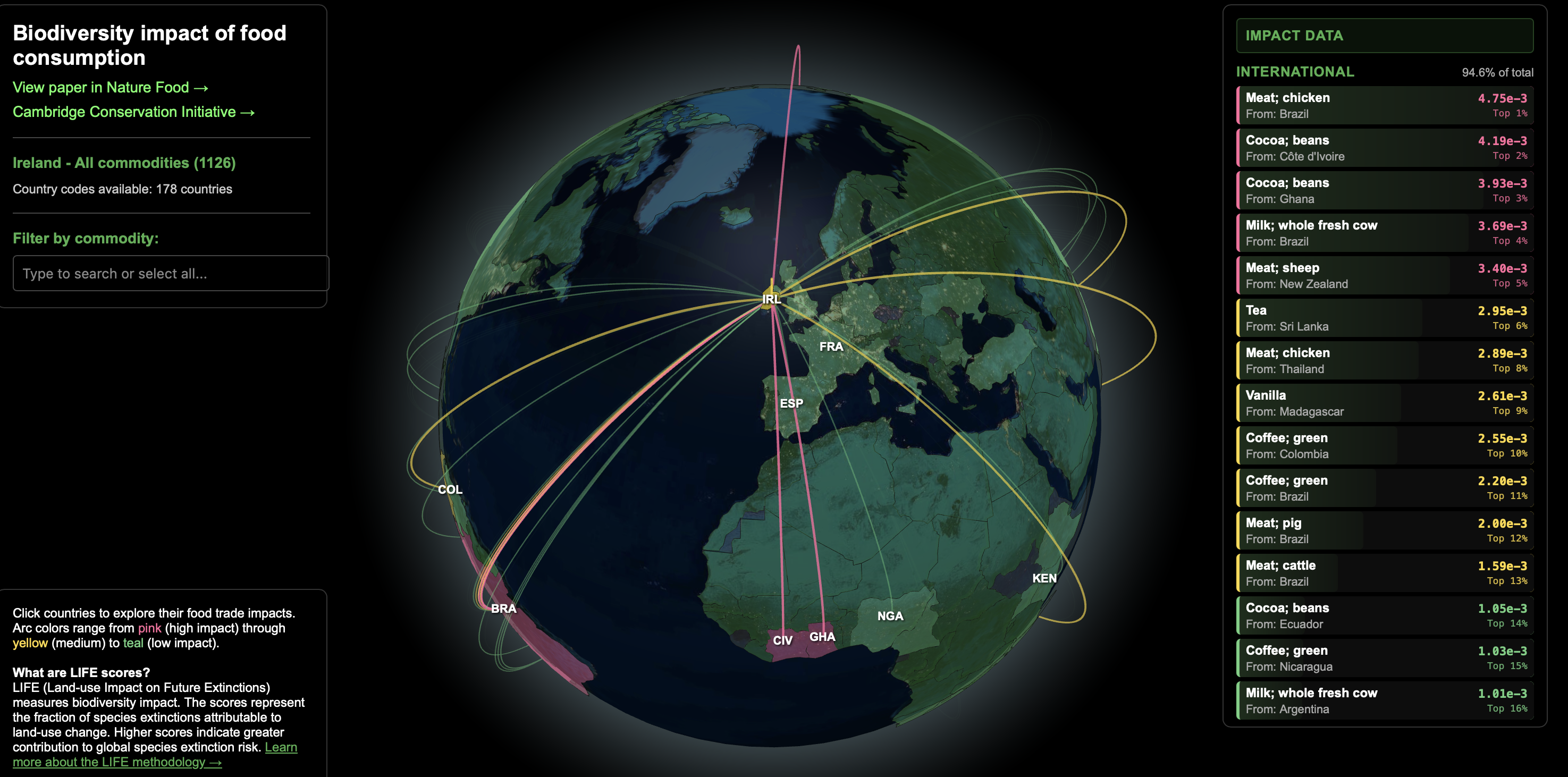
to explore, I knocked up an [interactive global explorer](https://quantifyearth.github.io/food-globe/)
using the data that the team (lead by [Thomas Ball](https://www.zoo.cam.ac.uk/directory/dr-tom-ball)) generated.
Explore food trade impacts on every country interactively
The methodology is described in the [paper](https://anil.recoil.org/papers/2024-food-life):
> The marginal impact of current food consumption on biodiversity can be viewed
> as the forgone opportunity to restore biodiversity arising through ongoing
> agricultural land use. By linking LIFE with spatial crop and pasture
> distributions, consumption, production and trade data from the [Food and
> Agriculture Organisation](https://www.fao.org/home/en/) of the United Nations, \[...\]
> we quantify the \> opportunity cost to biodiversity of producing or consuming 1kg of each
> FAO-aligned food commodity in 174 countries, taking the feed and grazing
> requirements for animal products into account.
> \-- [Food impacts on species extinction risks can vary by three orders of magnitude](https://www.nature.com/articles/s43016-025-01224-w)
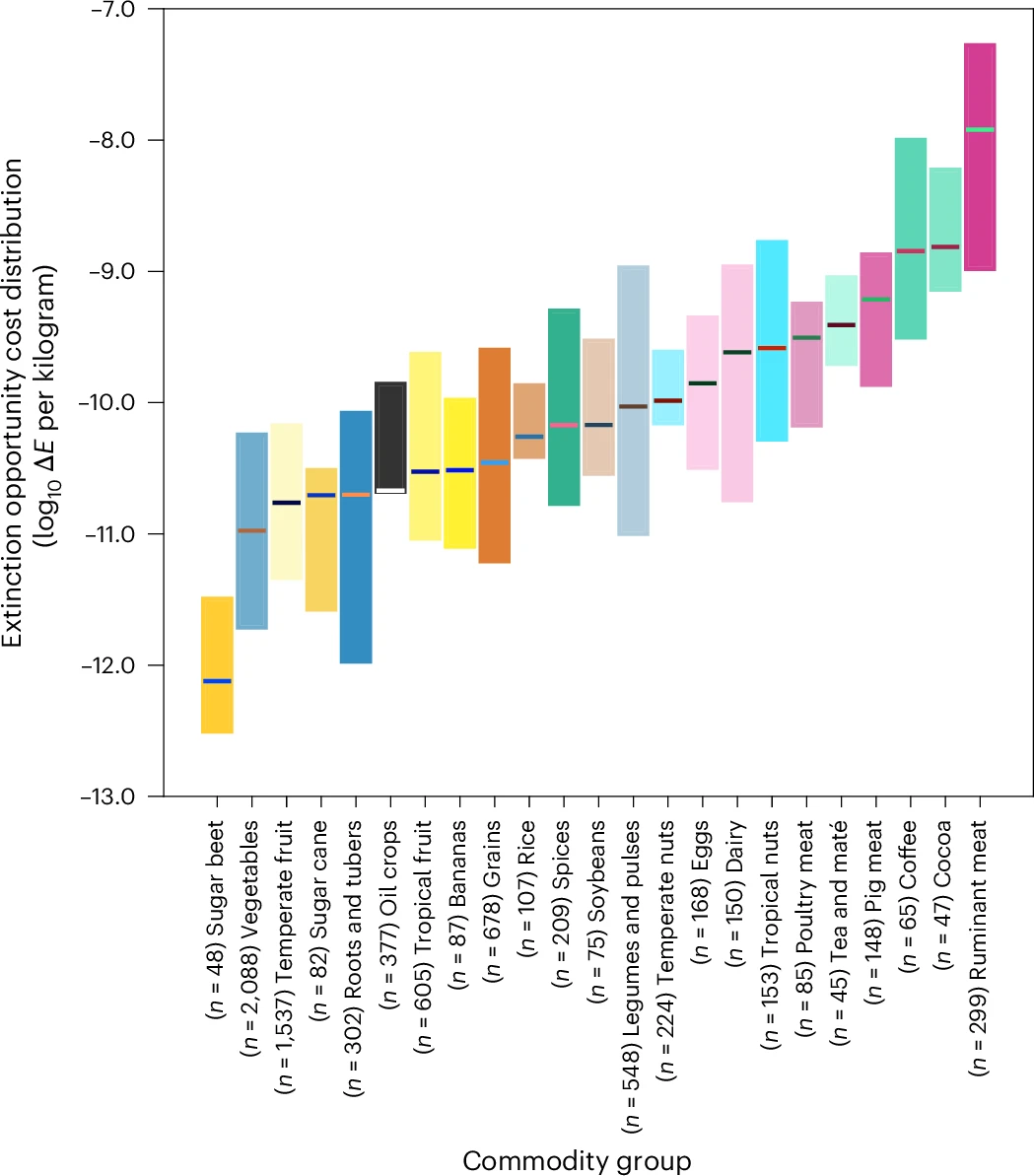
The results themselves are absolutely fascinating. Firstly, ruminant meat has
median consequences 100 times higher than that of legumes and pulses, even when
accounting for the high protein content. That burger, while delicious, has an
enormous biodiversity cost somewhere in the world! Bear in mind that more than
3/4 of human-appropriated land surface on the planet is [dedicated to the
production of animal products](http://ourworldindata.org/land-use) while
providing only 17% of global calories.
But if you really _want_ a burger, then choosing _where_ you source the meat
from makes a huge difference as well. There is a great deal of spatial variance
about the selection of each commodity.
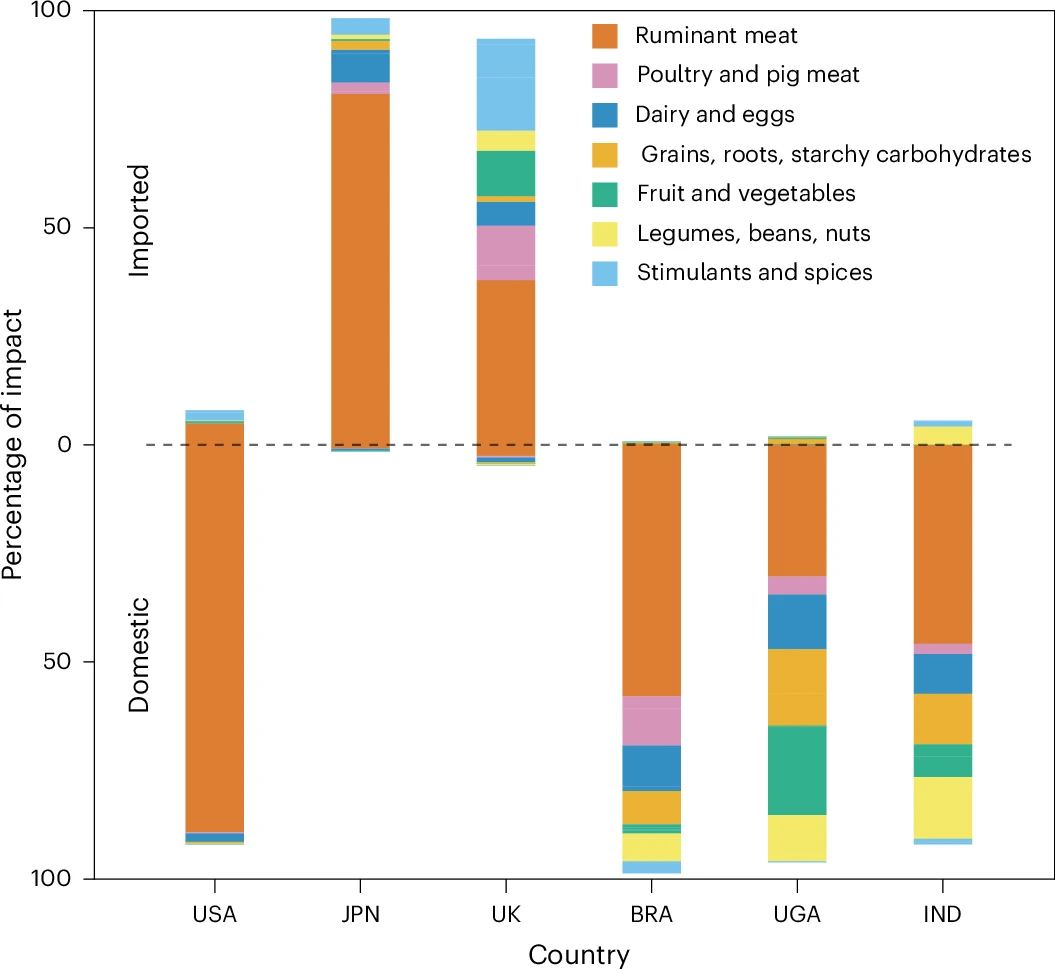
The vertical length show the spatial variance. It gets more interesting when you break it down by country and examine the imports and exports of each one:
The [biodiversity leak](https://www.science.org/doi/10.1126/science.adv8264) becomes clear now! Some countries do consume enormous amounts of meat, but do so from domestic production (i.e. a local political decision). Others, like the UK or Japan, import vast amounts of damaging food from _other countries_ which are highly biodiverse, resulting in the demand that is one of the primary drivers of deforestation.
The data is out there now, under a [CC-BY-SA](https://creativecommons.org/licenses/by-sa/4.0/) license, and the [interactive FOOD explorer](https://quantifyearth.github.io/food-globe/) allows you to break down impacts per country and look through 150 different foodstuffs.
I also mentioned the vast amount of data processing involved in coming up with these numbers; [Michael Dales](https://mynameismwd.org) has uploaded the calculators over to our [quantifyearth/](https://github.com/quantifyearth/) code organisation, and will be presenting the magic library [Yirgacheffe](https://github.com/quantifyearth/yirgacheffe) that drives much of this processing at [PROPL25](https://conf.researchr.org/home/icfp-splash-2025/propl-2025#program) in October. Tune in if you'd like to hear more about the computer science side of this sort of analysis\!
Synopsis: Nature Food paper revealing food choice biodiversity impacts vary by three orders of magnitude with interactive global explorer tool.
Words: 519
DOI: 10.59350/xj427-y3q48
## Related
- [.plan-26-03: TESSERA scaling and speaking at AI4Nature's launch](https://anil.recoil.org/notes/2026w3) (note, 2026-01-18)
- [Five ways to use the LIFE metric for conservation decision-making](https://anil.recoil.org/notes/life-uses-paper) (note, 2026-01-12)
- [Four Ps for Building Massive Collective Knowledge Systems](https://anil.recoil.org/notes/principles-for-collective-knowledge) (note, 2025-11-23)
- [On the path to the UK/India AI Summit with OpenUK and the ATI](https://anil.recoil.org/notes/path-to-uk-india-ai-summit) (note, 2025-11-11)
- [Food and the long term risk to life](https://anil.recoil.org/notes/food-and-risk-to-life) (note, 2025-11-06)
- [Do not rule out nature from climate action; an open letter](https://anil.recoil.org/notes/do-not-rule-out-nature) (note, 2025-09-10)
- [Food impacts on species extinction risks can vary by three orders of magnitude](https://anil.recoil.org/papers/2024-food-life) (paper, 2025-09-01)
- [LIFE: A metric for mapping the impact of land-cover change on global extinctions](https://anil.recoil.org/papers/2024-life) (paper, 2025-01-01)
---
Canonical: https://anil.recoil.org/notes/exploring-food-impacts
Type: note
Tags: food, biodiversity, spatial