# Learnings from the Cambridge Environmental Sustainability Committee
*2025-05-13 — note*
I joined Cambridge's loftily named [Environment Sustainability Strategy Committee](https://www.governance.cam.ac.uk/committees/essc/Pages/default.aspx) this academic year, and have attended a couple of meetings with the latest one being held today. While a lot of what goes on is intricately tied into the University's rather [special](https://www.governance.cam.ac.uk/Pages/default.aspx) governance structure and the complexity of the College system, there has been significant progress on making all of this more visible more widely.
[Sally Pidgeon](mailto:Sally.Pidgeon@admin.cam.ac.uk), our wonderful head of [Enviromental Sustainaibility](https://www.environment.admin.cam.ac.uk/), has been redeveloping the public website and has put a lot of interesting data online.
There is now a new [Environmental Sustainability website](https://www.environment.admin.cam.ac.uk/) that tracks the University [committment](https://www.environment.admin.cam.ac.uk/our-commitments-and-approach) structure more closely, with the areas broken up into [Carbon & Energy](https://www.environment.admin.cam.ac.uk/our-commitments-and-approach/carbon-and-energy), [Travel & Transport](https://www.environment.admin.cam.ac.uk/our-commitments-and-approach/travel-and-transport), [Waste & Circular Economy](https://www.environment.admin.cam.ac.uk/our-commitments-and-approach/waste-and-circular-economy), [Biodiversity](https://www.environment.admin.cam.ac.uk/our-commitments-and-approach/biodiversity), and [Water](https://www.environment.admin.cam.ac.uk/our-commitments-and-approach/water) usage.
These pages makes it far clearer what our University aims are for operational environmental sustainability, and how we're getting there. There's also a dedicated area to [track our actual progress](https://www.environment.admin.cam.ac.uk/our-progress) along with a bunch of [case studies](https://www.environment.admin.cam.ac.uk/news) such as our own [David Attenborough Building at the CCI](https://www.environment.admin.cam.ac.uk/news/david-attenborough-building-outstanding-environmental-management)\!
Some highlights from the progress as I read through them:
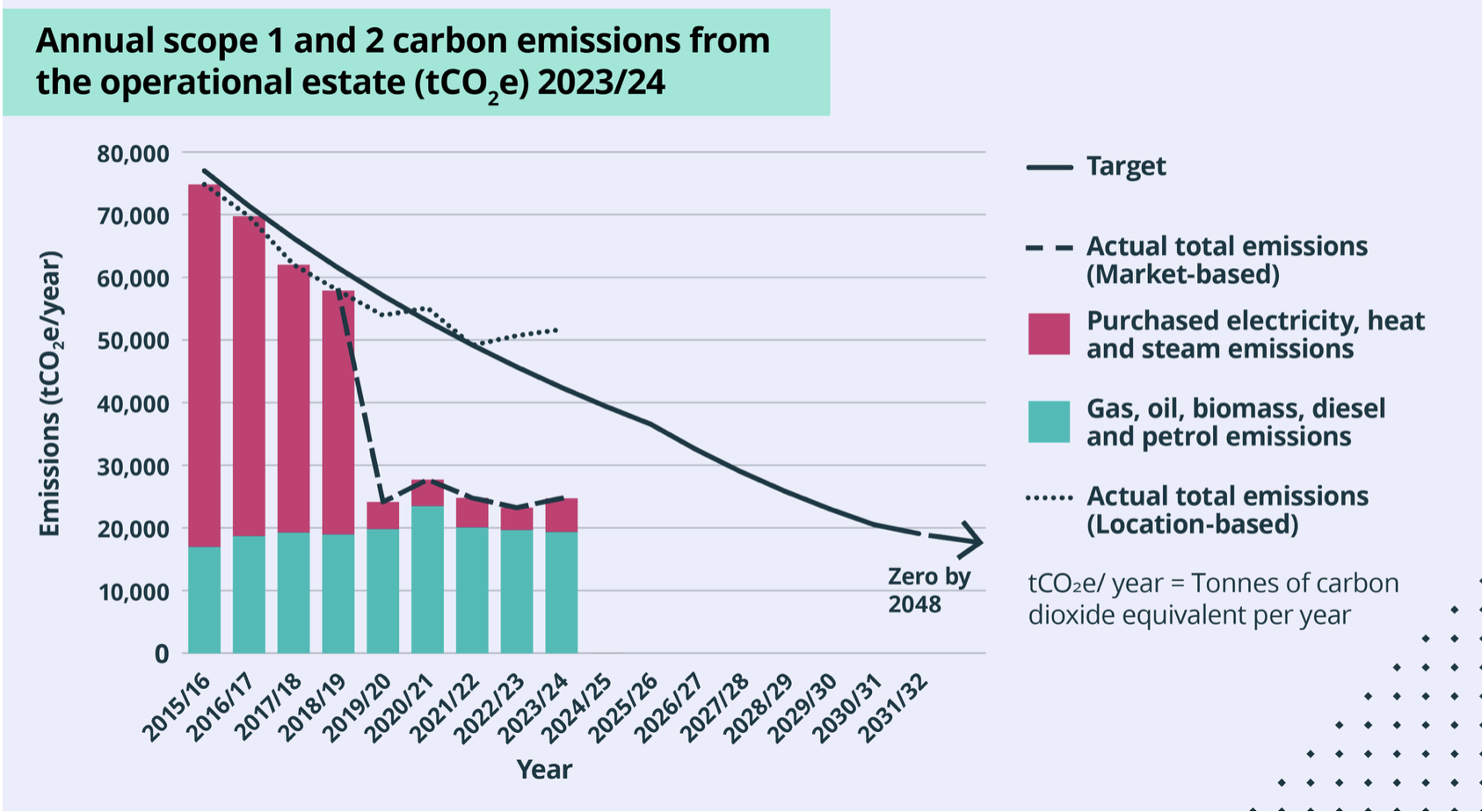
- [Carbon & Energy progress](https://www.environment.admin.cam.ac.uk/our-progress/carbon-and-energy-progress) reports on two different ways of measuring our energy usage: market _or_ location-based. The location-based emissions reporting is quite straightforward as it involves calculating the kWh of electricity used multiplied by the local grid emissions, therefore representing the mean emission resulting from energy generation within the local Cambridge area.[^1] The [market-based approach](https://ghgprotocol.org/sites/default/files/2022-12/Scope2_ExecSum_Final.pdf) calculates the emissions resulting from the energy supplier that we contract which spreads out the emissions calculation based on the contracts the energy supplier has. The market-based approach has many of the complexities that we've grappled with in [4C](https://4c.cst.cam.ac.uk) for avoided emissions, but is useful for [net-zero reporting](https://ghgprotocol.org/sites/default/files/2022-12/Scope2_ExecSum_Final.pdf) of GHG emissions. While this is best summarised as being "bloody complicated", it's good to see the University reporting _both_ calculations and letting the readers decide which (or both) calculations to use.
And finally, the use of the term "natural gas" turns out to be a surprisingly [bad idea](https://climatecommunication.yale.edu/publications/should-it-be-called-natural-gas-or-methane/). Names [do matter](https://news.gallup.com/opinion/polling-matters/169541/name-affordable-care-act-obamacare.aspx) when it comes to public communication.
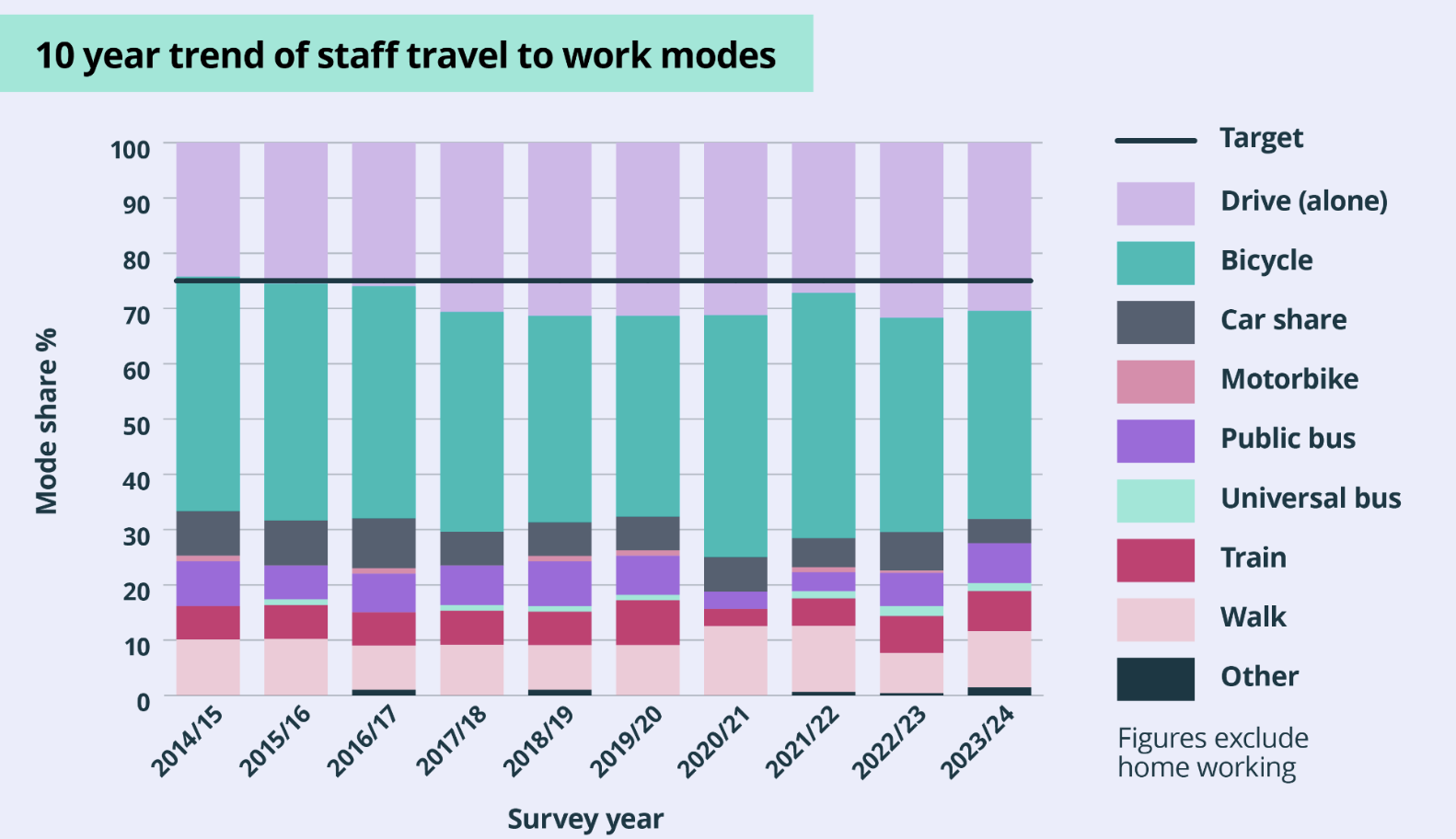
- [Transport & Travel progress](https://www.environment.admin.cam.ac.uk/our-progress/travel-and-transport-progress) is fantastic to go through, as I worked on this with Ian Leslie absolutely ages ago with a [Databox](https://anil.recoil.org/papers/2015-aarhus-databox)\-based [commuting calculator](https://anil.recoil.org/papers/2012-mpm-caware)! However, it's a little disappointing to see that there hasn't been much of a systematic change in the modes of transport used, and also that "work-from-home" is excluded from the figures here as that's an obvious way to reduce the emissions associated with travelling. It's also interesting to see that business flying has bounced back hard since the pandemic despite strict [business travel guidelines](https://www.environment.admin.cam.ac.uk/files/guidelines_for_sustainable_business_travel_approved.pdf) that require us to use trains when possible.
- [Waste and Circular economy progress](https://www.environment.admin.cam.ac.uk/our-progress/waste-and-circular-economy-progress) appears to be largely flatlined in the last couple of years with not much substantive progress but this is also tied to the [amount of building work](https://www.em.admin.cam.ac.uk/reshaping-our-estate) going on in the University and isn't a relative metric (i.e. more building projects will result in more waste, but the University does need to do this building for its operations).
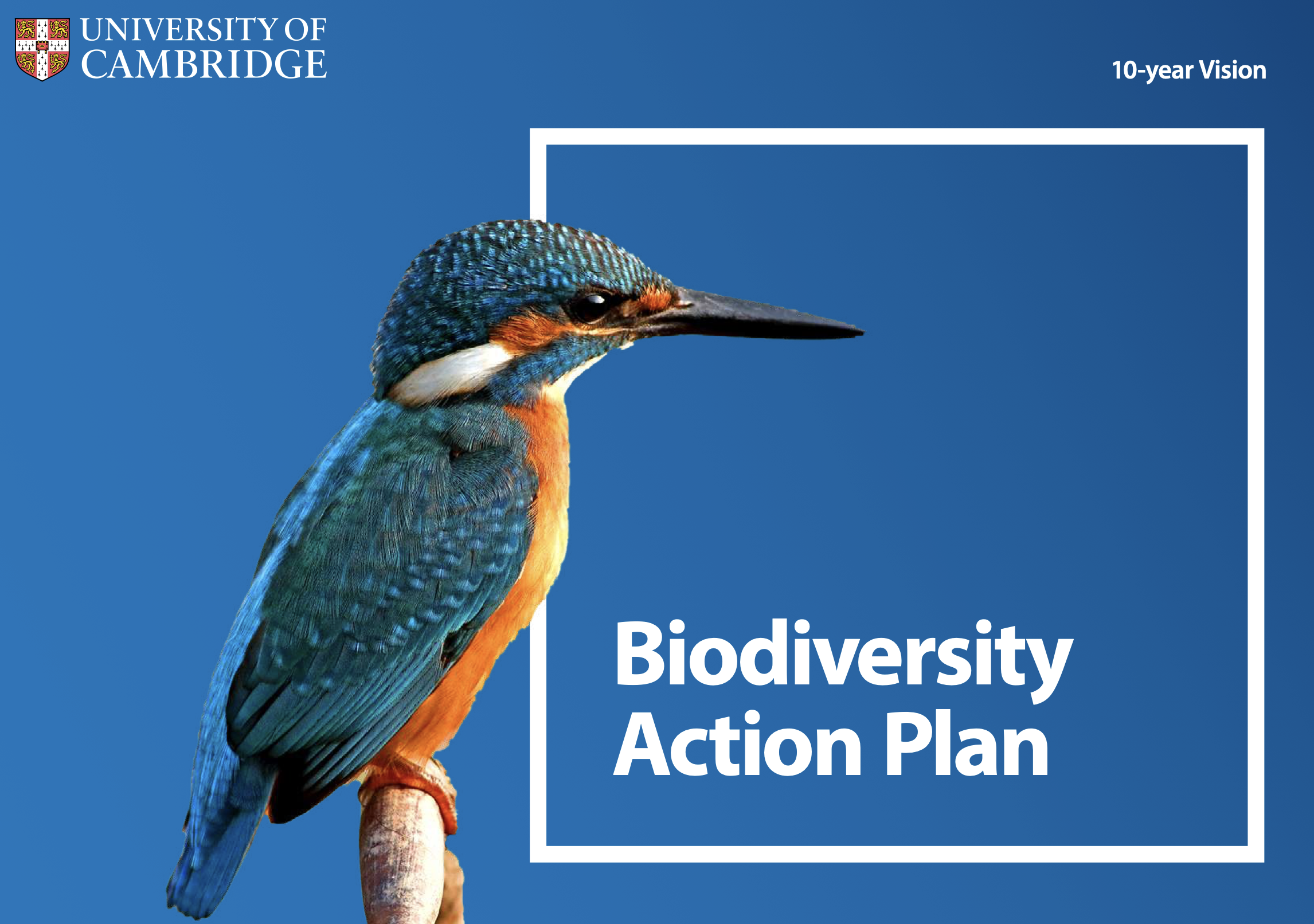
- [Biodiversity progress](https://www.environment.admin.cam.ac.uk/our-progress/biodiversity-progress) is closest to my heart, but also the hardest to assess despite the comprehensive [Biodiversity Action Plan](https://www.environment.admin.cam.ac.uk/files/uoc_bap.pdf) from last year (not because anyone's doing a bad job, but biodiversity is just a _really_ complicated [metric](https://anil.recoil.org/papers/2024-life)!). There's a University-wide biodiversity manager now and a really well described set of action points here.
My suggestion during the meeting (and one I'll turn into a project idea soon) is that we should put spatial polygons of the progress described up as a layer over the [University map](https://map.cam.ac.uk) so people can overlay these data points and get a sense of what's going on (and where we don't have data). [Andres Zuñiga-Gonzalez](https://ancazugo.github.io/) has been [steadily working](https://ancazugo.github.io/research/outreach/2025/04/27/weekly-notes.html) with the Estates department on a side project regarding this as well\!
- [Water progress](https://www.environment.admin.cam.ac.uk/our-progress/water-progress) shows some of the difficulty of long-term reporting in this space, as a quick glance seems to reveal that we're getting worse in terms of water consumption. However, our monitoring mechanisms were improved in recent years with smart meters, and so we're just getting more accurate. However, the rise in [AI for research](https://anil.recoil.org/notes/ai-for-science-2024) has meant that the demand for GPUs is causing our cooling needs to spike as well, with a corresponding increase in water usage.
So, lots to digest in here, and something I'm still piecing together in the context of the [Cambridge Green Blue](https://anil.recoil.org/notes/cambridge-green-blue) idea! The overall message seems clear that we need to continue to push harder for progress towards our net-zero goals to be far higher up the University's strategic plan than it currently is. That doesn't necessarily just involve spending more money, but bringing the juggernaut of [research innovation](https://www.cam.ac.uk/stories/ai-and-climate-and-nature) around here to bear, as well as shifting [landuse for renewable energy](https://csaenvironmental.co.uk/projects/lord-bridges-solar-farm/) while preserving biodiversity and water according to the biodiversity action plan.
[^1]: [Patrick Ferris](https://patrick.sirref.org) has developed a [carbon-intensity](https://github.com/geocaml/carbon-intensity) based on this reporting style which [Ryan Gibb](https://ryan.freumh.org) then used in a [carbon-aware DNS server](https://anil.recoil.org/papers/2024-loco-carbonres) recently. This is an example of location-based emissions data being used.
Synopsis: Insights from Cambridge University's Environmental Sustainability Strategy Committee on carbon reduction, biodiversity, and operational sustainability progress.
Words: 842
DOI: 10.59350/ymx6b-5th97
## Related
- [The Cambridge "Green Blue" competition to reduce emissions](https://anil.recoil.org/notes/cambridge-green-blue) (note, 2025-05-06)
- [LIFE: A metric for mapping the impact of land-cover change on global extinctions](https://anil.recoil.org/papers/2024-life) (paper, 2025-01-01)
- [Carbon-aware Name Resolution](https://anil.recoil.org/papers/2024-loco-carbonres) (paper, 2024-12-01)
- [Royal Society and DeepMind host AI for Science Forum](https://anil.recoil.org/notes/ai-for-science-2024) (note, 2024-11-18)
- [Personal Data: Thinking Inside the Box](https://anil.recoil.org/papers/2015-aarhus-databox) (paper, 2015-10-01)
- [Confidential carbon commuting: exploring a privacy-sensitive architecture for incentivising 'greener' commuting](https://anil.recoil.org/papers/2012-mpm-caware) (paper, 2012-04-01)
---
Canonical: https://anil.recoil.org/notes/cambridge-essc-progress
Type: note
Tags: conservation, biodiversity, policy, cambridge, urban