# Technology needs to unite conservation, not divide it
*2025-04-25 — note*
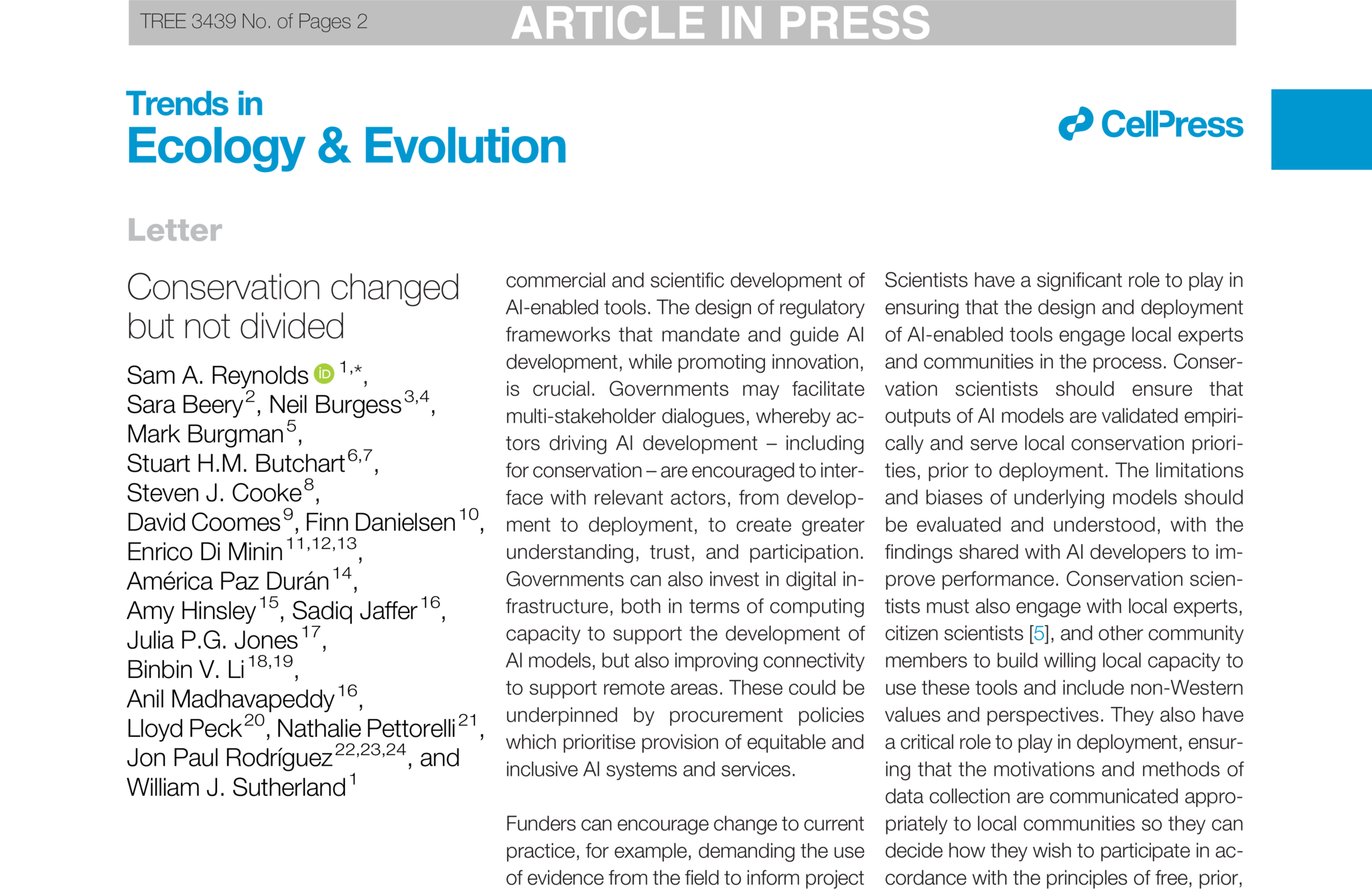
I had a tremendous time participating in last year's [horizon scan of AI and Conservation](https://anil.recoil.org/papers/2024-ai-conhorizon), which laid out the opportunities that technological progress from AI (a catchall phrase here) could bring to hard-working conservation practitioners. Since then, there's been a lot of corridor conversations about future projects (and even [dinner with the Wildlife Trusts](https://anil.recoil.org/notes/uk-national-data-lib)). However, there has also been discussion about the potential _harms_ of our work, most notably in a [response letter](https://www.sciencedirect.com/science/article/pii/S0169534725000588) to our paper written by [Katie Murray](https://experts.exeter.ac.uk/42389-katie-murray/about) and colleagues.
Murray et al make two really important points:
> - \[...\] importance of ecological expertise must be recognised as much more than just the expert annotation of training data
> - \[...\] effort should be made to build capacity for AI development in the Global South, so that the rewards of successful research can be shared
> \-- [The potential for AI to divide conservation](https://www.sciencedirect.com/science/article/pii/S0169534725000588)
Myself and the co-authors of the original horizon scan could not agree more with this statement, and [Sam Reynolds](https://samreynolds.org) lead us to publish a response-to-the-response [^1] dubbed "[Conservation changed but not divided](https://anil.recoil.org/papers/2025-conservation-div)".
In our response, we note that:
> We agree wholeheartedly with these points and recognise that the task of equitable integration of AI into conservation is beyond the scope of any single group and requires collective action.
>
> \[...\] Developers of AI tools have a foundational role to play in delivering an equitable AI landscape. Technologies disconnected from pragmatic ecological, cultural, and socioeconomic factors are unlikely to advance the field \[...\]
>
> \[...\] Developers should adopt participatory design and development principles, identifying conservation actors to guide the process, designing \[...\] protocols that respect cultural sensitivities and Indigenous and local knowledge \[...\]
>
> \[...\] All tools should be open source and thoroughly documented, so that they can be easily adapted for local contexts.
> \-- [Conservation changed but not divided](https://anil.recoil.org/papers/2025-conservation-div)
Many thanks to Katie Murray and colleagues for taking the trouble to call out the issues in our original paper! Both of the letters will be side-by-side in the next issue of [Trends in Ecology and Evolution](https://www.cell.com/trends/ecology-evolution/home) and, of course, we welcome any more perspectives about either of these.
# Cambridge goes full AI
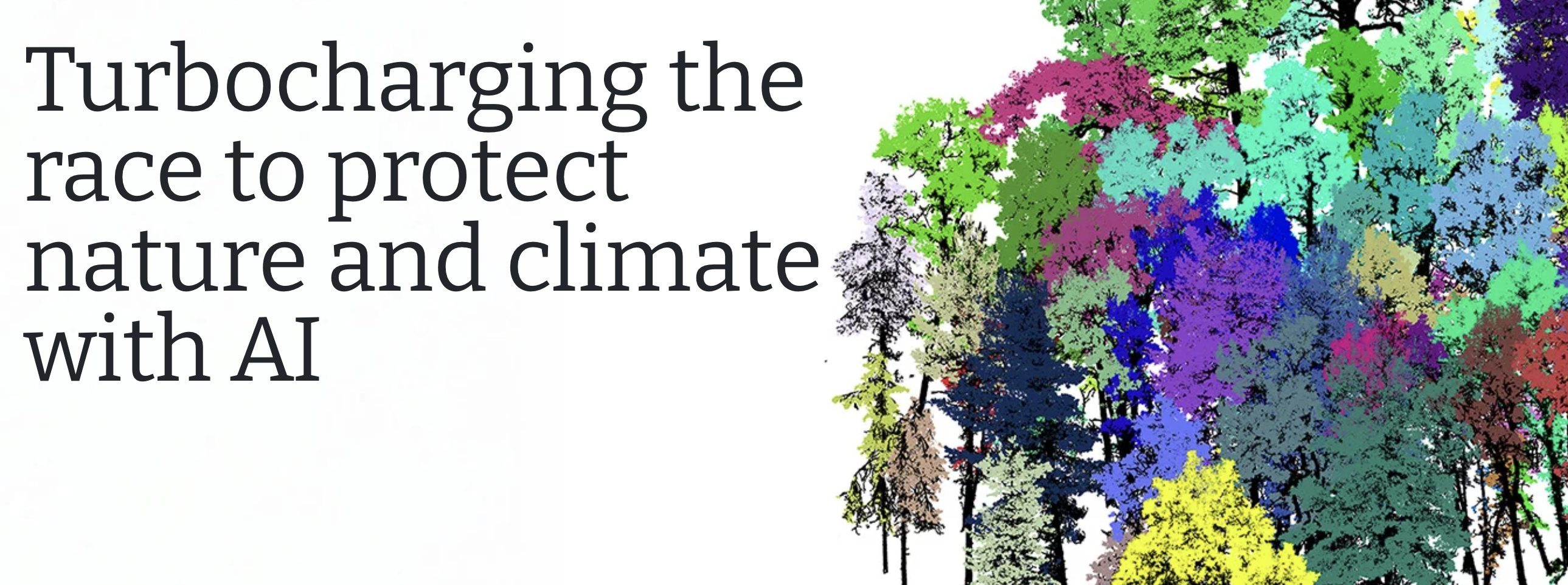
This whole discourse also happened at the same time as Cambridge [dove](https://www.cam.ac.uk/topics/artificial-intelligence) in with a major piece about [turbocharging the race to protect nature and climate with AI](https://www.cam.ac.uk/stories/ai-and-climate-and-nature). The piece itself (lead by the brilliant [Jacqueline Garget](https://uk.linkedin.com/in/jacqueline-garget-b24804214) and [Louise Walsh](louise.walsh@admin.cam.ac.uk)) covers a number of the projects in our [AICN](https://ai.conservation.cam.ac.uk/) project we started [last year](https://anil.recoil.org/notes/aicn-in-aicam).
The online story itself is a rather gorgeous layout, with pieces on:
- [landuse planning](https://www.cam.ac.uk/stories/ai-and-climate-and-nature#section-Land-use-planning-T1WPpYngXA) from me about our [UKRI-funded](https://anil.recoil.org/notes/ukri-grant-terra) "Terra" project to map global plants and the impact on [food supply chains](https://anil.recoil.org/papers/2024-food-life).
- [biodiversity conservation](https://www.cam.ac.uk/stories/ai-and-climate-and-nature#section-Biodiversity-conservation-50N1jQTVIa) with [Bill Sutherland](https://www.zoo.cam.ac.uk/directory/bill-sutherland) who leads [Conservation Evidence Copilots](https://anil.recoil.org/projects/ce) and whose [Conservation Concepts channel](https://www.youtube.com/@Bill_Sutherland) is a must-watch, and [Sadiq Jaffer](https://toao.com) and [Michael Dales](https://mynameismwd.org) who have the [coolest job titles](https://ai.conservation.cam.ac.uk/2024/06/05/planetary-computing-fellows-michael-dales-and-sadiq-jaffer-putting-systems-to-work-to-accelerate-ecological-interventions/) in Cambridge.
- [climate modelling](https://www.cam.ac.uk/stories/ai-and-climate-and-nature#section-Climate-modelling-NdQYHh3cRP) with Joe and Jack from the ICCS talking about [differentiable fortran](https://github.com/Cambridge-ICCS/FTorch) (I'm coorganising the [next PROPL](https://anil.recoil.org/notes/propl-at-splash) with ICCS lead [Dominic Orchard](https://dorchard.github.io) as well).
- [energy efficient homes](https://www.cam.ac.uk/stories/ai-and-climate-and-nature#section-Energy-efficient-homes-0AUJzMfjnS) with [Ronita Bardhan](https://www.arct.cam.ac.uk/people/dr-ronita-bardhan) (who I'm having a blast working with alongside [Andres Zuñiga-Gonzalez](https://ancazugo.github.io/) on [urban vegatation](https://anil.recoil.org/ideas/urban-vegetation)).
- [forest monitoring](https://www.cam.ac.uk/stories/ai-and-climate-and-nature#section-Forest-monitoring-VudaoOH7Rd) about Emily Lines and Harry Owens work on forest structure reconstruction and [Srinivasan Keshav](https://svr-sk818-web.cl.cam.ac.uk/keshav/wiki/index.php/Main_Page) and Frank Feng's work on [GreenLens](https://github.com/MingyueX/GreenLens).
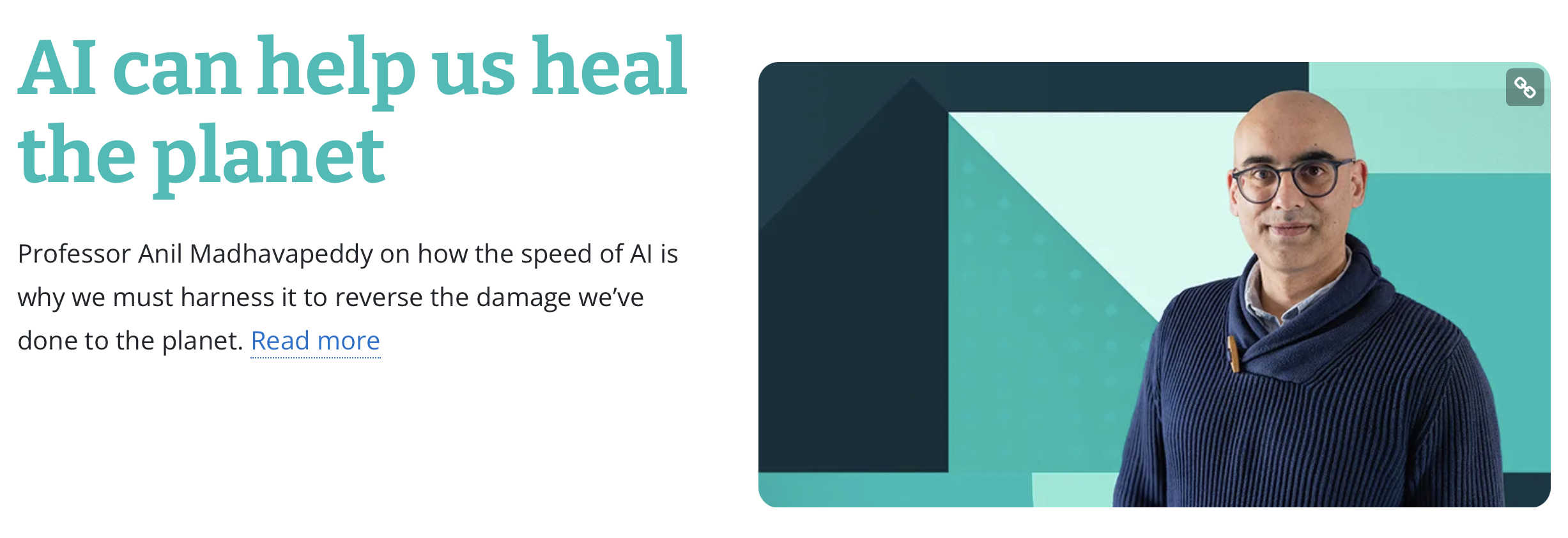
While each of these projects are fascinating research projects, the bit that made me stop and really think was the last [interview with me](https://www.cam.ac.uk/stories/Anil-Madhavapeddy-AI-climate-nature) about how AI could heal in the planet. In it, I talk about conservation from a technological lens:
> We need to act fast to mitigate the impacts of climate change, and to protect and restore biodiversity. There’s incredible potential in using AI to augment our work. It enables us to do things much more quickly – it’s like giving humans global knowledge superpowers\!
But, after more corridor conversations with colleagues in the [CCI](https://www.conservation.cam.ac.uk)[^2] more important angles to this story emerged. It's really easy for us to lose sight of the fact that AI is just a piece in the puzzle; a means to an end. We must keep the focus on the giant crisis in biodiversity unfolding in front of our eyes like a slow motion steamroller. Other pieces on the Cambridge website that cover this include [the pollinator risk index](https://www.cam.ac.uk/stories/pollinatorsriskindex) (with [Lynn Dicks](https://www.zoo.cam.ac.uk/directory/prof-lynn-dicks)), [lead poisoning of grouse](https://www.cam.ac.uk/research/news/pledge-to-phase-out-toxic-lead-ammunition-in-uk-hunting-by-2025-has-failed), [carbon emissions from peatland fires](https://www.cam.ac.uk/research/news/uk-peatland-fires-are-supercharging-carbon-emissions-as-climate-change-causes-hotter-drier-summers), or the risks of [biodiversity leakage](https://www.cam.ac.uk/research/news/restoring-wildlife-habitats-in-wealthy-nations-could-drive-extinctions-in-species-rich-regions) causing extinctions (by [Andrew Balmford](https://www.zoo.cam.ac.uk/directory/andrew-balmford)).
It's not all bad news of course! Cambridge has also covered [thriving Antarctic ecosystems](https://www.cam.ac.uk/research/news/thriving-antarctic-ecosystems-found-following-iceberg-calving) and [success stories in species restoration](https://www.cam.ac.uk/stories/conservation-success-stories).
My overall concerns with current central University (and world's) focus on AI stem from:
- the "distraction effect" caused by AI. If every conversation begins with 'artificial intelligence', then we lose track of the goal, which is to protect what remains of the natural world while making access to it as equitable as possible to every human who lives on this planet. In the past few months, I've had four separate meetings with groups in the CCI where I've been explaining things like [MCP](https://modelcontextprotocol.io/introduction) to a bunch of conservation practitioners who should be, frankly, not be having to keep up with this incredibly fast moving field in order to submit funding proposals in their own areas of core expertise on the natural world.
- the "leakage effect" to funding caused by AI. While almost anything AI has a better chance of getting dosh right now, this means conventional conservation work is being undermined as a result. But this in turn chokes out the lifeblood of AI -- the data that trains the models we build! I noticed also that [Richard Turner](https://rich-turner-group.github.io/) made the same point about his recent [revolutionary climate model](https://www.cam.ac.uk/research/news/fully-ai-driven-weather-prediction-system-could-start-revolution-in-forecasting), where he observes that *"Aardvark would not have been possible without decades of physical-model development by the community, and we are particularly indebted to ECMWF for their ERA5 dataset which is essential for training Aardvark"*. The same is true for conservation.
- the "credit effect", which ascribes all advances to AI rather than the hard work from a global community. I noticed this in Demis Hassabis' recent [talk on his Nobel prize](https://www.cam.ac.uk/stories/demis-hassabis-AI-Cambridge), where Alphafold was mainly possible due to a [decades-long competition](https://www.statnews.com/2025/01/07/casp-protein-structure-prediction-competition-after-alphafold/) organised by computational and experimental chemists. Whole cohorts of scientists withheld their latest results back for a year in order to allow the models to have benchmarks.
- the "fashion effect", whereby conservation interventions that might last decades (not [uncommon](https://golarainforest.org/grnp-history) in nature restoration projects) are forced to lurch between the latest topic of the week. [Alec Christie](https://profiles.imperial.ac.uk/a.christie) noted that plastic pollution was another example of how precious political attention was diverted suddenly; there was a BBC documentary with heart-breaking images of [plastic pollution killing dolphins](https://www.youtube.com/watch?v=EjIUp6A7GRU) and suddenly all attention was on [eliminating them](https://www.economist.com/international/2018/03/03/the-known-unknowns-of-plastic-pollution) at [all cost](https://www.gov.uk/government/news/gove-takes-action-to-ban-plastic-straws-stirrers-and-cotton-buds). This isn't to say that banning plastic straws was bad (quite the opposite!), but that we must also consider biodiversity impacts holistically and continue to fund [broad picture work](https://pubmed.ncbi.nlm.nih.gov/33213887/) as well as the 'charismatic topic of the week'. Alec, for example, held a fantastic workshop last year about the use of [OSINT](https://pubmed.ncbi.nlm.nih.gov/35979694/) for establishing the bigger picture in ecosystem management.
Would you trust this man with your garden? What's that? Yes? Yes you would?
## Telling the story from the conservation perspective
I only really started thinking about this properly _after_ talking to Jacqueline and Sam, so I'm grateful to them for sparking the chain of thoughts. I've started reading how other organisations (such as MacArthur's [Technology for the Public Good](https://www.macfound.org/programs/field-support/technology-public-interest/)) discuss the role of technology in societal domains, and would be grateful for any pointers to similar initiatives in conservation.
I would also dearly love to see a roundup of all the Cambridge [environmental coverage](https://www.cam.ac.uk/news/environment) in one place, perhaps on the [Conservation Research Institute](https://www.conservation.cam.ac.uk/) pages, told as a cohesive story from the perspective of the nature research and not the technology that enables just a part of it. If you're an undergraduate looking for something to do this summer, especially from the social sciences or journalism, do get in touch and I'd be delighted to work with you on this for an internship! Or maybe this is something for the first edition of the [Cambridge Green Blue](https://anil.recoil.org/notes/cambridge-green-blue) competition to assemble next year...
Thanks to [Sam Reynolds](https://samreynolds.org), [William Morgan](https://www.zoo.cam.ac.uk/directory/dr-william-morgan), [Sadiq Jaffer](https://toao.com), [Ash Simkins](https://www.zoo.cam.ac.uk/directory/ashley-simkins) and [Alec Christie](https://profiles.imperial.ac.uk/a.christie) for corrections and suggestions to this post! \**7th May 2025:* See also [a followup article](https://anil.recoil.org/notes/humans-save-nature-not-ai) on this by [Jacqueline Garget](https://www.communications.cam.ac.uk/our-team).
[^1]: As an aside, I love this long-form, carefully considered mechanism for scholarly discussion, as espoused by the letter back-and-forth in a journal. I wish we had more of this in computer science rather than social media arguments that disappear like tears in the rain just a few scrolls later.
[^2]: Amusingly, they were triggered by an accidental reply-all from me to the whole building rather than a private reply. I hold that this is the best way to start a real conversation\!
## References
1. Reynolds et al (2024). The potential for AI to revolutionize conservation: a horizon scan.
2. Madhavapeddy (2025). Humans are the ones that will save nature, helped by AI.
3. Madhavapeddy (2025). Thoughts on the National Data Library and private research data.
4. Ball et al (2025). Food impacts on species extinction risks can vary by three orders of magnitude.
5. Reynolds et al (2025). Conservation changed but not divided.
6. Madhavapeddy (2025). The Cambridge "Green Blue" competition to reduce emissions.
7. Madhavapeddy (2025). 2nd Programming for the Planet workshop CFP out.
Synopsis: Response to critique of AI in conservation emphasizing participatory design, open source tools and equitable capacity building in Global South.
Words: 1481
DOI: 10.59350/vwrvd-3sg08
## Related
- [AI, science and the UK–EU relationship at the Royal Society](https://anil.recoil.org/notes/rs-eu-ai-science) (note, 2026-04-21)
Notes from a Royal Society policy meeting with the European Commission on responsible AI, interoperable data and UK–EU alignment in AI for science; covering AI-poisoned literature, federated TESSERA-scale infrastructure, disclosure standards and the practical value of sustained UK–EU dialogue.
- [Food impacts on species extinction risks can vary by three orders of magnitude](https://anil.recoil.org/papers/2024-food-life) (paper, 2025-09-01)
Thomas Ball, Michael Winston Dales et al. — Nature Food
- [What I learnt at the National Academy of Sciences US-UK Forum on Biodiversity](https://anil.recoil.org/notes/nas-rs-biodiversity) (note, 2025-06-06)
Report from NAS/Royal Society forum on standardized biodiversity measurement technologies covering foundation models, eDNA and evidence synthesis.
- [Out-of-the-box LLMs are not ready for conservation decision making](https://anil.recoil.org/notes/2024-ce-llm-3) (note, 2025-05-16)
PLOS One publication showing pretrained LLMs perform poorly on conservation questions but improve dramatically with Conservation Evidence database training.
- [Humans are the ones that will save nature, helped by AI](https://anil.recoil.org/notes/humans-save-nature-not-ai) (note, 2025-05-07)
Discussion of responsible AI adoption in conservation, emphasizing human agency and equity over technological solutions.
- [The Cambridge "Green Blue" competition to reduce emissions](https://anil.recoil.org/notes/cambridge-green-blue) (note, 2025-05-06)
Thinking about a Cambridge "Green Blue" competition to reduce emissions among Colleges, promoting cooperation through a semi-competitive league
- [2nd Programming for the Planet workshop CFP out](https://anil.recoil.org/notes/propl-at-splash) (note, 2025-04-03)
Call for papers for PROPL 2025 workshop on programming methods for climate and biodiversity research at ICFP/SPLASH Singapore.
- [Conservation changed but not divided](https://anil.recoil.org/papers/2025-conservation-div) (paper, 2025-04-01)
Sam A. Reynolds, Sara Beery et al. — Trends in Ecology & Evolution
- [Thoughts on the National Data Library and private research data](https://anil.recoil.org/notes/uk-national-data-lib) (note, 2025-02-17)
Exploring the National Data Library and its potential to improve access to private research data while balancing security and privacy concerns.
- [The potential for AI to revolutionize conservation: a horizon scan](https://anil.recoil.org/papers/2024-ai-conhorizon) (paper, 2024-12-01)
Sam Reynolds, Sara Beery et al. — Trends in Ecology & Evolution
- [Building species models of the planet](https://anil.recoil.org/notes/ukri-grant-terra) (note, 2024-09-02)
Researchers receive £1.2m grant to build species models for planetary intelligence.
- [Selected in the AI@CAM challenge for conservation research](https://anil.recoil.org/notes/aicn-in-aicam) (note, 2024-02-05)
Won the AI@CAM challenge towards climate and nature conservation research using remote sensing and LLMs
- [Conservation Evidence Copilots](https://anil.recoil.org/projects/ce) (project, 2024-01-01)
- [The role of urban vegetation in human health](https://anil.recoil.org/ideas/urban-vegetation) (idea, 2023-01-01)
Ongoing · PhD
---
Canonical: https://anil.recoil.org/notes/ai-should-unite-conservation
Type: note
License: CC BY 4.0
Tags: conservation, biodiversity, policy, ai