# .plan-26-30: Bananas ripen, models open, and OxCaml releases
*2026-07-26 — note*
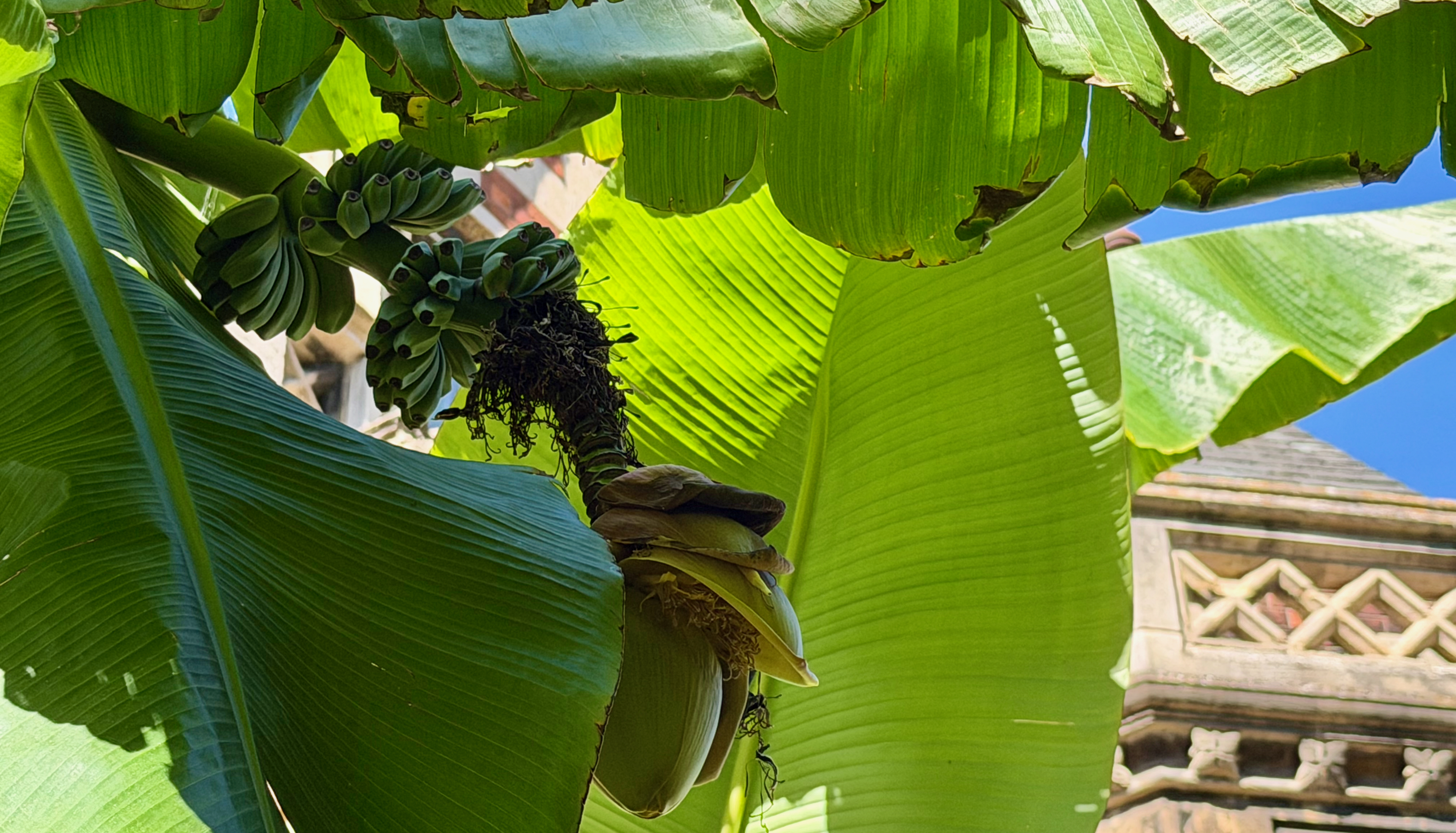
I was in Ireland most of the week attending to family matters, so another quieter weeknote! My picture of the week is that the Pembroke College Cambridge banana tree has, err, sprouted real bananas, so I'm trying to pluck up the courage to attempt to pickle them and not poison anyone.
Climate change is going bananas in the UK
I appeared up in the [OpenUK openness report](#the-uk-openness-report-from-openuk), got the [Evidence TAP website prototyped](#prototyping-the-evidence-tap-website-with-an-agent) using [an agent on exe.dev](#trying-out-exedev), cut [Eio, cohttp and mdx releases](#ocaml-and-oxcaml-releases) along with a comprehensive [OxCaml and Claude skills update](#improving-oxcaml-support-and-the-claude-skill), started taking Windows seriously now that [Forester](#eio-in-forester) has found me a real user, and on [matters of nature](#on-matters-of-nature) followed a discussion on [conservation versus ecology](#conservation-versus-ecology) and celebrated [funding for optimising ranger patrols](#ranger-patrols-get-funding). The usual [fun links](#fun-links) are at the end.
## The UK Openness report from OpenUK
[OpenUK](https://openuk.uk) published their excellent [AI Openness report](https://openuk.uk/wp-content/uploads/2026/07/AI-Openness-Report-July-2026.pdf) this month. I'm in there with a fireside chat on open foundation models like [TESSERA](https://anil.recoil.org/projects/tessera), and a followup to conversations I started with Amanda Brock at the [Indian AI summit](https://anil.recoil.org/notes/india-ai-summit):
> Openness matters here because a foundation model of the planet that you
> cannot inspect, cannot reproduce, and cannot train yourself would be a
> dangerous thing to derive social land-use policy from. The people who need it
> most -- conservationists, smallholder farmers, government agencies across the
> Global South -- are the least likely to be able to pay big money for
> proprietary access.
> \-- me in the [OpenUK AI Openness: 3 Years on From Llama 2](https://openuk.uk/wp-content/uploads/2026/07/AI-Openness-Report-July-2026.pdf), July 2026
'Openness' is a little odd these days in that we have to manage community more these days than adoption. For example, every [TESSERA hackathon we've run](https://anil.recoil.org/notes/first-tessera-hackathon) has filled to capacity, and the [geotessera](https://github.com/ucam-eo/geotessera) issue tracker is flowing with issues, so people are certainly using our output\!
But then every single user I talked to at the [CNG summit recently](https://anil.recoil.org/notes/cng-london-2026) was coding at high speed with AI assistance and not really reading the docs directly, and so getting people to talk to each other (mentoring, trading tips of the craft, understanding how it all works, etc) takes much more effort than it used to before the advent of Claude. We're in a new world of open source...
## Prototyping the Evidence TAP website with an agent
I started working on [a website for Evidence TAP](https://anil.recoil.org/notes/2026w29) last week, and put up a work-in-progress site at [evidencetap.exe.xyz](https://evidencetap.exe.xyz/) and I hope to push it live next week once the content takes shape. We've had a staggering number of requests from policymakers who are interested in our approach, and so the site gathers up the basic idea of living evidence databases that continuously ingest, screen, appraise and extract from the literature, with every claim traceable back to its source. This began with the [Conservation Evidence](https://anil.recoil.org/projects/ce) team, and we're moving next into an education strand with [Jenny Gibson](https://www.educ.cam.ac.uk/people/staff/gibson/) and Mélanie Gréaux.
### Trying out exe.dev
As an experiment in collaborative agent prompting, I've been using [exe.dev](https://exe.dev), which gives you a pool of CPU, RAM and disk and lets you spin up as many persistent VMs as you like. The lack of ephemereality is useful when dealing with authentication and state, i.e. when doing agentic programming.
Their inhouse web agent is called 'Shelley' which also has a mobile app that's just been released. My only gripe is that Shelley can't seem to interact directlly with Claude Code, and it runs on usage credits rather than being able to use a subscription account like the one I already pay for. I suspect this will get resolved as these agent platforms mature, and I'm on the [Kimi K3 waitlist](https://x.com/Kimi_Moonshot/status/2078855608565207130) if it doesnt\!
Outside of agentic stuff, exe.dev also has really useful protocol proxies like an inbound HTTPS tunnel that takes care of certificates, and also a very good CLI. It's a very pleasant experience to anyone familiar with Unix-style environments.
## OCaml and OxCaml releases
A year's worth of changes went into [Eio 1.4](https://github.com/ocaml-multicore/eio/releases/tag/v1.4), which is out thanks to [Thomas Leonard](https://github.com/https://roscidus.com) and [his excellent changelogging](https://notes.roscidus.com/2026/07/24/). This website is now running on Linux 7.x and using my [uring socket/bind/listen conversion ](https://github.com/ocaml-multicore/eio/pull/884), and the Evidence TAP literature downloader (more on that soon!) uses the [ftruncate/fdatasync](https://github.com/ocaml-multicore/eio/pull/850) and other filesystem optimisations too.
I also cut a minor [cohttp 6.2.2 release](https://github.com/ocaml/opam-repository/pull/30339) to be compatible with the new Eio, which is winding its way through opam-repository. Eio 1.4 changed the `getaddrinfo(3)` into an exception and to include the query in the error message.
### Improving OxCaml support and the Claude skill
I also cut a [mdx 2.6.0](https://github.com/realworldocaml/mdx/releases/tag/2.6.0) release which I made compile with [OxCaml](https://anil.recoil.org/projects/oxcaml). Unfortunately you can't actually use it yet, because this new version needs an explicit dependency on `unix` and the [fix for that in dune](https://github.com/ocaml/dune/pull/15592) is merged but not yet released. We'll have to wait for dune 3.25 before its fully usable, but that's already [under preparation](https://github.com/ocaml/dune/issues/15593)\!
Once that's done, getting Eio compiling with the latest [OxCaml minus39 release](https://github.com/oxcaml/opam-repository/pull/54) will be much easier thanks to mdx compiling out of the box. I've also published a [comprehensive update](https://github.com/avsm/ocaml-claude-marketplace/commit/90cd8e910f755527d2a6a63b6eae6dd748adbd4b) of my [ocaml-claude-skills](https://github.com/avsm/ocaml-claude-marketplace) marketplace (which seems to be accruing users). I'm going to do a massive update of my monorepo over to minus39 in the next week or two, which should be a good test of this Claude Fable skill! Feel free to send PRs if you've got improvements to my skills.
### Eio in Forester
I'm now also looking at Windows support rather glumly (no matter how much I try, I
can't get a good CRLF conversion environment). The reason I'm
investigating it is that we have a REAL USER I KNOW in the form of [Jon Sterling](https://jonmsterling.com) \!
In Jon's recent [weeknotes](https://www.jonmsterling.com/2026-W28/) he mentioned progress towards Forester 6.0 (which Kento Okura is pushing along with support from Tarides and the OCaml Software Foundation). [Patrick Ferris](https://patrick.sirref.org) chimed in on [our Zulip thread](https://eeg.zulipchat.com/#narrow/channel/522690-Blogs/topic/JMS.20Weeknotes.202026-W28/with/611607207) with some tips about cutting out a `stat` per file. Patrick knows [Forester](https://tangled.org/@jonmsterling.com/ocaml-forester) well, having become familiar with its directory scanning logic while writing his own [graft](https://github.com/patricoferris/graft) fork/variant which his website runs on.
I also integrated a few quality-of life utilities like the [null sink](https://github.com/ocaml-multicore/eio/pull/894) into Eio 1.4 which a future Forester can hopefully use. Temporary files and directories are next on my list, as I've discovered `O_TMPFILE` on Linux that allows for the creation of anonymous fds.
I asked Jon whether he ships Windows binaries and he said it has long been a goal, blocked mostly on how Forester handles paths. After I achieved the milestone of working out how to map the `\` key onto my Windows machine, I started understanding modern Windows paths. Kento's [pathname PR](https://github.com/ocaml-multicore/eio/pull/738) is a start, but we'll likely need to have Windows and POSIX specific pathname logic that's separate.
## On matters of nature
### Conservation versus ecology
[Aneesh Naik](https://aneeshnaik.github.io/) started [an interesting thread](https://eeg.zulipchat.com/#narrow/channel/522690-Blogs/topic/APN.20weeknotes.202026.2F07.2F20/with/612517496) on our Zulip off the back of [his weeknote](https://www.aneeshnaik.com/blogposts/20260720_weeknotes_2026_29.html) about whether nature should be monitored at all.
His thought came from a colloquium in the CCI by [Hugh Possingham](https://en.wikipedia.org/wiki/Hugh_Possingham), who argued that one should only pursue a nature monitoring project when there is a specific on-the-ground action that will follow from it. However, a great deal of what we now know about effective conservation comes from people who kept their monitoring schemes running long past the point where they had any planned interventions left! The [paper behind the talk](https://doi.org/10.1098/rspb.2025.2527) lays out many reasons for monitoring as a checklist and a theory of change, and does include plain societal curiosity\!
Much of the [remote sensing](https://anil.recoil.org/projects/rsn) work going on here is really _ecological_ monitoring rather than _conservation_ monitoring: the former is aimed at understanding an ecosystem itself and the latter at establishing the counterfactual impact of some intervention. Ecology does have a close sister discipline of conservation with some extremely vital imperatives attached, and a [temporal urgency](https://anil.recoil.org/notes/nas-rs-biodiversity) with respect to human actions.
### Ranger patrols get funding
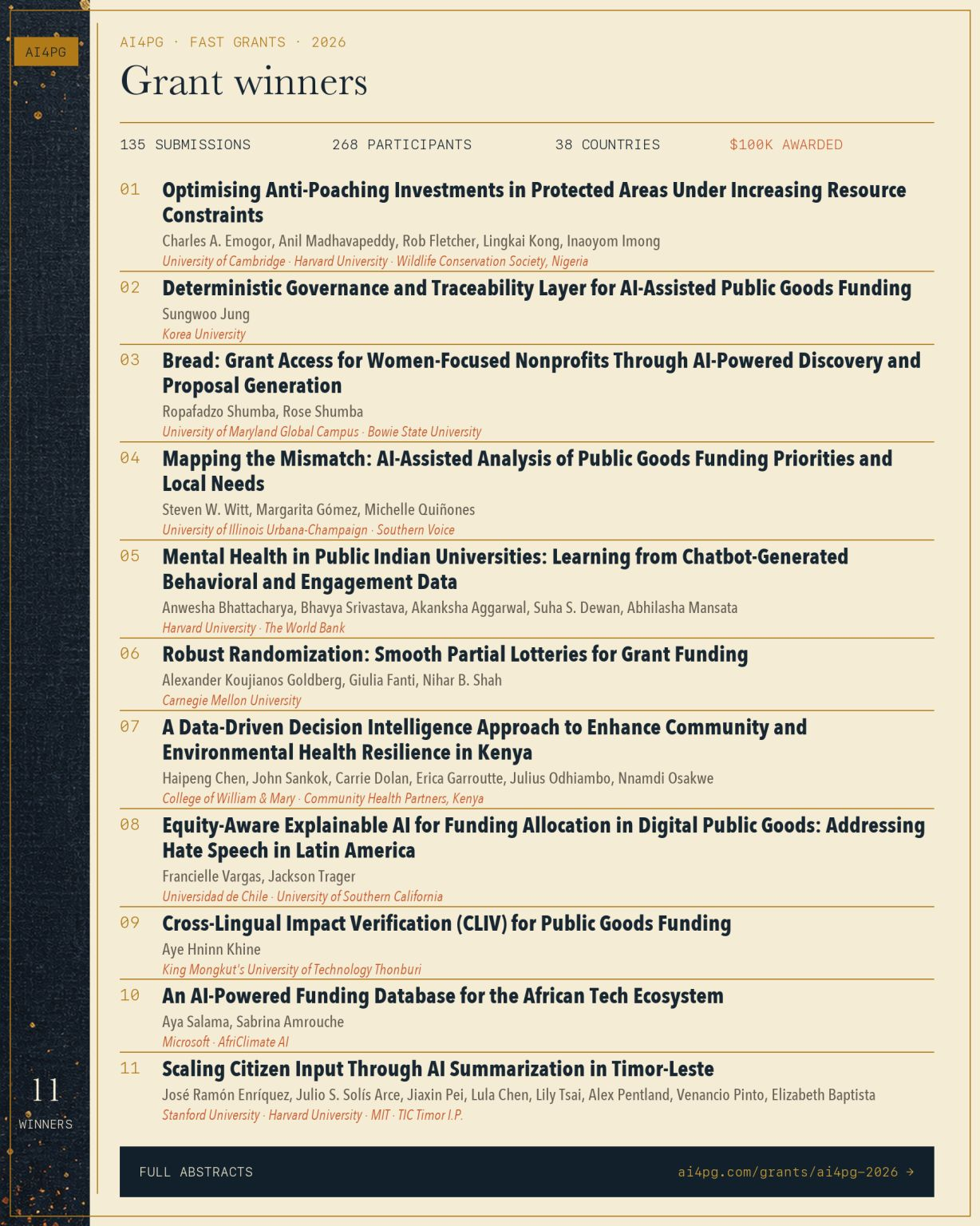
The eleven AI4PG 2026 grant winners, in excellent company from Korea to Timor-Leste
Huge congratulations to [Charles Emogor](https://charlesemogor.com), who has landed one of the highly contended [AI4PG 2026 fast grants](https://www.ai4pg.com/grants/ai4pg-2026) for our work on optimising ranger patrol deployment in sub-Saharan Africa. The project is with [Rob Fletcher](https://www.zoo.cam.ac.uk/directory/professor-rob-fletcher), Lingkai Kong at Harvard and Inaoyom Imong at the Wildlife Conservation Society in Nigeria, and eleven proposals were selected from 135 submissions across 38 countries.
This funds the next stage of the work Charles has been driving on [validating anti-poaching predictions with ranger insights](https://anil.recoil.org/ideas/validating-anti-poaching-predictions) and [mapping hunting risks](https://anil.recoil.org/ideas/mapping-hunting-risks-for-wild-meat). The core problem is that patrol-collected data is biased since rangers only see what they walk past, and so a map of "where poaching happens" is often really just a map of "where rangers went". Charles plans to combine ranger patrols from 2016 onwards with GPS data collected from 120 hunters across eight communities, model the two independently, and use the mismatch to build a bias-correction layer over three protected areas in southeast Nigeria.
Given that [billions have been spent on anti-poaching globally](https://thedocs.worldbank.org/en/doc/fa250077ab87b35d0451b82653e0f4f3-0320072025/original/GWP-2025-Analysis-of-International-Donor-Funding-to-Combat-IWT-2010-2023.pdf) since 2010, even modest improvements in where the patrols go are worth a great deal\!
## Fun links
- Diamond prices have crashed to [their lowest level this century](https://finance.yahoo.com/markets/commodities/articles/diamond-prices-plunge-lowest-levels-175618297.html). Even lab-grown stones have fallen by ~88% since January 2020. Meanwhile [Brent crude](https://tradingeconomics.com/commodity/brent-crude-oil) touched \$120 in April and is still hovering near \$97, so this is a year in which the carbon is dear and carbon crystals are cheap. Go figure.
- [Frank Feng](https://www.cst.cam.ac.uk/people/zf281) found a great paper that does to the Moon roughly what we've been doing to Earth with [TESSERA](https://anil.recoil.org/projects/tessera). [LunarFM](https://arxiv.org/abs/2607.22408) is a multimodal foundation model that assimilates observations from six instruments across three lunar missions and maps 18 input channels into a shared embedding space. This then allows very similar functionality to what we have in tools like [TEE](https://tee.cl.cam.ac.uk) with similarity search, few-shot resource mapping, mineral abundance regression and geological unit classification. There's also efforts ongoing for Mars via [a domain-specific vision foundation model](https://doi.org/10.1029/2025JH000827) trained with self-supervision on millions of Mars Reconnaissance Orbiter Context Camera images.
- Closer to home, [Delineate Anything v2](https://arxiv.org/abs/2607.19069) is going to be very useful for [TESSERA v2](https://anil.recoil.org/papers/2026-tessera-v2) evaluation. It's a global field boundary delineation model with an accompanying 73m dataset spanning 61 countries, and a benchmark covering 100 countries for zero-shot generalisation. Field boundaries are a pretty tough test for a geospatial representation since it needs both the texture of the crop and often a sub-10m scale. Looking forward to trying this out later in the year.
Synopsis: An OpenUK openness interview, prototyping the Evidence TAP site with exe.dev, Windows eio support finds a user in Forester, and a new grant for optimising ranger patrols.
Words: 1734
## Related
- [.plan-26-29: Perfect weather, imperfectly measured, precisely predicted](https://anil.recoil.org/notes/2026w29) (note, 2026-07-19)
- [TESSERA v2: Scaling Pixel-wise Earth Foundation Models](https://anil.recoil.org/papers/2026-tessera-v2) (paper, 2026-07-01)
- [A scorching CNG London during Climate Action Week](https://anil.recoil.org/notes/cng-london-2026) (note, 2026-06-24)
- [At the AI Impact Summit in Delhi: people, planet, progress](https://anil.recoil.org/notes/india-ai-summit) (note, 2026-02-21)
- [1st TESSERA/CoRE hackathon at the Indian AI Summit](https://anil.recoil.org/notes/first-tessera-hackathon) (note, 2026-02-19)
- [What I learnt at the National Academy of Sciences US-UK Forum on Biodiversity](https://anil.recoil.org/notes/nas-rs-biodiversity) (note, 2025-06-06)
- [Validating predictions with ranger insights to enhance anti-poaching patrol strategies in protected areas](https://anil.recoil.org/ideas/validating-anti-poaching-predictions) (idea, 2025-06-01)
- [OxCaml Labs](https://anil.recoil.org/projects/oxcaml) (project, 2025-01-01)
- [TESSERA, a pixelwise geospatial foundation model](https://anil.recoil.org/projects/tessera) (project, 2025-01-01)
- [Mapping hunting risks for wild meat in protected areas](https://anil.recoil.org/ideas/mapping-hunting-risks-for-wild-meat) (idea, 2024-08-01)
- [Conservation Evidence Copilots](https://anil.recoil.org/projects/ce) (project, 2024-01-01)
- [Remote Sensing of Nature](https://anil.recoil.org/projects/rsn) (project, 2023-01-01)
---
Canonical: https://anil.recoil.org/notes/2026w30
Type: note
Tags: ocaml, eio, tessera, ai, conservation, academia, biodiversity